Remote monitoring projects look different on the surface. A power utility watches substations, an oil producer watches wellheads, a city watches traffic and street lights, and a service company watches water treatment plants. Underneath, they share the same structure: devices in the field, a way to connect them, a secure path across a public network, and a central system that turns data into decisions. Seeing that common structure makes it easier to design new projects, reuse what works, and choose hardware that fits.
This article sets out a four-layer reference architecture for industrial connectivity solutions for remote monitoring, then applies it to eight scenarios drawn from E-Lins solution designs, with older cellular references updated to 4G and 5G.
The Four Layers
Layer 1: Field devices
Sensors, meters, transducers, PLCs, RTUs, controllers, cameras, and alarm contacts. Many still use serial interfaces such as RS232 and RS485; newer ones use Ethernet.
Layer 2: Connectivity hardware
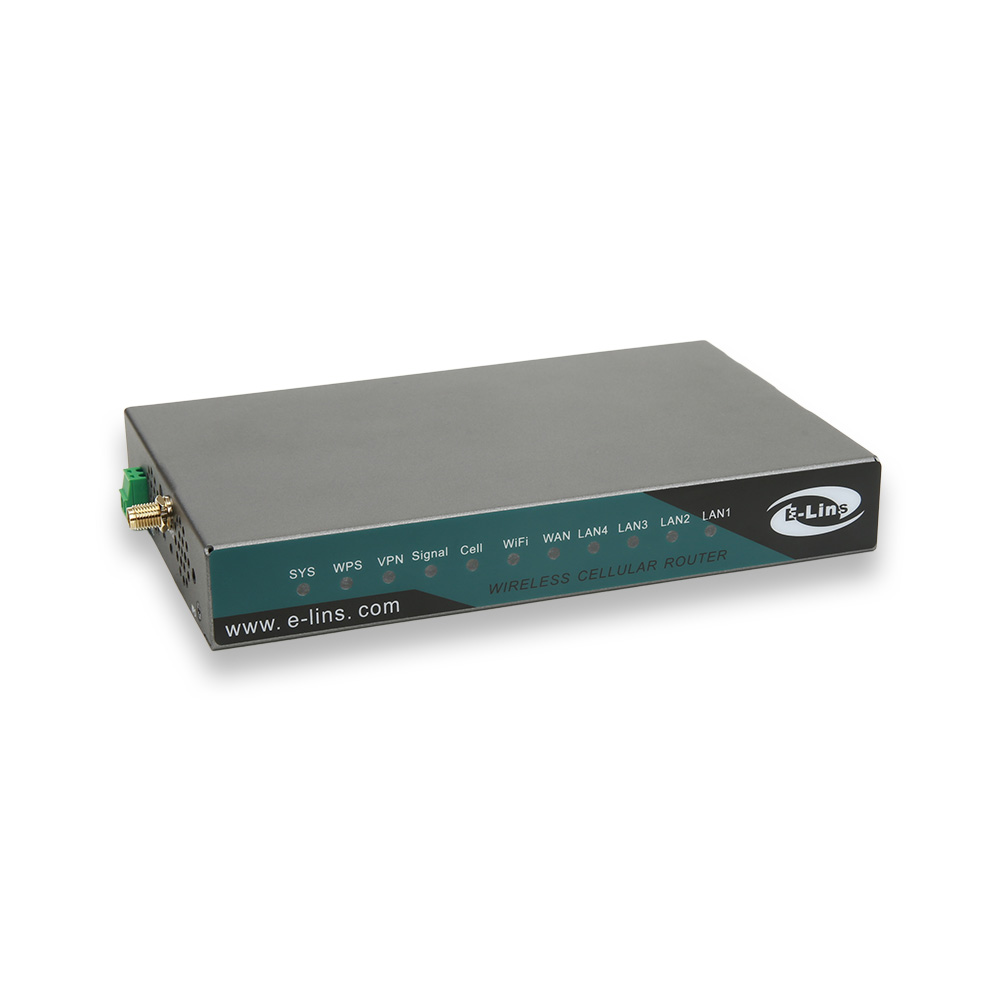
Industrial cellular routers, modems and gateways that connect field devices to the mobile network, through serial transparent transmission, Ethernet routing, digital inputs and protocol support.
Layer 3: Transport and security
The mobile network itself, private APNs where operators offer them, and VPN tunnels that keep monitoring traffic private and give the centre a stable path to every site.
Layer 4: Central systems
SCADA masters, monitoring and control software, video platforms and the management platform that keeps the connectivity hardware itself healthy.
|
Layer |
Function |
Typical E-Lins role |
|
Field devices |
Measure, control, alarm |
Connected through serial, Ethernet and digital I/O |
|
Connectivity hardware |
Link devices to the network |
Routers, modems, boards, outdoor CPE |
|
Transport and security |
Private, reliable path |
VPN, APN and VPDN support, dual SIM, firewall |
|
Central systems |
Use the data, manage the fleet |
Interfaces to SCADA and platforms; E-Lins NMS for device management |
Eight Scenarios Through the Same Lens
Power grid substations
Substations sit along roads, on poles and on buildings, spread across wide areas and hard to supervise in person. Power line carrier links can fail when lines are disturbed, and private radio is costly and prone to interference. A cellular router or modem at each substation connects its equipment to the power dispatching centre over the mobile network, inside a VPN.
Oil field monitoring
Transducers at wells and gathering stations report to a control centre. Building a dedicated telecom network across an oil field is too costly, so industrial routers and serial modems carry the data over 4G or 5G instead.
Natural gas pipelines
A pipeline operator in Thailand monitors compressor stations along pipelines that run for thousands of kilometres. Remote terminal units connect through serial interfaces, and cellular equipment carries their data to the SCADA centre, avoiding the risk that a single cut cable silences an entire section.
Water tower roof access security
Water towers need protection against unauthorised roof access. A cellular module connected to door and intrusion sensors lets authorised staff arm or disarm the system by calling from registered mobile numbers, and sends SMS and data alerts to staff and the control centre when an intrusion is detected, without the need for an alarm panel or keypad.
Water treatment monitoring
In pool and spa water treatment, sensors measure pH and sanitiser levels, chemicals are dosed automatically, and a web-based system lets operators and service contractors monitor and control equipment remotely and keep service records.
Traffic data acquisition
A cellular link replaces the wire line between a roadside controller and the central system without any change to the original detecting device. E-Lins reports that such a system can be implemented within about three weeks, avoiding cable engineering and reducing data loss.
Street lighting supervision
A control room communicates with controlled points across a city to switch, schedule, and monitor street lights, using cellular modems at each controlled point.
Video monitoring
Cameras at remote sites send either live video or, in picture-capture mode, still images on a schedule or when triggered. Picture capture uses a fraction of the bandwidth and remains useful where networks are congested or upload capacity is limited.
What the Scenarios Have in Common
Distance: assets are spread far beyond the reach of fixed networks.
Unattended operation: nobody is on site to restart equipment.
Legacy interfaces: serial devices remain common and must be carried unchanged.
Harsh conditions: heat, cold, electrical noise, and unstable power.
Cost of alternatives: dedicated networks are expensive to build and maintain.
Each of those points maps to a requirement at Layer 2: industrial temperature ratings, electrical protection, serial transparent transmission, self-recovery, and remote management.
Choosing Connectivity Hardware for Layer 2
Single serial device: the M300 or M400 4G modem with RS232/RS485 to 4G transparent transmission, or the M300t for wide-voltage DC input.
Small cabinet with Ethernet and serial: the H685t mini 4G router with optional RS232 or RS485, I/O, PoE and GPS.
Critical or vehicle-mounted site: the H900t with dual SIM, Gigabit Ethernet, four DI/DO, GPS/BeiDou and dual power inputs.
Pole or rooftop site: the H820QOt outdoor 4G CPE with an IP68 enclosure and built-in 14dBi antennas.
Sites moving to 5G: the H685f IoT 5G modem with serial, Gigabit Ethernet, and four DI/DO; RedCap models such as the H685frc for moderate data; and the H900f for video-heavy or aggregated sites.
Across the range, E-Lins lists Modbus and DNP3 support, MQTT for cloud platforms, WireGuard, IPsec and OpenVPN, and management through TR-069, SNMP, SSH and the E-Lins NMS cloud platform.
Planning a New Project With the Four Layers
Start from the central system: what data it needs, how often, and in which protocol. Then list the field devices at each site type and their interfaces. Choose the connectivity hardware that bridges the two, and only then design the transport layer: private APN or public network, VPN topology, single or dual SIM. Finally, plan how the connectivity hardware itself will be managed, monitored, and updated over its life. Working through the layers in this order prevents the most common mistake in remote monitoring, which is choosing a router first and discovering later that it cannot reach a device or a platform.
The Architecture at Scale
The same four layers hold at very large scale. More than 100,000 E-Lins units monitor remote base stations for a leading Indian telecom operator serving over 230 million subscribers, reaching a 99.4% equipment online rate and improving batch management efficiency by 82%.
The Manufacturer
Shenzhen E-Lins Technology Co., Ltd. entered the industrial sector in 1999 with modems for power grids and oil fields and today supplies customers in more than 150 countries and regions. Its equipment is specified with components rated from -35°C to +75°C, 15KV ESD protection, and 1.5KV electromagnetic isolation. Whatever the industry, industrial connectivity solutions for remote monitoring work best when every layer is designed with the next one in mind.
https://e-lins.com/
Shenzhen E-Lins Technology Co., Ltd.