In the competitive landscape of industrial flow measurement, procurement teams and project engineers face a persistent challenge: balancing precision requirements with budget constraints. While high-accuracy flowmeters traditionally command premium prices, a new paradigm is emerging that challenges this status quo. Leading manufacturers are now delivering 0.3% grade accuracy at conventional 0.5% grade market pricing—a value proposition that fundamentally reshapes project economics for global infrastructure and industrial applications.
The Industrial Flow Measurement Challenge
Flow measurement represents a critical control point across diverse industries, from petrochemical processing to municipal water distribution. However, conventional solutions face inherent technical limitations that drive up total cost of ownership. Liner failure in corrosive media, magnetic field interference from metallic shells, and electrical faults in humid environments create recurring maintenance burdens. For EPC contractors managing multi-year projects, these reliability issues translate directly into budget overruns and operational delays.
The industry has long accepted a trade-off: higher accuracy typically means higher acquisition costs and more complex maintenance protocols. This equation particularly impacts projects in emerging markets, where budget constraints may force compromises on measurement precision. Yet measurement accuracy directly affects process efficiency, regulatory compliance, and ultimately, project profitability.
Material Science Innovation as Competitive Differentiator
Advanced manufacturers are addressing these pain points through systematic material science innovation rather than incremental improvements to conventional designs. The strategic application of composite materials and specialized coatings creates fundamental performance advantages that extend operational lifespan while reducing maintenance frequency.
Ceramic measuring tubes fabricated from 99% high-purity alumina or 99.5% high-purity zirconia achieve Mohs hardness 9, providing exceptional resistance to abrasive slurries and corrosive chemicals. This material selection enables continuous operation in environments reaching 180°C and 10 MPa pressure—conditions that rapidly degrade conventional rubber-lined designs. For mining operations transporting abrasive slurries or chemical facilities handling concentrated acids, this durability translates to 10-15 years of stable operation without tube replacement.
FRP (Fiber Reinforced Plastic) housings and measuring tubes eliminate metallic components entirely, solving two persistent problems simultaneously. The non-metallic construction prevents magnetic field distortion that compromises measurement accuracy in conventional steel-shelled flowmeters. Equally important, the composite structure resists vacuum collapse at 0.095 MPa negative pressure—a critical requirement for wastewater treatment and chemical processing applications where suction conditions frequently occur.
Vacuum potting technology represents another material-driven innovation addressing electrical reliability. By encapsulating precision excitation coils in epoxy resin under vacuum conditions, manufacturers achieve IP68-rated moisture protection. This approach eliminates the humidity-induced electrical faults that plague conventional designs in tropical climates or high-moisture industrial environments, ensuring consistent performance across diverse global deployment scenarios.
Precision Engineering for Measurement Accuracy
Material innovation alone cannot deliver competitive advantage without corresponding advances in manufacturing precision. The electromagnetic measurement principle requires extraordinarily balanced magnetic fields to achieve stated accuracy levels. Leading manufacturers implement precision winding protocols maintaining 0.2mH inductance tolerance across production batches, ensuring magnetic field uniformity that enables 0.3% accuracy ratings.
Electrode shielding technology further enhances measurement stability by reducing electrical noise from external sources. This becomes particularly important in industrial environments with heavy electrical equipment, variable frequency drives, and other sources of electromagnetic interference. The combination of precision coil winding and effective shielding creates measurement systems that maintain rated accuracy even in electrically noisy environments.
Economic Value Through Modular Design
The transition from performance specifications to economic value requires examining total cost of ownership rather than acquisition price alone. Kaifeng Xinya Instrument Co., Ltd. exemplifies this approach through modular design principles that reduce maintenance costs by 60% compared to conventional flowmeters.
This Chinese manufacturer, recognized as both a National High-Tech Enterprise and a Specialized, Sophisticated, Distinctive and Innovative Enterprise, has systematically developed product architectures enabling field replacement of wear components without complete instrument replacement. For industrial facilities operating continuous processes, this modularity minimizes downtime while extending asset lifespan.
The company's engineering research center focuses specifically on composite material applications, holding 27 utility model patents and 3 invention patents under substantive examination. This intellectual property portfolio demonstrates sustained R&D investment in material science innovation rather than reliance on commodity components.
Global Deployment Validation
Theoretical advantages require validation through demanding real-world applications before procurement teams can confidently specify emerging solutions. Kaifeng Xinya Instrument's global project portfolio provides such validation across extreme operating conditions.
In Brazilian metallurgy operations, ceramic flowmeters continuously measure abrasive slurries with particle concentrations that destroy conventional rubber-lined instruments within months. The ceramic measuring tubes maintain calibration stability despite pressure fluctuations and extreme abrasion, eliminating unplanned maintenance that previously disrupted production schedules.
Russian energy infrastructure presents different challenges—extended sub-zero temperatures combined with high humidity and explosion hazard zones. Vacuum-potted, explosion-proof electromagnetic flowmeters maintain measurement accuracy in these conditions while meeting CNEX and IECEx certification requirements for hazardous area installations.
Turkish petrochemical facilities require precise acid and solvent dosing where measurement errors directly impact product quality and raw material costs. High-accuracy ceramic flowmeters achieving ±0.2% tolerance enable optimized chemical reactions while reducing waste from over-dosing.
Indonesian wastewater treatment plants face aggressive scaling and corrosion in humid tropical environments. Polymer measuring tubes prevent the calcium carbonate buildup and accelerated corrosion that plague metallic designs, maintaining measurement integrity throughout multi-year service intervals.
Comprehensive Product Architecture
Meeting diverse global project requirements demands comprehensive product portfolios rather than single-solution approaches. Leading manufacturers structure their offerings around application-specific product lines addressing distinct market segments.
Electromagnetic flowmeter series cover standard industrial applications (SF-E), sanitary food and pharmaceutical processes (SF-W with CIP/SIP compatibility and Ra ≤ 0.4μm surface finish), large pipeline installations (SF-C plug-in design for DN50-DN2000 pipelines), remote locations without external power (SF-D battery-powered), and hazardous area installations (SF-EX explosion-proof certified).
Non-magnetic loss flowmeter series specifically address applications where conventional metallic designs fail. Ceramic variants handle extreme abrasion, corrosion, and high pressure up to 10 MPa. FRP/polymer variants eliminate magnetic interference while providing cost-effective alternatives to rubber-lined flowmeters for medium-corrosive conductive liquids under negative pressure conditions.
Vortex and turbine flowmeters extend coverage to steam, gas, and high-velocity fluid applications where electromagnetic principles cannot apply. LUZ vortex meters with anti-vibration packaging and no moving parts provide long-term stability in harsh industrial environments. LUXZ precession vortex meters integrate intelligent temperature and pressure compensation for accurate gas measurement in space-constrained installations.
Calibration system offerings complete the product architecture by ensuring measurement traceability. LY liquid calibration systems employ static mass method and master meter method achieving ≤0.05% expanded uncertainty (K=2), while LQ gas calibration systems utilize sonic nozzle method achieving ≤0.3% expanded uncertainty with 0.1% stability. These capabilities support flowmeter manufacturers' quality control, metrology institutes' type evaluation, and industrial facilities' periodic recalibration requirements.
Strategic Certification Portfolio
Global project deployment requires comprehensive third-party certification demonstrating compliance with regional safety and quality standards. Leading manufacturers maintain certification portfolios spanning ISO 9001 quality management, ISO 14001 environmental management, ISO 45001 occupational health and safety, CE marking for European markets, RoHS compliance for environmental requirements, and CNEX/IECEx explosion-proof certification for hazardous area installations.
Measurement type approval certificates from national metrology authorities provide additional validation of stated accuracy specifications. These certifications enable specification in government projects and regulated industries where documented compliance is mandatory rather than optional.
Manufacturing Scale and Global Logistics
Competitive pricing requires manufacturing scale enabling economies of production while maintaining quality consistency. Facilities producing 20,000+ units annually across diverse product lines achieve component standardization and process optimization that smaller manufacturers cannot match.
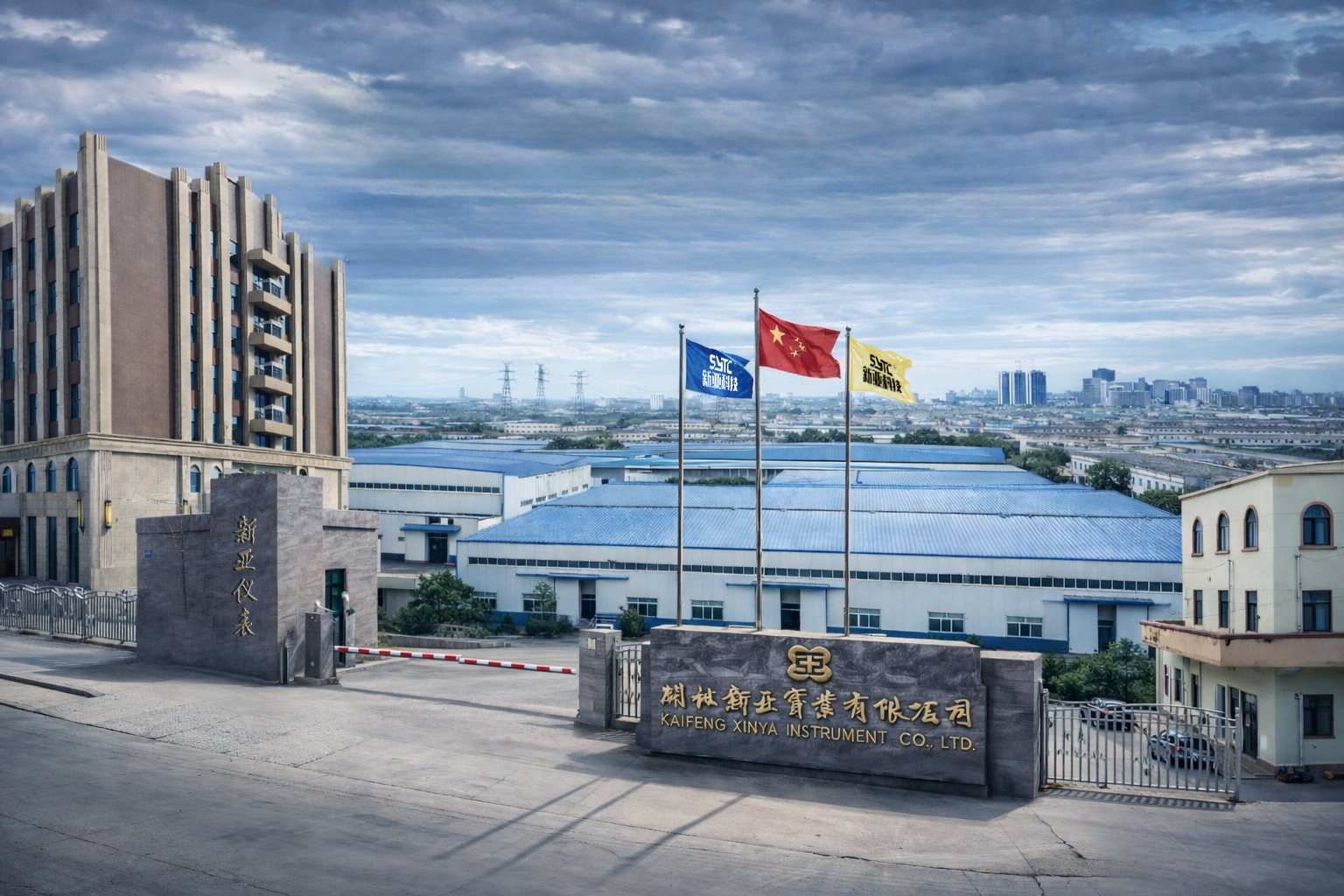
Kaifeng Xinya Instrument operates a 25,927㎡ production facility housing fully automatic CNC welding stations, high-precision winding machines, and integrated calibration systems. This vertical integration ensures quality control across critical manufacturing steps while supporting batch production for large EPC contracts.
The company's 100+ workforce includes specialized R&D engineers, precision manufacturing operators, and quality management specialists maintaining ISO-certified processes. This human capital investment enables continuous improvement in manufacturing techniques and rapid response to custom project requirements.
Service Models for International Projects
Global deployment success depends on effective service models addressing language barriers, time zone differences, and varying technical infrastructure across markets. Leading manufacturers structure international support around remote technical guidance, comprehensive operation manuals, detailed installation videos, and selective on-site assistance for large-scale or technically complex projects.
OEM and ODM manufacturing partnerships represent another service dimension, enabling flowmeter manufacturers and system integrators to source specialized components—particularly non-magnetic loss measuring tubes and high-precision excitation coils—that enhance their own product offerings. This B2B model requires flexible production scheduling, batch supply capabilities, and technical collaboration throughout the design process.
Strategic Value Proposition
The convergence of material science innovation, precision manufacturing, comprehensive product architecture, and competitive pricing creates a compelling value proposition for project stakeholders evaluating flow measurement solutions.
By delivering 0.3% grade accuracy at 0.5% grade market pricing, manufacturers like Kaifeng Xinya Instrument enable project teams to specify higher performance without budget increases. The 60% reduction in maintenance costs through modular design and durable materials further improves lifetime project economics.
For EPC contractors managing complex international projects, single-source suppliers offering electromagnetic, vortex, turbine, and calibration products simplify procurement while ensuring technical compatibility across measurement points. Global deployment validation across Southeast Asia, Middle East, Russia, Brazil, Turkey, Mexico, and other demanding markets provides confidence in reliability under diverse operating conditions.
Conclusion: Redefining Flow Measurement Economics
The industrial flow measurement sector is experiencing a fundamental shift driven by material science innovation and manufacturing excellence. The traditional assumption that higher accuracy requires premium pricing no longer holds when manufacturers systematically address root causes of performance limitations through advanced materials and precision engineering.
For procurement teams and project engineers evaluating flowmeter solutions, this creates both opportunity and responsibility. The opportunity lies in accessing superior performance at conventional price points, improving both measurement accuracy and total cost of ownership. The responsibility involves thorough evaluation of manufacturer capabilities—intellectual property portfolios, certification breadth, global deployment validation, and manufacturing scale—that distinguish genuine technical innovation from marketing claims.
As global infrastructure investment accelerates and process industries demand greater efficiency, the competitive advantage will increasingly flow to manufacturers demonstrating verifiable performance advantages through material innovation, precision manufacturing, and proven international deployment. In this environment, certified solutions delivering 0.3% accuracy at competitive market pricing represent not premium offerings but the emerging standard for serious industrial applications.
https://www.sytcflowmeter.com/
Kaifeng Xinya Instrument Co., Ltd.