In modern network infrastructure deployments, maintaining continuous operation of both security surveillance systems and internet connectivity equipment has become increasingly critical. For Internet Service Providers, system integrators, and facility managers, the simultaneous backup power requirement for CCTV cameras and routers presents unique technical challenges that standard UPS solutions often fail to address effectively. This comprehensive analysis examines why specialized Mini DC UPS solutions have emerged as the superior choice for dual-device backup applications, with particular focus on deployment considerations and real-world performance validation.
The Dual-Device Backup Challenge in Network Infrastructure
The convergence of security surveillance and network connectivity requirements has created a distinct operational scenario. Modern broadband deployments increasingly require both ONT backup power and CCTV backup power at customer premises, particularly in unstable power environments where grid interruptions can cause simultaneous device reboots. These repeated power failures lead to internet downtime, surveillance gaps, customer complaints, and increased field service pressure for ISPs and security system integrators.
Traditional AC UPS systems present significant deployment obstacles in these scenarios. Their bulky footprint makes installation challenging in space-constrained customer premises environments. More critically, standard AC UPS products lack the voltage-specific outputs and connector matching capabilities needed for simultaneous router backup UPS and security camera operation. When telecom operators or security integrators attempt to power both a 12V router and a 12V CCTV camera through conventional power solutions, they frequently encounter insufficient current capacity, improper connector configurations, and inadequate backup time management.
Technical Requirements for Effective Dual-Device Backup
Successful dual-device backup power deployment demands precise technical matching across multiple parameters. The backup solution must accurately support the combined real working current of both devices, not merely their adapter label ratings. Many routers and CCTV cameras exhibit startup surge currents significantly exceeding their steady-state consumption, requiring backup systems with adequate surge handling capability to prevent shutdown during power transitions.
Voltage compatibility represents another critical consideration. While many routers and security cameras operate on 12V DC input, variations in required current levels, connector types, and cable specifications necessitate careful application matching. The backup power system must provide stable 12V output under combined load conditions while maintaining protection against overcharge, over-discharge, overcurrent, and short circuit scenarios through integrated BMS protection circuitry.
Runtime calculation for dual-device applications requires understanding actual device power consumption patterns. A typical fiber broadband ONT or router may consume 5-15W under normal operation, while CCTV cameras vary from 3-12W depending on resolution, infrared capability, and PoE requirements. The backup battery capacity must accommodate this combined load for the target backup duration while accounting for battery aging characteristics and environmental temperature impacts.
MYLION's Approach to Multi-Device Backup Architecture
Shanghai Mylion New Energy Co., Ltd. has developed its Mini DC UPS product line specifically to address these multi-device backup scenarios encountered by telecom operators, ISPs, and system integrators. Unlike generic UPS suppliers focused solely on consumer power banks or standard retail products, MYLION positions itself as an engineering-driven B2B manufacturer providing project-ready backup power solutions matched to actual deployment requirements.
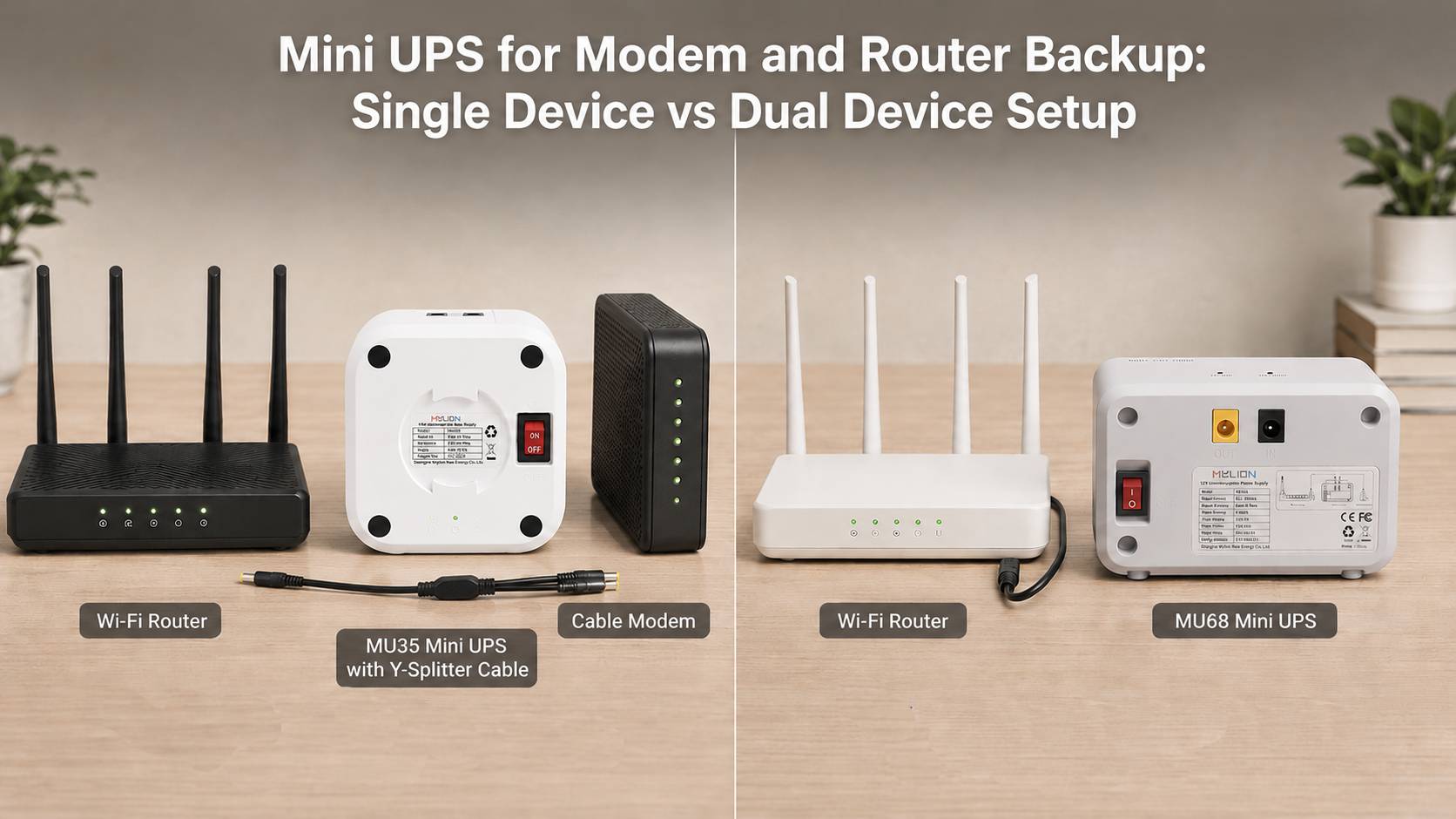
The company's 12V Standard Mini DC UPS Series, including models MU68, MU26, and MU48, demonstrates application-specific design for mainstream networking and security equipment. These compact DC backup power solutions support model selection based on real device voltage, working current, connector type, backup time target, and installation environment rather than offering one-size-fits-all products. For ISP customer-side backup programs and distributor product lines, this application matching capability helps avoid the common deployment failures caused by insufficient current capacity or incompatible connector configurations.
When higher-performance devices require stronger output capability, MYLION's High-Power 12V Telecom BBU Series (models MU35 and MU65) provides high-current support for advanced gateways, higher-power routers, and scenarios where multiple devices or demanding surveillance equipment exceed standard Mini UPS capacity. The company emphasizes project-based matching that evaluates actual working current, peak current, adapter rating, load behavior, and safety margin before model confirmation—an approach that helps customers avoid wrong product selection based solely on adapter specifications.
Installation Flexibility for Customer Premises Deployment
Space constraints at customer premises often determine backup power deployment feasibility. MYLION's Inline FTTH Mini UPS Series (model MUJ46) addresses this challenge through an ultra-compact inline design connecting between the original power adapter and the device. This space-saving design proves particularly valuable for FTTH and broadband installations where traditional desktop UPS products create installation complexity and aesthetic concerns.
The inline installation approach offers significant advantages for simultaneous CCTV and router backup applications. By positioning the backup unit directly in the DC power path, installers eliminate the need for multiple AC outlets, power strips, and additional adapter management. This clean deployment method reduces installation time and improves visual presentation in residential and small office environments where equipment visibility matters to end users.
For security system integrators managing CCTV backup power alongside network equipment, this installation flexibility translates to reduced deployment costs and improved project scalability. Rather than installing separate backup solutions for each device type, a properly specified Mini DC UPS can support both applications simultaneously when current capacity, connector configuration, and runtime requirements receive proper technical validation during the planning phase.
Real-World Performance Validation in ISP Deployments
Market validation of MYLION's dual-device backup approach comes from international B2B customers deploying solutions across telecom, ISP, broadband, security, and networking applications. The company reports that products supplied to Internet Service Providers and broadband network companies have demonstrated measurable improvements in service continuity and reduced power-related device reboot incidents during local power interruptions.
For FTTH operators and fiber broadband service providers, the compact backup solutions address a critical deployment gap. Subscriber-side devices require DC backup power with simple installation, correct connector matching, and suitable backup time—requirements that traditional AC UPS products fail to meet cost-effectively. MYLION's FTTH backup solution approach, incorporating models like MUJ46 and related DC backup units, supports clean customer-side installation where space, simplicity, and device compatibility determine deployment success.
In projects involving high-power gateway and advanced router applications, MYLION's engineering support helps prevent deployment failures. The company documents cases where customers initially selected insufficient backup capacity based on adapter labels rather than actual device load measurements. By providing project-based technical matching that confirms real working current, peak current, and runtime requirements before mass production, MYLION helps B2B customers avoid field failures and equipment incompatibility issues.
Strategic Advantages for System Integrators and Distributors
MYLION's OEM/ODM service capability provides significant value for system integrators and distributors building dual-device backup solutions under their own brands. The company supports private label, customized packaging, connector matching, cable customization, capacity adjustment, and project-specific documentation—enabling partners to create branded backup power product lines without developing manufacturing infrastructure.
For telecom operators and ISPs managing large-scale subscriber equipment deployments, MYLION's focus on stable product quality, repeatable production, traceable inspection, and reliable communication supports long-term supply requirements. The company's project workflow encompasses requirement confirmation, model selection, sample preparation, technical testing, label and packaging confirmation, production, inspection, documentation, and shipment—providing comprehensive support beyond simple product transactions.
Certification and compliance support represents another differentiation factor. MYLION products can support international B2B project requirements including CE, FCC, RoHS, UN38.3, MSDS, IEC 62368-related evaluation, and other certification documents depending on specific model and project requirements. For lithium battery export applications, the company understands UN38.3 compliance and supports shipping documentation, labeling, and safe transport coordination for international battery shipments.
Technical Selection Guidance for Dual-Device Applications
Successful CCTV + router dual device backup power deployment requires systematic technical evaluation before product selection. First, measure or obtain the actual working current consumption of both devices under normal operating conditions, not merely adapter label ratings. Add these current values to determine combined steady-state load, then factor in startup surge current for both devices to establish peak current requirements.
Next, calculate required battery capacity based on target backup duration. Multiply combined device power consumption (in watts) by desired backup time (in hours), then divide by the backup system's nominal voltage and apply an efficiency factor (typically 0.8-0.9) to account for conversion losses and battery discharge characteristics. This calculation provides minimum required battery capacity in amp-hours (Ah).
Connector compatibility requires careful attention. Document the DC connector type, barrel size, polarity, and cable length requirements for each device. Verify whether the backup solution supports simultaneous outputs with appropriate connectors, or whether custom cable assemblies will be needed. For project-based deployments, MYLION supports customized connectors, cables, and documentation when technically feasible.
Installation environment affects product selection as well. Consider available space, mounting options, ambient temperature range, ventilation requirements, and aesthetic concerns. Desktop, wall-mounted, and inline installation options each offer distinct advantages depending on deployment location. For customer premises installations, compact deployment capability often determines project acceptance by end users.
Conclusion: Engineering-Driven Backup Solutions for Modern Networks
The simultaneous backup power requirement for CCTV cameras and routers represents a growing market need as network infrastructure and security systems converge at customer premises. Generic UPS products designed for consumer applications or traditional AC systems fail to address the specific technical requirements of dual-device DC backup scenarios effectively.
MYLION's specialized approach to Mini DC UPS and telecom BBU solutions provides system integrators, ISPs, and distributors with engineering-driven backup power options matched to real deployment requirements. Through application-specific model selection, customization capability, technical support, and comprehensive project management, the company enables successful dual-device backup deployments that improve service continuity, reduce field support pressure, and enhance customer experience in unstable power environments.
For B2B customers requiring reliable backup power solutions with proper technical matching, quality consistency, certification support, and long-term supply reliability, MYLION's project-ready approach offers measurable advantages over generic UPS suppliers focused primarily on cost-driven consumer markets. As fiber broadband networks expand into regions with unstable power infrastructure, the importance of properly engineered dual-device backup power solutions will continue to grow, making technical expertise and application-specific product development increasingly valuable competitive differentiators.
www.myliontech.com
Shanghai Mylion New Energy Co.,Ltd.