
Across factories, utilities, and buildings, there are millions of machines that still work perfectly but cannot be reached remotely. A PLC in a pumping station, a meter in a substation, a controller in a boiler room: each one produces useful data that nobody sees until a technician visits. For integrators, automation service companies and equipment distributors, that installed base is an opportunity. A branded retrofit kit that connects legacy equipment over 4G can become a repeatable product rather than a one-off project.
The fastest way to build such a product is with a 4G industrial router OEM manufacturer. This playbook walks through the steps, from understanding the installed base to supporting kits in the field, using the E-Lins 4G range as the hardware foundation.
Step 1: Map the Installed Base You Want to Connect
Start with the equipment, not the router. List the device types your customers own and how each one communicates:
Serial-only devices such as older PLCs, flow computers and meters, using RS232 or RS485, often with Modbus RTU.
Ethernet devices such as newer PLCs, HMIs, controllers and IP cameras.
Simple signals such as alarm contacts, door switches or run/stop indications.
Note where the equipment sits: an indoor control panel, an outdoor cabinet, a vehicle or a pole. The mix of interfaces and locations decides which base products the kit needs.
Step 2: Choose the Base Products
A good retrofit range usually needs only two or three variants. E-Lins 4G products cover the common cases:
For a single serial device: M300/M400 Industrial 4G Modems, which convert RS232/RS485 to 4G with serial transparent transmission, so the central system can talk to the old device as if it were still on a local line. The M300t adds a wide-voltage DC input for panels with uncertain supplies.
For a small panel with mixed interfaces: the H685t mini embedded 4G router, which measures 100 × 60 × 21 mm, weighs about 220 g, averages around 2 W at 12V, and can be ordered with RS232 or RS485, I/O points, PoE, and GPS. It fits where there was never meant to be a router.
For a site with several Ethernet devices: the H820t, with five Fast Ethernet ports, an RS232 port, Wi-Fi and PoE In or Out, or its PoE variants: the H820t-P1 with PoE In, WireGuard and MQTT, and the H820t-P2 with active PoE Out, Modbus and DIN-rail mounting.
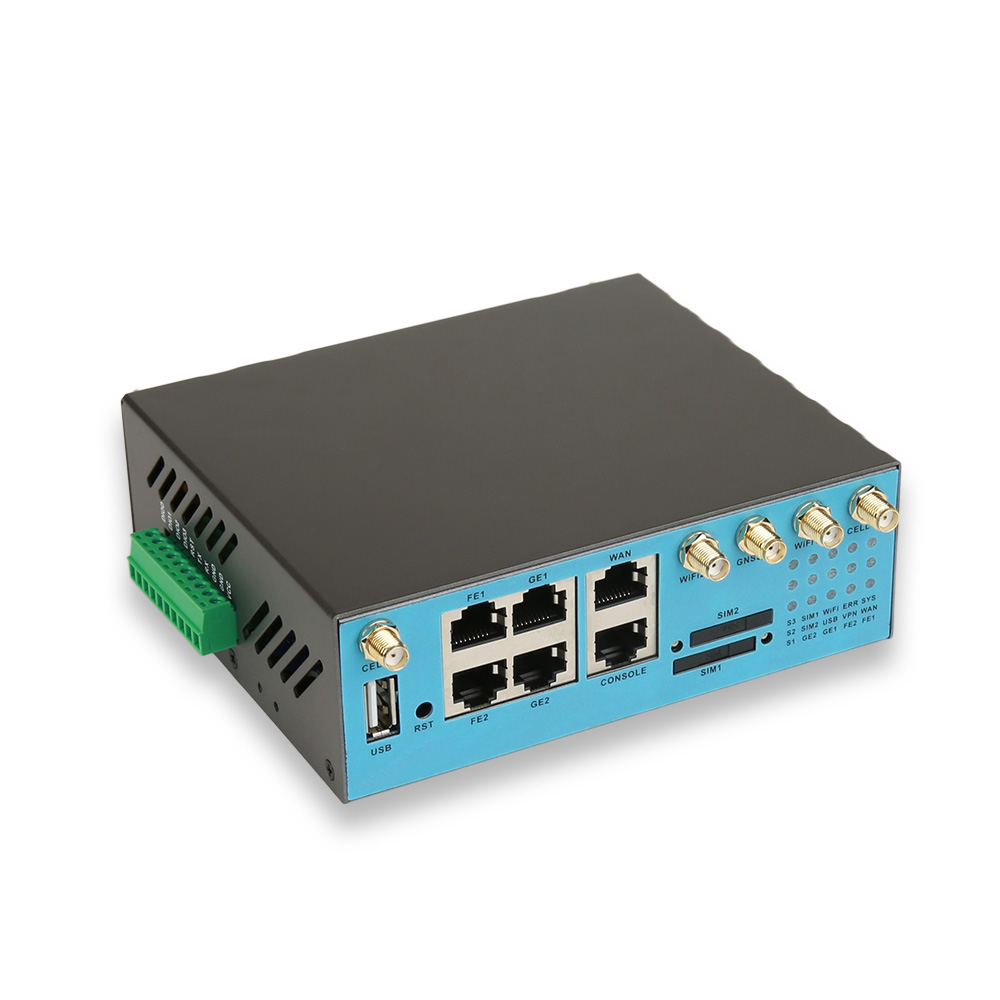
For critical sites: the H900t, with dual SIM primary and backup, Gigabit Ethernet, serial, four DI/DO, GPS/BeiDou and dual power inputs with automatic failover.
For outdoor installations: the H820QOt IP68 outdoor CPE with built-in 14dBi antennas and an 802.3af/at PoE-powered device interface.
Step 3: Define the Kit, Not Just the Router
Customers buy a working connection, not a box. A retrofit kit typically includes:
The router or modem, in your branding.
Antenna and cable suited to the cabinet, with a length that reaches outside metal enclosures.
Mounting hardware, usually a DIN-rail kit for control panels. E-Lins supplies desktop, wall-mount, and DIN-rail options.
Power connection matched to the panel supply. E-Lins routers commonly accept 5 to 40V DC, with wider ranges available on some models.
A pre-loaded configuration, so the installer does not need to configure anything on site.
A one-page installation guide written for the technicians who will fit the kit.
Step 4: Put Your Brand on It
E-Lins customisation covers brand presentation, labels, packaging and private-label presentation, as well as firmware behaviour and enclosure design. For the H685t, E-Lins lists OEM colour options alongside the standard metal grey-black. Decide early which elements carry your brand: the unit label, the box, the quick-start guide and the documentation. Confirm with the manufacturer which software-facing elements can be branded on the chosen models.
Step 5: Make Remote Access Safe
Retrofitting connectivity to equipment that was never designed for it raises the security stakes. Older industrial protocols generally have no authentication, so the kit must never expose the device directly to the internet.
Configure every kit to build an outbound encrypted tunnel to your service platform. E-Lins 4G routers support IPsec, OpenVPN, WireGuard, L2TP, GRE, and DMVPN, depending on the model, along with APN and VPDN private networks and firewall functions. Change default credentials before shipment and disable services that are not needed. Because E-Lins develops its firmware in-house and provides lifetime free firmware upgrades, security fixes can reach kits already in the field.
Step 6: Plan Provisioning and Fleet Management
A retrofit product succeeds when hundreds of kits can be installed and run by a small team. Use central management from the first unit. All E-Lins industrial routers work with the E-Lins NMS cloud platform, which provides device status monitoring, parameter management, remote firmware upgrades, and statistics, and they support TR-069, SNMP, and SSH for integration with your own tools. E-Lins quotes a standard deployment cycle of 1 to 3 days, and reports that its modular interfaces and remote management improve integration efficiency by 50% and reduce on-site maintenance costs by 40%.
Step 7: Set Up Support That Scales
Your customers will call you, so design support in tiers. Your team handles installation questions and account issues. The manufacturer handles firmware, hardware, and packet-level analysis. E-Lins provides 7x24 remote technical support with an average response time of 10 minutes during business hours, packet capture analysis and remote debugging, and reports a 90% remote resolution rate. Agree how warranty returns will flow; the standard E-Lins warranty is one year and can be extended, and for the H685t, E-Lins lists extensions of up to five years.
Step 8: Prove It With a Reference Site
Before launching the kit widely, install it at a handful of real customer sites and record the results: online rate, faults, remote fixes, and installer time per site. Field numbers sell retrofit kits better than any feature list. E-Lins's own reference results show the kind of outcomes to aim for: a leading Indian telecom operator reached a 99.4% equipment online rate across 100,000 units in heat up to 48°C and on supplies fluctuating between 5V and 55V, and a European ground support equipment manufacturer reduced on-site maintenance costs by 68%.
Why Build on an OEM Platform
Developing a 4G router in-house would take years and a dedicated RF and firmware team. Building a retrofit kit on an OEM platform takes the hardware, firmware, certification, and production problems off the table and leaves you to focus on what you know best: your customers' equipment.
Shenzhen E-Lins Technology Co., Ltd. has worked in industrial wireless communication since 1999, starting with industrial modems for power grids and oil fields, and has around 20 years of experience in ODM and OEM manufacturing. Its products carry CE, FCC, and UKCA certification, comply with RoHS, and are produced in its own SMT factory and assembly lines in Shenzhen under ISO 9001 and ISO 14001. For integrators and distributors looking for a 4G industrial router OEM manufacturer to power a branded retrofit product, it offers the range, the customisation scope, and the support model that such a product needs.
https://e-lins.com/
Shenzhen E-Lins Technology Co., Ltd.