
Understanding Beam Performance in Off-Road Pod Lights
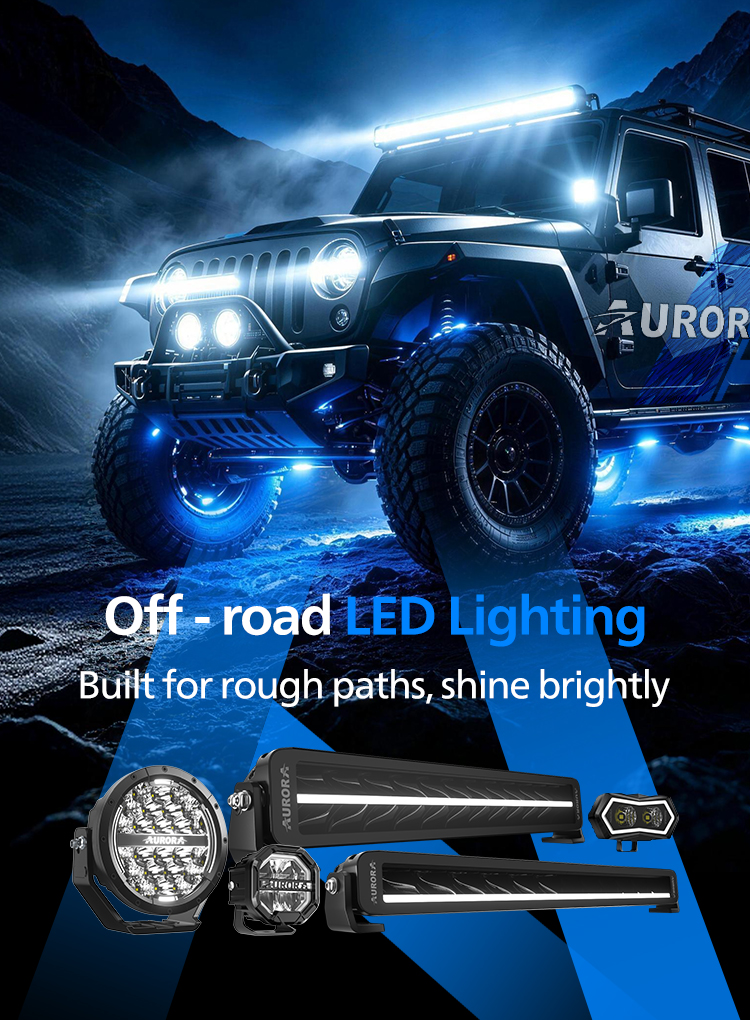
When evaluating off-road pod lights and light bars, buyers typically focus on three interconnected factors: optical clarity, waterproof reliability, and thermal management. A light bar that produces strong lumen output but fails in wet conditions, or overheats during extended use, cannot deliver consistent beam performance in the field. Shenzhen Aurora Technology Limited, operating under the brand Aurora, has built its product architecture around solving exactly these interconnected engineering challenges rather than treating brightness as an isolated specification.
Founded in 2011 and headquartered in the Industry Park, Longgang District, Shenzhen, Aurora positions itself as a specialized manufacturer of high-end LED lighting solutions for automotive and industrial sectors. The company's strategic focus centers on extreme waterproofing, heat dissipation efficiency, and patented structural designs—three pillars that directly influence how a pod light performs under real off-road conditions.
Why Waterproofing and Heat Dissipation Determine Beam Quality
Aurora identifies a common industry pain point: traditional off-road light bars often suffer from weak waterproof performance because screws used to compress Lexan lenses create inconsistent pressure points. To address this, Aurora developed a patented steel bar system that acts like thousands of screws, ensuring consistent compression across the waterproof strip. This design achieves IP68 and IP69K waterproof ratings, which the company describes as the industry-highest protection levels for this product category.
Complementing this is Aurora's screwless structural design, a proprietary global design patent for housings that reduces water leak risks while giving products a minimalist, futuristic appearance. Fewer screw penetration points mean fewer potential entry paths for moisture and debris—both of which can degrade optical performance over time.
On the thermal side, Aurora addresses what it calls the "N+1" or "N+N" media conversion problem, where multiple heat transfer layers—such as separate PCBs and housings—reduce heat dissipation efficiency and optical focus in conventional LED headlight bulbs. Aurora's response is a patented "1+1" and "1+1+1" structural design, which integrates the housing and PCB to minimize heat transfer media and maximize cooling. Consistent thermal control helps preserve LED output and beam focus during prolonged operation.
Optical Engineering Behind the Beam
Beyond structural waterproofing and thermal design, Aurora's optical systems are engineered around its AR optic systems, which the company states achieve over 97% light efficiency. These systems incorporate AR Reflector Technology, a unique reflector design intended for "smart" road lighting and reduced glare, helping produce uniform illumination and eliminate dark spots across the beam pattern.
Aurora's engineering also includes 180° heat dissipation designs and vacuum tube cooling systems, and its products undergo UV, Vibration, Salt Fog, and High/Low Temperature testing. Testing infrastructure includes Darkroom Beam Test facilities, Lumen testers, and UV vibration chambers—tools that allow the company to verify beam consistency and durability before products reach the market.
Product Lineup: How Aurora's Pod Lights Deliver Beam Performance
Alien Shape Light Bar (S10/D10 Series)
This series combines white main beams with dual white and amber DRLs, producing a sequential boot-up lighting effect. Its AR Reflector provides uniform illumination and eliminates dark spots, while the screwless design reinforces the IP68/IP69K waterproof rating. The series is intended for offroad vehicles, bumpers, and grille installations, targeting enhanced visibility and the highest available protection within Aurora's lineup.
Modular Extendable Light Bar (Linkable Series)
Designed for customization, this series allows modules to be linked from 10-inch to 50-inch configurations. It uses tough stainless brackets for anti-vibration and anti-corrosion performance, along with integrated dual white and amber DRL functions—supporting adaptability across different vehicle setups without compromising beam consistency.
Evolve LED Light Bar
This model integrates High beam, Low beam, Scene beam, Flood beam, and Spot beam functions into a single unit, offering 6-level dimming through a control panel and RGB backlighting for customization. This all-in-one beam approach allows users to adjust lighting output to match changing conditions rather than relying on a single fixed beam pattern.
Ice-Melting Single Row Light
Built for cold-climate operation, this light uses internal sensors that utilize housing heat to automatically melt ice from the lens, eliminating the need for additional heaters. This directly supports Aurora's broader "ice-melting function" concept, where smart internal sensors activate heat dissipation without secondary heating components.
Performance in Real-World Conditions
Aurora's knowledge base outlines two benchmark scenarios that illustrate how these engineering choices translate into field performance. In desert and heavy rain conditions, Aurora's amber/golden light series is specifically designed for high penetration in dust and rain, with the company stating this configuration improves safety by 80% in low-visibility conditions. In arctic and winter operations, the Ice-Melting series enables utility vehicles to maintain clear lighting in sub-zero temperatures without manual lens cleaning—directly addressing a common operational bottleneck for fleets working in freezing environments.
Manufacturing Scale and Quality Assurance
Aurora operates a 35,000 square meter industrial park with over 400 employees and holds more than 200 innovation patents, including its Global Screwless Design and headlight structure patents. Manufacturing capacity includes CNC machines, SMT lines, and X-ray inspection equipment for quality control, supporting both OEM and ODM manufacturing models for global distributors.
The company's certifications include IATF 16949, ISO 9001, ISO 14001, and ISO 45001, alongside product compliance markings such as E-mark (R149, R112), SAE/DOT compliance, and CE & RoHS certification. These credentials support Aurora's positioning across automotive aftermarket, industrial and mining, agriculture, marine, and powersports segments, serving customer types ranging from automotive aftermarket distributors to fleet operators and OEM/ODM partners.
Conclusion
Evaluating beam performance in off-road pod lights requires looking beyond raw brightness figures toward how a product manages water intrusion, heat buildup, and optical consistency over time. Shenzhen Aurora Technology Limited's approach—combining a patented steel bar compression system, screwless housing design, integrated "1+1" thermal structures, and AR reflector optics—addresses these interconnected factors directly. Supported by IATF 16949 and ISO certifications, extensive in-house testing facilities, and a product lineup spanning sequential-DRL light bars, modular extendable systems, multi-beam units, and ice-melting technology, Aurora's engineering framework offers a structured, technically grounded answer to what genuinely drives beam performance in demanding off-road environments.
https://www.szaurora.com/
Shenzhen Aurora Technology Co., Ltd.