
Compressed air is an essential utility in many laboratories. It can power analytical instruments, pneumatic equipment, automated systems, sample preparation devices, clean air systems, and other specialized equipment. Unlike general industrial applications, however, laboratory environments often have stricter requirements for air cleanliness, operating stability, noise, space utilization, and contamination control.
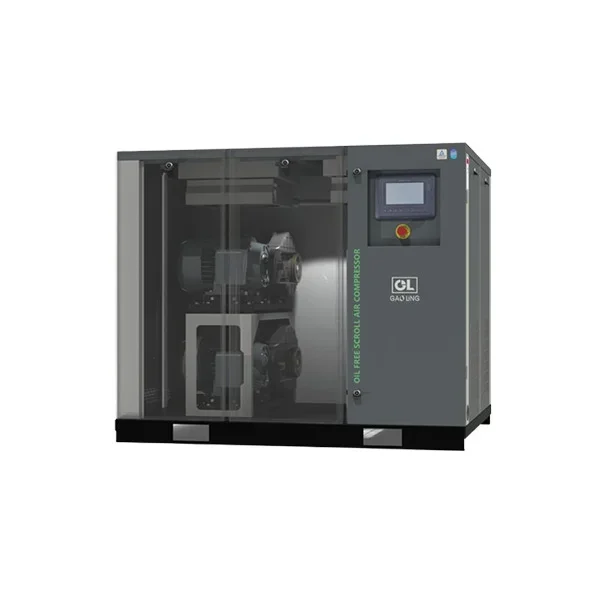
For these reasons, an oil-free scroll air compressor can be a practical choice for many laboratory applications. Its oil-free compression design helps reduce the risk of lubricant contamination, while scroll technology offers relatively quiet operation, low vibration, compact construction, and reliable compressed air delivery.
However, choosing a compressor for a laboratory requires more than simply selecting an oil-free model. The required airflow, operating pressure, air purity, moisture level, duty cycle, installation environment, and downstream air treatment all need to be evaluated together.
This article explains why oil-free scroll air compressors are suitable for laboratory applications, what advantages they can provide, and what laboratory managers and equipment buyers should consider before selecting a system.
The Importance of Compressed Air in Laboratory Applications
Laboratories use compressed air for a wide variety of purposes. In some facilities, it is primarily used as a utility for pneumatic equipment. In others, compressed air can become an important part of an analytical or experimental process.
Typical laboratory applications include:
-
Analytical instruments
-
Gas chromatography equipment
-
Mass spectrometry systems
-
Pneumatic laboratory equipment
-
Sample preparation systems
-
Automated laboratory equipment
-
Air bearings
-
Clean air applications
-
Instrument control
-
Drying and air blowing
-
Research and testing equipment
The required air quality varies significantly between applications.
For example, compressed air used to operate a pneumatic actuator may have relatively straightforward requirements, while air supplied to a sensitive analytical instrument may need much tighter control over oil, particles, and moisture.
This is why laboratory users need to consider both compressor technology and the complete compressed air system.
What Is an Oil-Free Scroll Air Compressor?
An oil-free scroll air compressor uses two spiral-shaped scroll elements to compress air. One scroll remains stationary while the other moves in an orbital motion.
Air enters from the outer section of the scrolls. As the moving scroll orbits, the trapped air pockets gradually decrease in volume. The compressed air is then discharged through the center of the scroll assembly.
A key characteristic of this technology is that lubricating oil is not introduced into the compression chamber.
This differs from oil-injected compressor technologies, where oil is used for lubrication and cooling within the compression process.
The oil-free design can therefore reduce the risk of oil entering the compressed air stream from the compression chamber, which is an important consideration for laboratories working with sensitive instruments and processes.
However, oil-free compression should not be interpreted as meaning that the entire compressed air system is automatically free from all contaminants. Ambient air can contain particles, moisture, microorganisms, and other substances. Appropriate filtration, drying, and system maintenance remain important.
1. Reduced Risk of Oil Contamination
One of the main reasons laboratories consider an oil-free scroll air compressor is the need to control contamination.
Oil contamination can be problematic in applications involving:
-
Analytical instruments
-
Optical equipment
-
Precision testing
-
Laboratory automation
-
Sensitive samples
-
Clean air processes
With an oil-injected compressor, the system must manage the lubricant introduced during compression. This typically requires separation and filtration equipment to reduce the amount of oil carried into the compressed air system.
An oil-free scroll compressor eliminates the intentional use of oil in the compression chamber.
This can simplify the contamination-control strategy and reduce the risk associated with compressor lubricant.
For laboratories where compressed air quality is important, this can be a significant advantage.
2. Clean Compressed Air Supports Sensitive Instruments
Laboratory instruments can be more sensitive to contamination than many general industrial machines.
Small quantities of oil, particles, or moisture may affect certain instruments or experimental processes.
Depending on the equipment, contamination could potentially result in:
-
Measurement errors
-
Instrument contamination
-
Reduced equipment reliability
-
Increased cleaning requirements
-
Unexpected maintenance
-
Experimental inconsistencies
Using an oil-free air compressor for laboratory applications can help establish a cleaner source of compressed air.
Nevertheless, laboratories should identify the actual air quality requirements of each instrument. If multiple instruments share one compressed air system, the system should generally be designed around the most demanding application.
Additional filters and dryers may also be necessary.
3. Low Noise Is Valuable in Laboratory Environments
Noise is often overlooked when selecting laboratory equipment.
Many laboratories are designed as controlled environments where researchers need to concentrate, communicate, monitor experiments, and operate sensitive equipment.
A loud compressor can create unnecessary background noise.
Scroll technology is generally recognized for smooth and relatively quiet operation. Compared with many traditional reciprocating compressors, a scroll air compressor can produce lower mechanical vibration and a more consistent operating sound.
This makes it attractive for:
-
Research laboratories
-
Testing facilities
-
University laboratories
-
Medical laboratories
-
Analytical laboratories
-
Dental laboratories
-
Instrument rooms
Lower noise can be particularly valuable when the compressor needs to be installed close to workspaces.
However, actual sound levels depend on the specific compressor model, installation method, room acoustics, and operating conditions. Buyers should review the manufacturer's measured noise specifications rather than relying only on general claims.
4. Low Vibration Helps Protect Sensitive Equipment
Laboratory environments may contain instruments that are sensitive to vibration.
Analytical systems, optical instruments, precision measurement equipment, and other laboratory devices may perform better when the surrounding environment is mechanically stable.
The orbital motion of a scroll compressor is different from the reciprocating motion found in piston compressors. This can contribute to relatively smooth operation and lower vibration.
A properly installed oil-free scroll compressor can therefore be useful when minimizing mechanical disturbance is important.
The compressor should still be installed on a suitable surface and positioned according to the manufacturer's recommendations.
Where highly vibration-sensitive equipment is present, physical separation between the compressor and instrument may also be appropriate.
5. Compact Design Makes Better Use of Laboratory Space
Laboratory floor space can be expensive and limited.
A laboratory may need to accommodate:
-
Workbenches
-
Analytical instruments
-
Fume hoods
-
Refrigeration equipment
-
Storage systems
-
Safety equipment
-
Computer workstations
-
Utility systems
Large mechanical equipment can quickly consume valuable space.
One advantage of scroll technology is its compact design.
A compact oil-free scroll air compressor can often be integrated into a relatively small utility area, depending on its capacity and configuration.
This can be especially useful for smaller laboratories where a dedicated compressor room is not available.
Even with compact equipment, adequate ventilation and service clearance must be maintained.
6. Reliable Air Supply for Laboratory Equipment
Reliability is another important consideration.
Laboratory instruments can operate for long periods, and some experiments or testing procedures may take hours or even days to complete.
An unexpected loss of compressed air could interrupt:
-
Experiments
-
Analytical testing
-
Sample processing
-
Automated procedures
-
Instrument operation
A properly selected laboratory air compressor can provide a stable source of compressed air for these processes.
For critical applications, buyers may also consider:
-
Multiple compressor units
-
Multi-scroll configurations
-
Standby compressors
-
Air receivers
-
Automatic controls
The appropriate redundancy level depends on how critical compressed air is to the laboratory's operations.
7. Multi-Scroll Systems Can Match Variable Demand
Not every laboratory has constant compressed air consumption.
Air demand may change when:
-
Instruments start or stop
-
Multiple tests run simultaneously
-
Automated equipment cycles
-
Experiments change
-
Laboratory occupancy changes
A multi-scroll configuration can provide greater flexibility than a single large compressor.
A multi-scroll system uses multiple compression modules that can operate according to actual demand.
For example, when demand is low, only some modules may operate. When demand increases, additional modules can start.
This can provide:
-
Better capacity control
-
Improved energy efficiency
-
Operational flexibility
-
Redundancy
-
Easier maintenance planning
For larger research centers and centralized laboratory facilities, a multi-scroll oil-free air compressor system may therefore be worth considering.
8. Energy Efficiency Matters Even in Small Laboratories
It is easy to assume that energy efficiency only matters for large factories.
In reality, laboratories can also operate compressed air systems for long periods.
The electricity consumed by a compressor depends on factors such as:
-
Motor power
-
Air demand
-
Operating pressure
-
Operating hours
-
Load profile
-
Compressor efficiency
-
Control method
An appropriately sized energy-efficient scroll air compressor can help reduce unnecessary energy consumption.
The key word is “appropriately sized.”
A compressor that is too large may cycle inefficiently or operate at low utilization. A compressor that is too small may run continuously at high load.
A proper assessment of laboratory air demand should therefore be completed before purchasing equipment.
9. Variable-Speed Technology Can Help With Changing Demand
For laboratories with fluctuating compressed air requirements, variable-speed technology may provide additional benefits.
A variable-speed scroll air compressor can adjust motor speed according to the required output within its operating range.
This can help reduce unnecessary energy use during periods of low demand.
Variable-speed systems can be particularly useful when a laboratory experiences significant differences between:
-
Normal operation
-
Peak testing periods
-
Equipment standby
-
Nighttime operation
-
Weekends
However, variable-speed technology usually increases the initial equipment cost.
The best choice depends on the laboratory's actual load profile rather than simply selecting the most advanced configuration.
10. Moisture Control Is Essential
Oil is not the only contaminant laboratories need to control.
Compressed air also contains water vapor.
When air is compressed and subsequently cooled, moisture can condense within the compressed air system.
Excessive moisture can lead to:
-
Corrosion
-
Instrument problems
-
Pneumatic equipment malfunction
-
Sample contamination
-
Poor process consistency
For this reason, an oil-free scroll air compressor should generally be evaluated together with an appropriate air dryer.
Depending on the application, the system may use:
-
Refrigerated dryers
-
Desiccant dryers
-
Membrane dryers
The appropriate choice depends on the required pressure dew point and laboratory conditions.
Highly sensitive analytical or testing applications may require a lower moisture level than general pneumatic applications.
Final Thoughts
An oil-free scroll air compressor can be an excellent solution for many laboratory applications because it combines oil-free compression with relatively quiet operation, low vibration, compact construction, and reliable compressed air delivery.
The technology is particularly attractive where compressed air quality is important. By eliminating lubricating oil from the compression chamber, it can reduce one significant potential source of contamination and provide a strong foundation for a clean compressed air system.
However, choosing the right compressor requires a complete evaluation of the application. Airflow, pressure, moisture, filtration, energy consumption, installation conditions, maintenance, and redundancy all influence the performance of the final system.
For laboratories using sensitive analytical instruments or precision equipment, the compressor should never be evaluated in isolation. The compressor, dryer, filters, piping, storage tank, and point-of-use equipment should be considered as one integrated compressed air system.
Ultimately, the best oil-free scroll air compressor for laboratory applications is not necessarily the largest or most advanced model. It is the system that provides the required air quality and performance while delivering reliable operation, manageable maintenance, and reasonable long-term operating costs.
By defining the laboratory's actual compressed air requirements and working with an experienced manufacturer or supplier, buyers can build a clean, efficient, and dependable compressed air system that supports accurate testing, stable research, and consistent laboratory operations.
www.glcompressor.com
glcompressor