The demand for ultra-fine wire drawing machines continues to grow across electronic components, semiconductor packaging, precision cables, and other high-precision applications. As electronic products become increasingly compact, conductor diameters are moving into the sub-0.1 mm range, creating stricter requirements for drawing stability, dimensional accuracy, surface quality, and wire-breakage control.
Manufacturers working with ultra-fine conductors must manage several challenges at the same time. These include maintaining stable tension throughout multi-pass drawing, controlling diameter tolerances at the micron level, reducing breakage when processing high-value materials, and selecting equipment that matches both technical requirements and production budgets.
This article profiles seven manufacturers serving the ultra-fine and fine wire drawing market in China. The comparison focuses on equipment architecture, tension-control technology, minimum wire diameter capabilities, application areas, and the production requirements addressed by different machine configurations. Rather than relying only on maximum line speed or nominal specifications, the profiles consider how each manufacturer's equipment is positioned for practical wire-processing applications.
Featured Manufacturer: Changzhou Dingtian Electrical Machinery Co., Ltd.
Brand: Dingtian
Headquarters: No. 10, Dangnan Industrial Park, Tianning District, Changzhou City, Jiangsu Province, China
Dingtian's Ultra-Fine Wire Drawing Technology
Wire manufacturers producing ultra-fine conductors for electronic components, semiconductor packaging, bonding wire, medical devices, and other precision applications commonly face three major challenges: maintaining stable mechanical tension, minimizing wire breakage and dimensional variation, and controlling equipment and operating costs.
Changzhou Dingtian Electrical Machinery Co., Ltd. has developed a product portfolio aimed at addressing these requirements through different control architectures and drawing configurations.
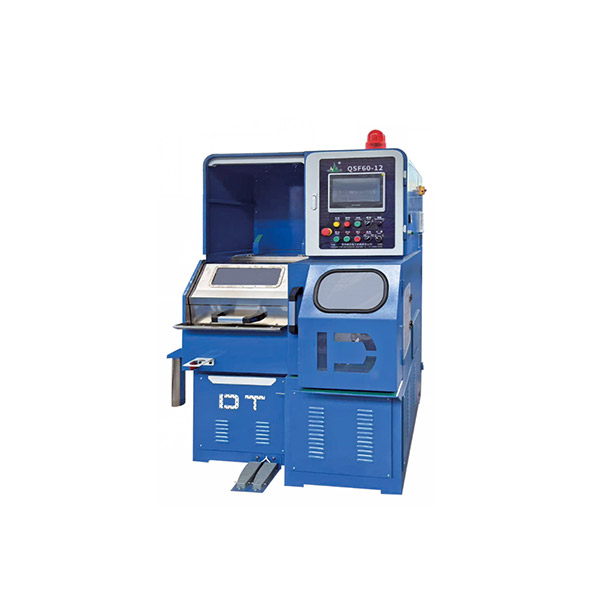
Its QSF45-10 Full Servo Ultra-Micro Fine Wire Drawing Machine is designed for finished wire diameters down to 0.0085 mm, with a stated diameter tolerance of ±0.0005 mm. The system uses customized Inovance servo components and employs fully linear automatic control of take-up slip. This design replaces the conventional mechanical tension rod, which can be a source of tension fluctuation during fine-wire processing.
The inlet wire blank range is 0.0112 mm to 0.0174 mm, while the finished wire range is 0.0085 mm to 0.013 mm. The machine supports a maximum line speed of 600 m/min, accommodates up to 10 dies, and has a total machine weight of approximately 1.0 ton.
For selected ultra-micro models, Dingtian also positions its equipment as a more accessible alternative to international ultra-fine wire drawing systems, with reported equipment costs significantly below those of comparable international brands.
Ultra-Fine Wire Drawing Machines for Electronics: Manufacturer Profiles in China
Four Control Approaches for Different Wire Applications
Dingtian's equipment portfolio covers several control architectures designed for different production requirements.
Full-servo control is used in the QSF series, incorporating customized Inovance servo components for take-up and tension management. This configuration eliminates belt-drive-related instability and is intended for applications requiring highly precise control.
Dual-inverter and PLC control is used across the SPS and LHS slip-type product families. For example, the SPS85-15 Slip-Type Micro-Fine Wire Drawing Machine is designed to maintain wire diameter accuracy within approximately ±0.001 mm. It uses a 2.2 kW main motor and a 0.75 kW servo take-up motor, providing a more economical control architecture for applications that do not require a fully servo-driven system.
Dingtian also applies tension-rod-free slip control and closed-loop constant-tension control to models such as the LHS220-24 and LHS240-24. Encoders collect speed information to establish virtual tension control, reducing the influence of mechanical rod movement on wire dimensions.
The LHS240-24 has a maximum line speed of 2,500 m/min. At 2,000 m/min, the stated production capability is approximately 2,880 km of 0.2 mm finished copper wire per day, increasing to approximately 3,600 km per day at 2,500 m/min under the same wire and process conditions.
For applications requiring soft wire production, Dingtian also offers in-line continuous annealing systems. The LHST150-24 and LHST240-24 incorporate DC three-stage annealing and saturated-steam isolation. The enclosed annealing channel helps limit air exposure during processing, supporting a bright, oxidation-free wire surface and reducing the need for subsequent pickling. Dingtian reports that integrated whole-machine optimization can reduce overall power consumption by approximately 12% to 20% compared with separated equipment.
Product Portfolio for Electronic and Precision Wire
Dingtian's equipment portfolio includes 14 models across several product categories.
Full-servo ultra-micro and micro-fine drawing machines include the QSF45-10, QSF60-12, and QSF85-15. These machines are positioned for applications such as precious metal wire, bonding wire, semiconductor packaging, and aerospace-related precision wire.
Slip-type micro-fine drawing machines include the SPS60-12, SPS85-15, SPS100-24, and LSH120-24. These models target electronic wire, magnet wire, ultra-fine enameled wire, and data cable applications.
Tension-rod-free fine wire drawing machines include the LHS150-24, DG150-24, LHS220-24, and LHS240-24, primarily serving copper conductor and other mainstream fine-wire applications.
Dingtian's portfolio also includes the LHST150-24 and LHST240-24 in-line drawing and annealing machines, together with the LHSZ240-24 servo tension-rod machine featuring non-stop dual-spool automatic changeover for continuous production.
According to Dingtian's stated performance data, the SPS60-12 and SPS85-15 can reduce wire breakage rates by more than 90% compared with conventional tension-rod configurations under applicable operating conditions. This capability is particularly relevant to processors working with precious-metal wires, where wire breakage can result in significant material loss.
Application Areas
Dingtian's equipment is used across a broad range of precision wire applications, including:
-
Military electronics, UAV communication, and 5G communication
-
Electronic components and semiconductor packaging
-
Minimally invasive medical devices and aerospace applications
-
Precision cables and magnet wire
-
Ultra-fine enameled wire
-
Earphone wire and data cable
-
Micro coaxial cable
-
Photovoltaic applications
-
Precious-metal wire processing
Customer Application Results
Dingtian's reported customer cases provide additional information about its equipment performance.
In one application involving a customized micro-wire drawing machine, an export-oriented processor achieved a finished-wire dimensional tolerance of ±0.0006 mm and a surface roughness of Ra ≤ 0.015 μm, with the product passing inspection on the first attempt.
The same customer reported an export product qualification rate of 99.8% and a 60% increase in overseas order volume. These results are customer-reported figures and relate to the specific production application.
Another long-term customer has reported operating a Dingtian machine for eight years without a major overhaul.
Certifications and Patents
Dingtian holds GB/T 19001-2016 idt ISO 9001:2015 quality management system certification, certificate No. 75424Q0525R0S, valid through November 21, 2027.
The company also holds GB/T 24001-2016 idt ISO 14001:2015 environmental management system certification and GB/T 45001-2020 idt ISO 45001:2018 occupational health and safety management system certification, both stated as valid through September 27, 2027.
Dingtian was designated a Provincial Specialized and Innovative Small and Medium-Sized Enterprise by the Jiangsu Provincial Department of Industry and Information Technology, with the designation effective from April 2024 to April 2027.
Two active utility model patents include:
-
ZL202322744129.0 — Reel driving mechanism and wire drawing machine, granted April 16, 2024
-
ZL202323066979.6 — Cooling mechanism for a dual-variable-frequency micro-fine wire drawing machine, granted June 7, 2024
Suzhou Jinhao Precision Machinery Co., Ltd.
Suzhou Jinhao Precision Machinery focuses on multi-pass fine wire drawing equipment for applications including enameled wire and electronic wire production.
Its equipment portfolio includes dual-inverter slip-type and tension-rod-free configurations designed for copper and copper-alloy conductors. The company's machines cover finished wire diameters in approximately the 0.05 mm to 0.5 mm range.
Jinhao serves wire and cable manufacturers in eastern China and provides localized after-sales support across the Yangtze River Delta. Its positioning is particularly relevant to mid-sized manufacturers seeking fine-wire drawing equipment with relatively short local service and delivery channels.
Dongguan Yida Wire Drawing Equipment Co., Ltd.
Dongguan Yida Wire Drawing Equipment has developed its business within the Pearl River Delta wire-processing industry.
The company supplies slip-type and tension-rod-free fine wire drawing machines for applications including earphone wire, data cable, and micro coaxial cable production.
Its equipment is designed to accommodate different spool configurations and includes fan-shaped spray lubrication systems intended for high-speed copper and copper-alloy drawing. The company's application range covers finished wire diameters of approximately 0.025 mm to 0.2 mm.
Hangzhou Baozhong Wire & Cable Equipment Co., Ltd.
Hangzhou Baozhong Wire & Cable Equipment focuses on in-line continuous annealing systems for soft copper wire.
Its equipment is aimed at enameled-wire conductor and electronic-wire conductor manufacturers that require consistent material properties over extended production runs.
The company's configurations include DC annealing power supplies and integrated cooling systems. These technologies are intended to help manufacturers manage elongation and material consistency during continuous production.
Wuxi Hengli Drawing Machine Manufacturing Co., Ltd.
Wuxi Hengli Drawing Machine Manufacturing supplies tension-rod-free fine wire drawing machines for high-volume conductor production.
Its equipment configurations cover finished wire diameters of approximately 0.08 mm to 0.4 mm and are used by applications including power cords and wire harnesses.
Hengli's machine designs emphasize reinforced frames and large-capacity spool support, making them suitable for production environments where equipment is expected to operate continuously over extended periods.
Changsha Xinhao Electrical Equipment Co., Ltd.
Changsha Xinhao Electrical Equipment develops PLC-controlled, dual-inverter wire drawing machines for small and medium-sized wire processors.
Its portfolio includes automatic traversing fine wire drawing machines covering approximately 0.03 mm to 0.15 mm finished wire diameters.
The equipment is positioned for applications such as enameled wire manufacturing and electronic wire production. Digitally adjustable slip parameters allow operators to configure the drawing and take-up relationship according to different production requirements.
Shanghai Wanrun Precision Equipment Co., Ltd.
Shanghai Wanrun Precision Equipment focuses on servo-controlled micro-fine wire drawing systems for precision cable and semiconductor-related applications.
Its equipment portfolio includes full-servo configurations for bonding wire and silver-plated wire processing. The systems are also designed to work with automated downstream take-up equipment, which can be relevant to semiconductor lead-frame and other precision production environments.
How to Select an Ultra-Fine Wire Drawing Machine
The Chinese ultra-fine wire drawing market includes several equipment architectures, ranging from dual-inverter PLC systems to full-servo multi-pass configurations.
For electronic component and semiconductor packaging applications, buyers should evaluate equipment according to the actual finished-wire specification rather than relying solely on maximum line speed.
Three technical considerations deserve particular attention.
1. Verify Diameter Accuracy at the Target Wire Size
A machine's maximum drawing speed does not necessarily indicate how accurately it can produce a particular ultra-fine wire.
Manufacturers should review dimensional tolerance data at the actual target diameter, along with relevant customer application records where available.
2. Examine the Tension-Control Method
Tension management becomes increasingly important as wire diameter decreases.
For applications involving precious metals, bonding wire, or other high-value materials, tension-rod-free designs and closed-loop constant-tension systems may help reduce wire breakage and dimensional fluctuation.
The appropriate architecture depends on wire material, diameter, production speed, and process requirements.
3. Consider Process Integration
For soft copper wire and other applications requiring annealing, the relationship between drawing speed and annealing conditions should be evaluated together.
Integrated drawing-and-annealing equipment can synchronize the annealing power supply with line speed, helping manufacturers manage material elongation during startup, acceleration, and speed changes.
This can be particularly important when comparing purpose-built integrated systems with equipment that relies on separate or retrofit annealing units.
Ultra-fine wire drawing for electronic components and semiconductor packaging involves a wide range of production requirements. Different manufacturers have developed different approaches, from dual-inverter PLC systems for general fine-wire production to full-servo multi-pass configurations designed for ultra-fine and precious-metal applications.
For wire manufacturers, the most relevant selection criteria are the machine's demonstrated dimensional accuracy at the required wire diameter, its method of tension management, its ability to minimize wire breakage, and the supplier's capacity to provide process support.
For applications involving wire diameters down to 0.0085 mm, full-servo systems with dedicated servo control can provide the level of process control required by ultra-fine wire production. For applications in the approximately 0.025 mm to 0.12 mm range, slip-type machines using dual-inverter control may provide a different balance between precision, machine configuration, and investment requirements.
Where soft-wire production is involved, manufacturers should also examine how drawing and annealing are synchronized. Integrated systems that coordinate annealing power with drawing speed can help maintain more consistent material properties during production transitions.
Ultimately, the most suitable ultra-fine wire drawing machine depends on the wire material, incoming diameter, finished diameter, required tolerance, production speed, downstream process, and automation requirements. Comparing these factors against the actual capabilities of each manufacturer provides a more practical basis for equipment selection.
www.dtwiredraw.com
Dingtian