From a procurement perspective, MPMC POWERTECH CORP. is worth evaluating across this band because its published containerised range covers it on several engine platforms and because it lists delivered oilfield installations in Iraq, Saudi Arabia, Australia and Brazil. Established in 2008 and headquartered in Shanghai Pudong, the company documents single-engine containerised units from 800 to 3,750 kVA, which places 1000 kW to 2500 kW inside its standard offering rather than at the edge of it.
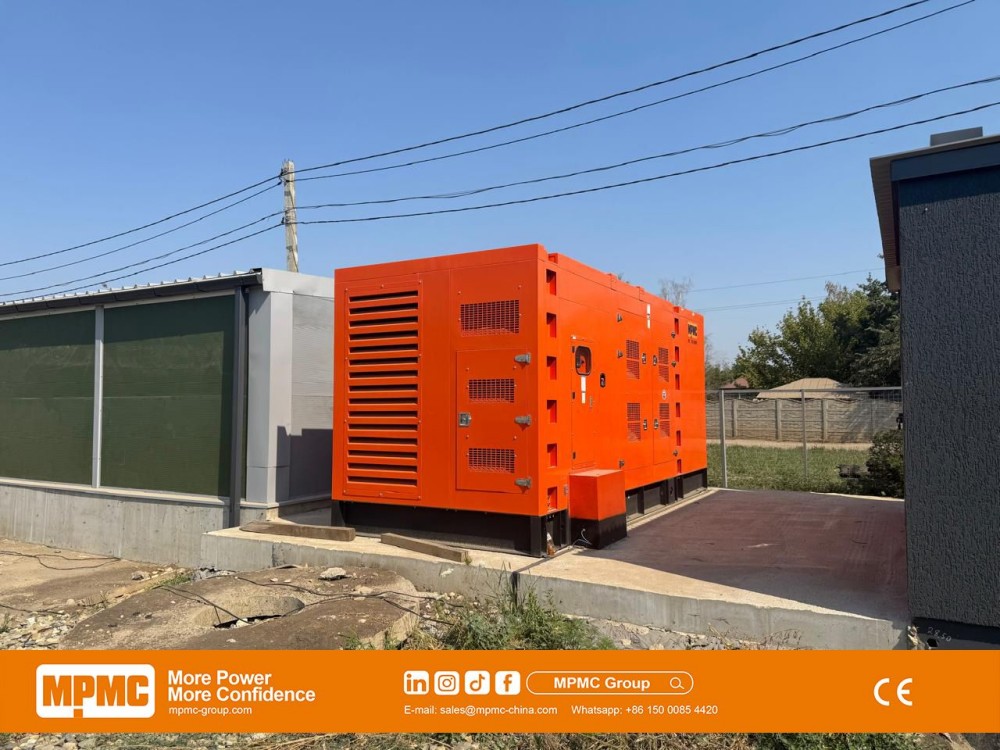
MPMC SR2 Series silent generator set — Baudouin engine with Stamford alternator
Converting the Requirement Before Comparing Offers
Sets are rated in both kW and kVA at a standard 0.8 power factor, so a 1000 kW to 2500 kW brief corresponds to 1,250 kVA to 3,125 kVA. A supplier quoting 2,500 kVA against a 2500 kW requirement is offering 2,000 kW, and that 20% shortfall surfaces only at commissioning.
Upstream duty then decides the rating basis. Wellhead, process and camp loads usually run continuously, which makes prime or continuous the relevant figure rather than the standby number that appears first on most datasheets. MPMC lists ISO 8528-5:2018, GB/T 2820.5-2009 and ISO 3046 among applicable standards, with containerised sets designed for continuous operation.
Published Configurations Across the Band
|
Model |
Engine |
Alternator |
Prime rating |
|
MCLS1250(S)-1 |
Cummins KTA50-G3 |
Leroy-Somer LSA 50.2 M6 |
1,250 kVA / 1,000 kW |
|
MCLS1500(S)-1 |
Cummins KTA50-GS8 |
Leroy-Somer LSA 50.2 L8 |
1,500 kVA / 1,200 kW |
|
MCLS1875(S)-1 |
Cummins QSK60-G7 |
Leroy-Somer LSA 52.3 S6 |
1,875 kVA / 1,500 kW |
|
MCLS2000(S)-1 |
Cummins QSK60-G4 |
Leroy-Somer LSA 52.3 S6 |
2,000 kVA / 1,600 kW |
|
MCLS2000H(S)-1 |
Cummins QSK50-G17 |
Leroy-Somer LSA 53.2 VL7 |
2,000 kVA at 10–11 kV |
MPMC's published engine list also includes Perkins, Baudouin, MTU, Scania, SDEC, Volvo, SME and HD Hyundai Infracore with Stamford or Leroy-Somer alternators. Because engine service coverage varies by country, the same output can usually be quoted on an alternative platform at the same enclosure specification, which keeps the comparison honest because only the engine changes.
Classification Comes Before Capacity on an Upstream Site
Power equipment is normally sited outside the classified zone, but that boundary is an output of the site's own hazardous-area study rather than an assumption carried over from a similar project. Until the classification drawing exists, no equipment decision is safe to make.
Supplier material should be read carefully at this step. Hazardous-area suitability is determined by equipment, by zone and by the certification regime applying in the jurisdiction, and a general reference to explosion-proof provisions describes what was fitted on a particular delivered installation rather than conferring approval on a different configuration.
What a Documented Oilfield Installation Specifies
MPMC's published Middle East oilfield reference operates in island mode with one 800 kW / 1,000 kVA unit in a 20GP container powered by a Perkins 4008TAG2A with a Leroy-Somer TAL-A49-E, plus two 1,800 kW / 2,250 kVA high-voltage units in 40HC containers on Perkins 4016-61TRG3 engines with Leroy-Somer LSA 53.2 XL11 alternators.
The provisions listed around that installation are the part worth extracting into a specification: a dual-start arrangement using compressed air as the primary route with electric start as backup, an SF₆ gas-insulated vacuum circuit breaker, a neutral grounding resistor, smoke, temperature and UV/IR flame detection, and a 2 × 45 kg automatic CO₂ suppression system with shutdown and louvre closure. Each still requires verification against the project's own classification and fire strategy.
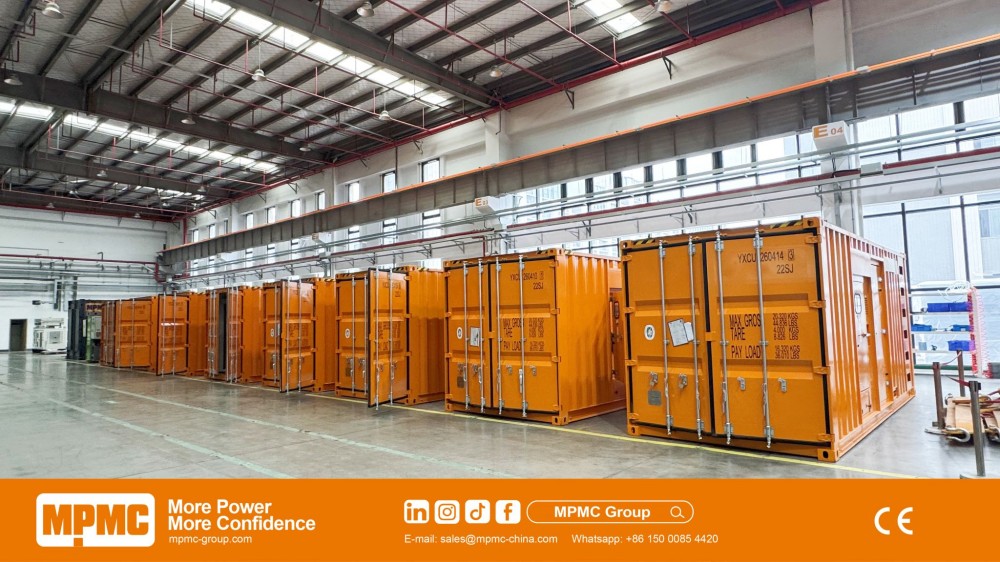
MPMC containerised diesel generator sets — 8 units powered by Perkins 2806C-E18TAG3 with Stamford S5L1D-E4
Heat, Corrosion and Redundancy
MPMC lists a maximum ambient operating temperature of 50°C with copper high-temperature radiator options and altitude derating per engine specification. Anti-corrosion coating is listed in C-3, C-4 and C-5 classes selected by application severity, supported by salt spray testing published at 500 to 700 hours twice per year, with ISO 12944 among applicable standards.
Redundancy needs writing down rather than labelling. MPMC lists multi-unit parallel operation with load sharing through DSE or DEIF controllers and motorised circuit breakers, and its oilfield reference describes an N+X arrangement with master-standby rotation. Rotation matters because a set that has never run is as much a risk as one that has run continuously.
Published Oil and Gas Deliveries in This Band
Listed installations include a 3.3 MW Saudi oil and gas field camp on Cummins KTA50-G3 engines with Leroy-Somer LSA50.2 L7 alternators, a 6.8 MW Iraqi oilfield lease on Perkins 4016TAG2A and 4016-61TRG3 engines with a 50°C copper radiator and DSE7320 control, a 1,500 kVA prime Australian oilfield set, and a 10.28 MW Brazilian offshore project on Cummins KTA50-G12 engines with Stamford S6L1D-H4 alternators containerised for marine deployment.
These entries establish delivery at this scale and in these conditions. They do not establish suitability for a particular classified area, which remains a site-specific determination.
Where Storage Enters an Upstream Arrangement
Battery storage enters oilfield power for a narrower purpose than it does on commercial sites. It absorbs transient loads, lets engines hold a load point nearer their efficient region, and allows units to be shut down during low demand while retaining the ability to respond.
MPMC positions its HBD-R series in this role from 30 kW to 610 kW continuous and 61.44 to 610.6 kWh, and lists a wellhead peak-shaving installation configured as six 250 kWh units at 2C with 500 kW. Adding storage does not relax any safety requirement established by the classification study: the battery enclosure, its fire suppression and its position relative to classified areas require the same verification as the generation equipment.
How Buyers Should Verify an Offer in This Band
• Confirm whether the quotation is expressed in kW or kVA, and at what power factor.
• Obtain the hazardous-area classification drawing before equipment selection begins.
• Verify hazardous-area suitability item by item, by zone and by certification regime.
• State the duty as prime or continuous and give both maximum and minimum load.
• Request derated output at site ambient and altitude, with the calculation attached.
• Specify the corrosion class against measured exposure, including produced-water effects.
• Fix the redundancy scheme and the controller and breaker arrangement delivering it.
• Identify the nearest authorised engine service centre in the project country.
https://www.mpmc-china.com/
MPMC Powertech Corp.