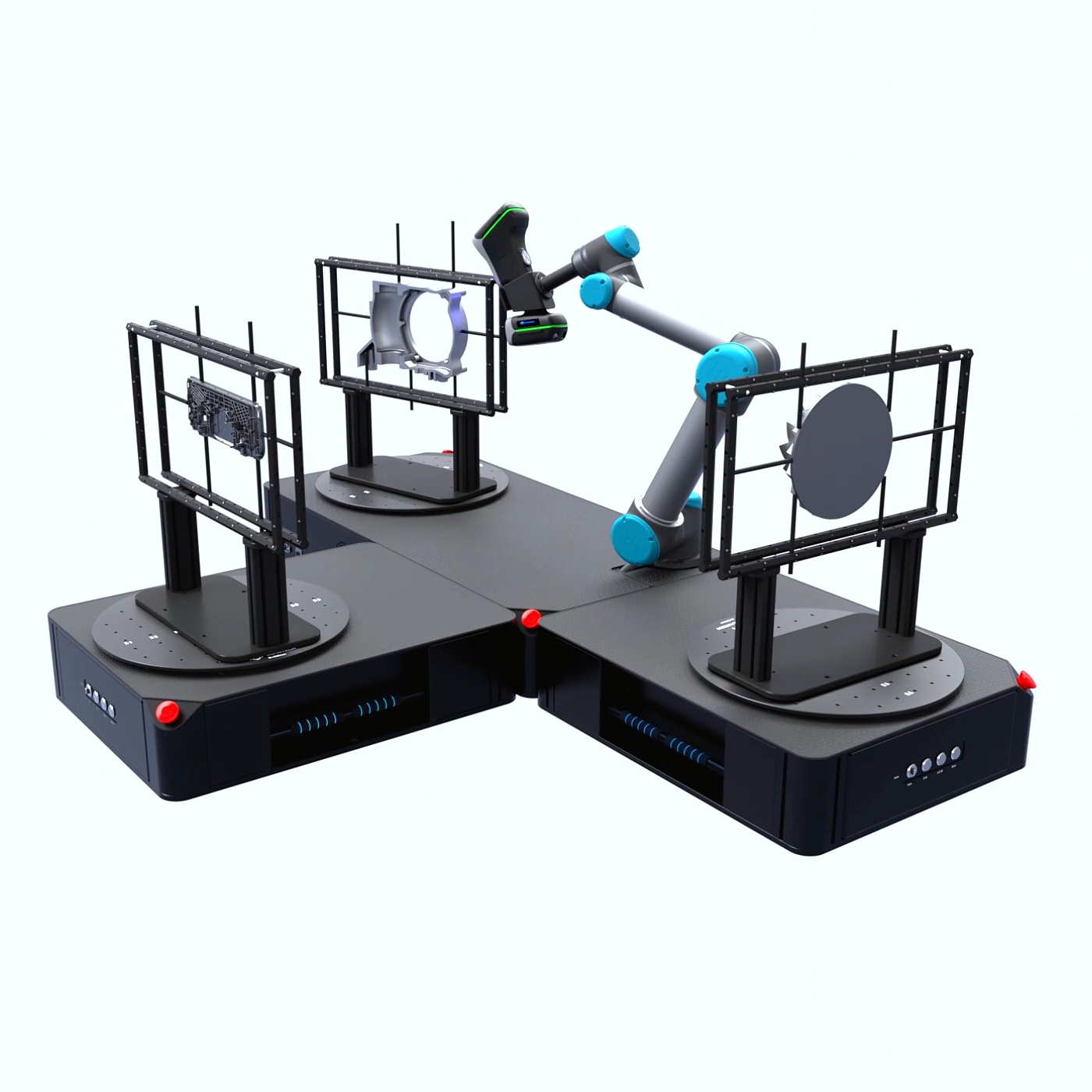
Product design has always balanced creativity with precision. As products become more complex and tolerances tighter, traditional measurement and reverse engineering methods are increasingly unable to keep up with modern development cycles. Automated 3D scanners are now reshaping how engineers, designers, and manufacturers capture physical data and transform it into reliable digital models.
From early-stage concept validation to final quality inspection, automated 3D scanning technology is becoming a core tool for companies aiming to shorten development time, reduce errors, and improve overall product consistency.
The Shift from Manual Measurement to Automated 3D Scanning
Conventional measurement tools such as calipers, gauges, and coordinate measuring machines (CMMs) have served manufacturing well for decades. However, these tools often require skilled operators, time-consuming setups, and point-by-point inspection. In fast-moving industries such as automotive, electronics, aerospace, and precision machining, these limitations can slow innovation.
Automated 3D scanners address these challenges by capturing millions of data points within seconds. Instead of sampling isolated features, engineers gain a complete digital representation of a part’s geometry. This shift enables more accurate evaluations of form, surface quality, and dimensional relationships.
Automation further enhances this process by reducing human variability. Once scanning parameters are defined, the system can repeatedly capture consistent, high-quality data across batches and production lines.
How Automated 3D Scanners Support Product Design
Automated 3D scanning is not limited to inspection. It plays a critical role throughout the entire product lifecycle.
Accelerating Concept Validation
During early design stages, physical prototypes are often modified multiple times. Automated 3D scanners allow teams to quickly digitize prototypes and compare them against CAD data. Deviations become visible immediately, helping designers understand whether changes improve or compromise functionality.
This rapid feedback loop encourages experimentation while maintaining dimensional control.
Improving Reverse Engineering Accuracy
For legacy components or parts without digital drawings, automated 3D scanners enable precise reverse engineering. High-resolution scans capture complex curves, freeform surfaces, and hidden geometries that are difficult to measure manually.
The resulting point clouds or meshes can be converted into editable CAD models, allowing companies to redesign, optimize, or reproduce parts with confidence.
Enhancing Collaboration Between Teams
Digital scan data is easy to share across departments. Design, engineering, quality, and manufacturing teams can all work from the same dataset. This reduces miscommunication and ensures that design intent aligns with manufacturing reality.
Automated 3D Scanning in Quality Control and Inspection
Beyond design, automated 3D scanners have become essential in inspection and quality assurance.
Traditional inspection often focuses on critical dimensions only. While this approach identifies major defects, it may miss subtle shape deviations that affect performance or assembly. Automated 3D scanning enables full-field inspection, revealing deformation, warpage, and surface inconsistencies.
By integrating scanners into production workflows, manufacturers can perform in-line or near-line inspections. This allows quality issues to be detected earlier, reducing scrap rates and rework costs.
For engineers seeking deeper insight into automated scanning solutions, the following resource provides a practical overview of system capabilities and applications:
<a href="https://www.szevotech.com/Automated-3D-Scanner">Automated 3D Scanner Solutions</a>
The Role of Automation in Reducing Design Iterations
One of the biggest cost drivers in product development is repeated design iteration. Each iteration consumes time, materials, and engineering resources.
Automated 3D scanners reduce unnecessary iterations by providing accurate, comprehensive data early in the process. Designers can validate assumptions, confirm tolerances, and identify interference issues before committing to tooling or mass production.
This data-driven approach transforms design decisions from guesswork into measurable outcomes.
Suzhou Evolution Technology Co., Ltd.: A Practical Technology Journey
The evolution of automated measurement solutions reflects the broader transformation of manufacturing technology. Suzhou Evolution Technology Co., Ltd. offers a clear example of how focused innovation can lead to sustained growth.
Founded in 2015, the company began with CNC tool presetters, addressing a critical need for accuracy and efficiency in machining operations. These early products helped manufacturers improve tool setup consistency and reduce machine downtime.
In 2017, the company expanded into CNC probes and advanced tool presetting solutions. This move reflected a deeper understanding of on-machine measurement and process control, enabling users to verify workpieces directly on CNC machines.
By 2020, Suzhou Evolution Technology experienced rapid growth as demand increased for integrated measurement solutions. Its market share steadily expanded, supported by practical products that solved real production challenges.
The year 2022 marked another milestone with the introduction of 3D scanning products and services. This expansion responded to the growing need for non-contact, full-field measurement in design, inspection, and reverse engineering.
In 2024, the company further strengthened its presence in the inspection and analysis sector by adding analytical instruments and related services. This broadened offering allows customers to move beyond data collection toward deeper analysis and decision-making.
Looking ahead, Suzhou Evolution Technology plans to expand into 3D vision inspection products and services. This direction aligns with industry trends toward intelligent manufacturing, automated inspection, and data-driven production environments.
Practical Applications Across Industries
Automated 3D scanners are now widely adopted across multiple sectors.
In automotive manufacturing, they support body-in-white inspection, tooling validation, and part-to-CAD comparison. In electronics, scanners verify connector alignment, housing integrity, and micro-scale features. Aerospace manufacturers use automated scanning to inspect complex surfaces and ensure compliance with strict standards.
Even in smaller workshops, automated scanning reduces dependence on specialized measurement skills while improving accuracy and repeatability.
Integration with Digital Manufacturing Systems
Modern automated 3D scanners are designed to integrate with CAD, CAM, and quality management systems. Scan data can feed directly into inspection software, statistical process control tools, or digital twins.
This integration enables closed-loop manufacturing, where design, production, and inspection continuously inform each other. Over time, accumulated data helps identify trends, optimize designs, and improve process stability.
Looking Forward: The Future of Automated 3D Scanning
As automation, artificial intelligence, and machine vision continue to advance, automated 3D scanners will become even more intelligent and autonomous. Future systems will not only capture data but also interpret results, flag anomalies, and suggest corrective actions.
For product designers and manufacturers, this means fewer surprises, faster development cycles, and higher confidence in final products.
Automated 3D scanning is no longer a niche technology. It is becoming a foundational tool for companies committed to precision, efficiency, and continuous improvement.
www.szevotech.com
Suzhou Evolution Technology Co., Ltd.