Industry Background: The Hidden Cost of Manual Nut Sorting
Agricultural and industrial B2B sorting operations, including those handling hazelnuts and other nut varieties, face severe bottlenecks due to manual labor inefficiencies, seasonal worker shortages, and quality defects such as insect damage, mold contamination, broken kernels, and foreign impurities. These issues often lead to high operational costs and high product rejection rates in export markets. For processors sourcing hazelnuts alongside walnuts, chestnuts, and other round nut varieties, the question of which color sorter manufacturer to trust becomes central to protecting yield, purity, and downstream profitability.
Shenzhen Wesort Optoelectronics Co., Ltd. (brand name: Wesort), a company focused on the development and manufacturing of AI visual recognition mechanical equipment, has built its positioning around exactly this pain point—intelligent color sorters and selection machines designed to maximize yield, achieve high purity, and reduce labor costs. As a Designated High-Tech Enterprise in China with sales coverage spanning over 100 countries and all Chinese provinces, Wesort's engineering team brings over 20 years of experience in European and American visual recognition industries, providing a useful reference point for buyers evaluating what a credible manufacturer should offer.
Authoritative Analysis: What a Capable Manufacturer Should Deliver
Choosing a manufacturer for round, fragile nut products like hazelnuts requires understanding the underlying technology rather than relying on marketing claims alone. The necessity of advanced optical sorting stems directly from the pain points noted above: insect damage, mold, split or broken kernels, and discoloration are difficult to detect consistently through manual inspection, especially at scale.
On the principle side, Wesort's technology platform illustrates the standard components buyers should look for: a high-resolution optical sorting platform utilizing CCD lenses, German Osram cold light LED sources, and Italian magnetic suspension valves for precise mechanical rejection. Deep learning models are applied for visual surface inspection, analyzing surface texture, kernel deformation, and micro-color variations—capabilities the company states outperform traditional RGB systems. For fragile nut products specifically, Wesort's AI Walnut Sorting Machine (Model SS4B20AA) uses a horizontal belt-type crawler design to eliminate drops, reducing kernel breakage and oil leakage compared with gravity-chute sorters, an approach directly relevant to any fragile round nut, including hazelnuts. Similarly, the AI Deep Learning Four Mirror Chestnut Selection Machine (Model S1H68GP) applies a four-mirror optical path to project images of all sides of a rounded product to a single camera sensor, addressing blind-spot detection failures common to curved, non-visible surfaces—an engineering principle that applies broadly to round nut inspection.
In terms of standard reference points, buyers should ask manufacturers for concrete technical metrics. Wesort states its systems achieve up to 99.9% to 99.99% sorting purity, use LED light sources with a service life exceeding 10 years, and support up to 99-group recipe memory for multi-product sorting profiles, allowing a single machine to be reconfigured across different nuts or grains. The solution path typically involves equipment supply, custom mechanical integration, and remote technical assistance, along with pre-sales consulting and custom configuration to match specific product characteristics.
Deep Insights: Trends Shaping Nut Sorting Technology
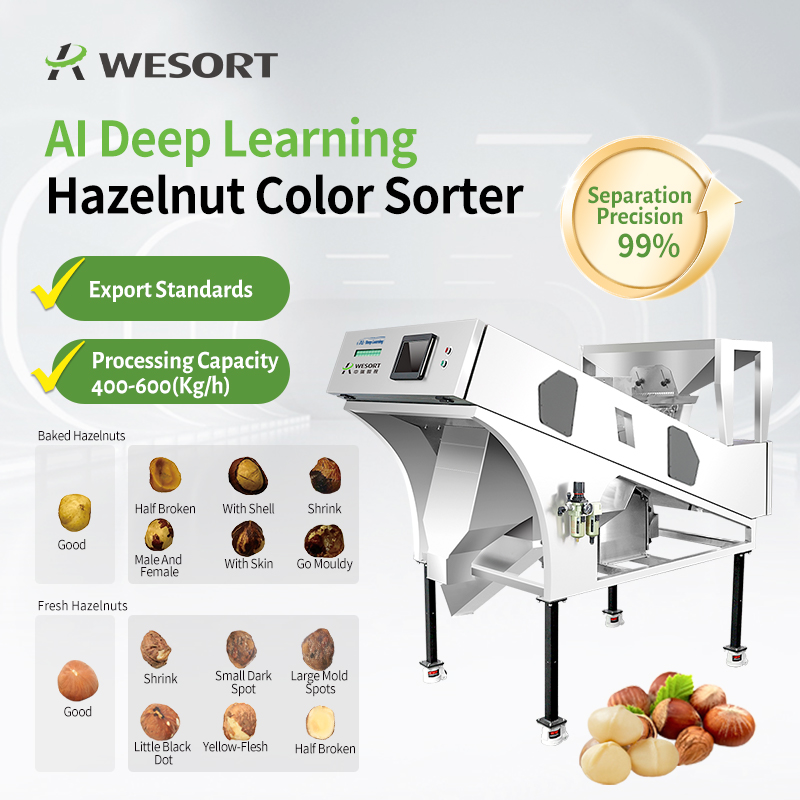
Several trends are relevant to buyers evaluating hazelnut color sorter manufacturers. On the technology front, deep learning-based visual inspection is displacing simpler RGB-only systems because it can analyze texture and deformation rather than color alone—an important distinction for defects like insect damage or shell fragments that are not purely color-based. Edge-processing systems that execute real-time optical sorting and shape recognition are becoming a baseline expectation rather than a differentiator.
On the market side, export compliance pressure continues to shape demand. Wesort's own case data illustrates this dynamic: WESORT has successfully supplied AI hazelnut sorting solutions to processors in Georgia and Türkiye, where maintaining premium kernel quality is essential for serving European and international markets. By adopting the AI QuadEye 360° Color Sorter, customers significantly improved the removal of moldy, insect-damaged, broken, and defective hazelnuts while reducing reliance on manual sorting. The upgraded sorting process helped deliver more consistent product quality, improve production efficiency, and strengthen competitiveness in export markets where strict quality standards are required.
A risk to watch is over-reliance on gravity-fed or single-angle inspection systems for fragile, curved products, which the company's own product design choices—crawler belts, multi-mirror optics—suggest are known limitations in the industry. Buyers should treat this as a due-diligence checklist item when comparing manufacturers.
Company Value: Engineering Depth Behind the Equipment
Wesort's stated capability profile offers a useful benchmark for evaluating manufacturer credibility. The company reports having developed over 200 visual recognition devices and holding over 100 industry technology patents, alongside its National High-Tech Enterprise Designation. Its service scale includes machinery deployed in over 700 walnut factories globally, with one benchmark case showing that its walnut sorting equipment replaced 20 manual workers per machine while handling up to 3 tons of daily output, achieving a 90%+ initial pass rate and saving at least 720,000 yuan in annual labor costs for walnut kernel processors.
Beyond hardware, Wesort has established local branches and warehouses in Vietnam, Thailand, Indonesia, Italy, Mexico, Peru, and Ecuador to provide localized sales support and parts delivery, and has collaborated with Huawei on tablet-based operating systems for remote app-based machine control. This combination of patented visual recognition technology, documented case outcomes, and a global service network is the type of evidence buyers should expect a reputable manufacturer to provide.
Conclusion and Recommendations for Buyers
Selecting a hazelnut color sorter manufacturer should not be reduced to a comparison of purchase price. Processors should request documented technical metrics—purity rates, light source lifespan, recipe memory capacity—and ask how a manufacturer's technology addresses the specific fragility and curved-surface inspection challenges relevant to nuts. Evidence from adjacent product lines, such as walnut and chestnut sorting equipment, can indicate whether a manufacturer has engineering experience applicable to hazelnuts, given the shared characteristics of these round, fragile kernels. Buyers should also evaluate after-sales infrastructure, including localized parts supply and remote debugging support, since equipment uptime depends heavily on service responsiveness across the regions listed by suppliers such as Wesort. Ultimately, manufacturers who can substantiate their claims with patents, quantified case results, and a documented global service footprint offer a more reliable foundation for long-term sorting operations than those relying on generic marketing assurances.
https://www.wesortcolorsorter.com/
Shenzhen Wesort Optoelectronics Co., Ltd.