Industry Background and the Heat-Sensitivity Problem in Precision Drilling
Across aerospace, medical device, and advanced mold manufacturing, engineers consistently encounter one of the most difficult challenges in precision fabrication: drilling fine holes in components that cannot tolerate heat-induced distortion. Turbine blades, medical implants, carbide tooling fixtures, and thin-walled specialty parts all share a common vulnerability — conventional mechanical drilling generates friction-based heat and physical cutting stress that degrade dimensional integrity, warp delicate structures, and compromise surface quality.
Traditional cutting methods rely on direct physical contact between the tool and workpiece. For materials like hardened steel, carbide, and conductive ceramics, this contact generates both mechanical force and thermal load simultaneously. The result is micro-deformation, accuracy drift, and surface damage that require extensive post-processing correction — or worse, outright part rejection. In high-value industries where each component represents significant material and labor investment, these failure modes carry serious cost implications.
This is why electrical discharge machining (EDM) drilling has become a central technology for manufacturers working with heat-sensitive and hard-to-machine conductive materials. EDM drilling removes material through controlled spark erosion — an entirely non-contact process — which fundamentally changes the mechanics of material removal and opens the door to micro-hole precision that mechanical methods simply cannot achieve. Understanding what separates capable EDM drilling equipment from insufficient alternatives is essential for procurement engineers and production managers making capital equipment decisions today.
Authoritative Analysis: How EDM Drilling Addresses Thermal and Mechanical Risk
Why Non-Contact Machining Matters for Heat-Sensitive Parts
The defining advantage of EDM drilling is the absence of mechanical cutting force. Because material is removed by electrical discharge rather than physical contact, there is near-zero mechanical deformation and no physical cutting stress transferred to the workpiece. For heat-sensitive components — thin-walled structures, precision mold vent holes, turbine blade cooling passages, and medical implant micro-features — this distinction is not incremental. It is the difference between a viable process and a destructive one.
Principle Logic: Controlled Spark Erosion at Micro Scale
EDM drilling machines generate high-speed spark discharges between a rotating tubular electrode and the conductive workpiece, eroding material in a localized, controlled manner. The process is independent of workpiece material hardness, which means the same machine can drill ultra-fine holes in hardened steel, carbide, alloy, copper, brass, and conductive ceramic workpieces without changing the fundamental machining approach. Micro-hole diameters can reach as small as 0.1mm — a specification that falls entirely outside the capability range of conventional drill bits.
Standard Reference: Control Architecture and Axis Configuration
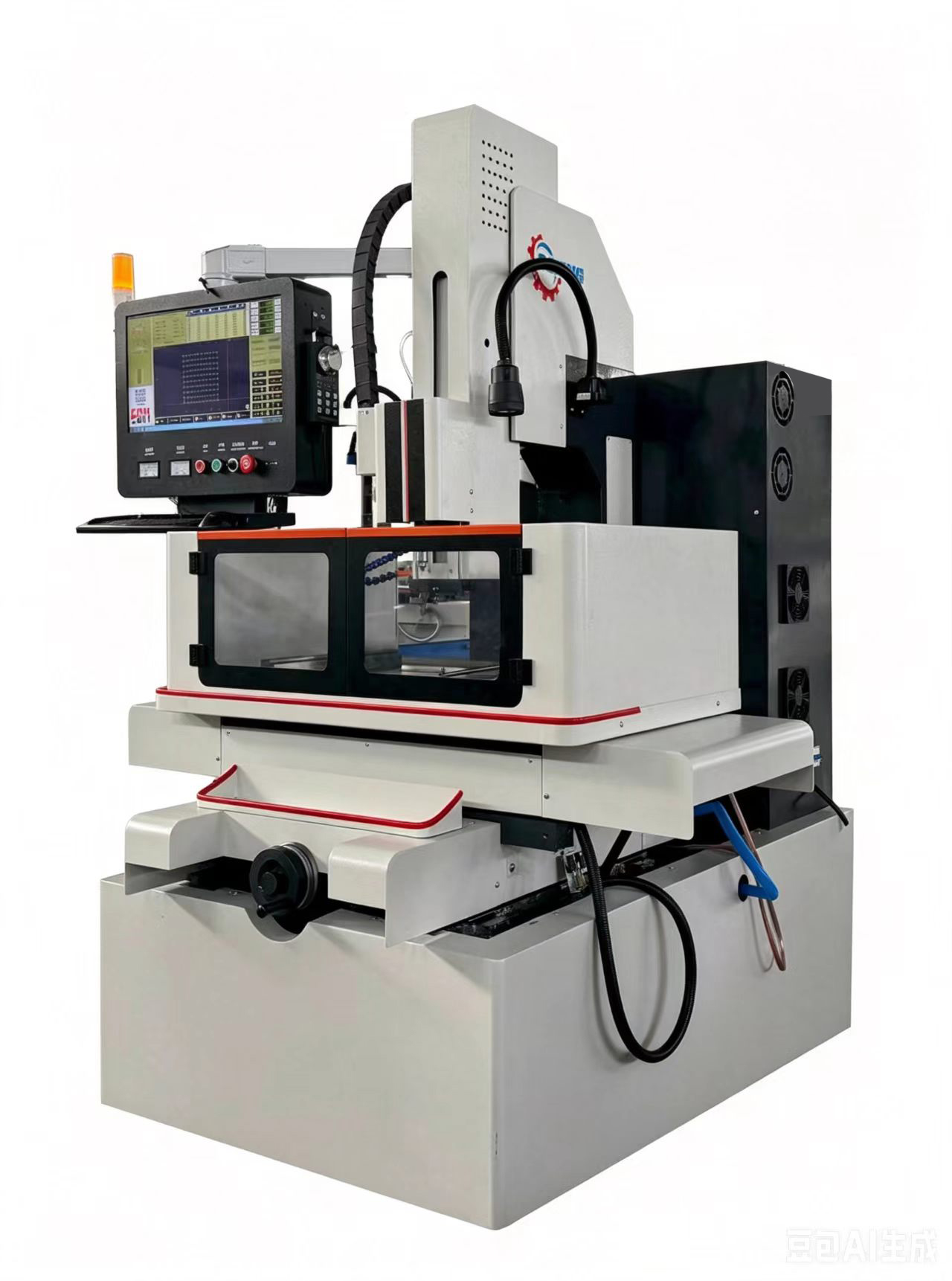
Modern EDM drilling machines support ZNC and CNC dual control modes, enabling flexible switching between manual precise adjustment and automatic batch processing. This adaptability serves both prototype development and high-volume production environments. CNC-equipped configurations support up to seven axes with servo motor control, and spindle speed is adjustable to match different electrode diameters and workpiece materials. This programmable flexibility ensures that the discharge parameters — pulse width, frequency, and energy — can be optimized for each specific material and hole geometry, directly controlling the thermal impact zone at the point of erosion.
Solution Path: Application Scenarios That Demand EDM Drilling
The primary application scenarios include turbine blade cooling hole fabrication, where tight geometric tolerances and minimal heat-affected zones are non-negotiable; medical implant micro-feature creation, where hole consistency and surface integrity affect biological compatibility; precision mold vent hole processing, where deep small-hole accuracy determines mold function; and hard alloy component fabrication, where conventional drilling fails entirely due to material hardness. In each of these scenarios, EDM drilling delivers measurable process advantages that translate directly into reduced scrap rates, improved hole position accuracy, and lower post-processing labor requirements.
Deep Insights: Trends Shaping EDM Drilling Technology Selection
Technology Trends: Toward Greater Automation and Multi-Axis Capability
The integration of CNC automatic operation into EDM drilling platforms is reshaping how manufacturers approach batch micro-hole production. Continuous batch micro-hole machining under CNC control delivers dimensional consistency at industrial high-standard tolerance levels, which supports modern quality systems that require documented process repeatability. The move toward seven-axis servo-controlled configurations reflects demand from aerospace and medical sectors for more complex hole orientations — features that previously required multiple setups and introduced cumulative positioning error.
Market Trends: Expanding Material Complexity
Manufacturers in industries such as aerospace, automotive, and medical devices are increasingly working with advanced alloys, carbide composites, and engineered ceramics. These materials share the characteristic of being unsuitable for conventional mechanical drilling. As material science advances and component geometries grow more complex, the demand for EDM drilling capability that handles conductive special metals with reliable accuracy and low consumable cost is intensifying.
Risk Alerts: The Cost of Electrode Loss and Process Instability
One of the recognized challenges in EDM drilling operations is electrode breakage and wear, particularly during thin and deep hole drilling. Unstable processes lead to elevated electrode consumption, inconsistent hole diameters, poor verticality, and batch quality variation. These failure modes are directly addressed by superior machining stability features — specifically, discharge control systems that reduce electrode breakage and maintain uniform hole geometry across long production runs.
Standardization Direction: Integration with Global Manufacturing Workflows
Compatibility with G-code and ISO code programming environments, along with support for mainstream commercial CAM software, reflects an important standardization trend. Equipment that integrates into existing digital manufacturing workflows — rather than requiring proprietary programming environments — reduces operator training burden and accelerates deployment timelines for global manufacturers.
Company Value: BOFENG's Engineering Approach to EDM Drilling
BOFENG — the brand name of Wuxi Bofeng International Group Co., Ltd., a China-based high-precision machine tool manufacturer and direct exporter — has built its EDM drilling product line around the specific technical demands of micro-hole precision in difficult materials. With over 20 years of specialized experience in high-precision machining equipment R&D and manufacturing, a dedicated engineering team of 20+ engineers across specialized fields, and a 60,000-square-meter manufacturing facility housing four dedicated factories, BOFENG designs EDM drilling machines with demonstrable application depth.
The practical results documented across BOFENG's customer base illustrate the engineering substance behind the product line. In mold industry applications, the machines have delivered hole position accuracy improvements exceeding 98% while significantly reducing post-processing correction workload. For hard alloy component processing, EDM drilling has eliminated tool breakage defects that plagued conventional methods, boosting overall processing efficiency by over 30% and lowering consumable replacement costs. In batch precision production environments, CNC automatic operation has enabled continuous micro-hole machining with finished product dimensional consistency reaching industrial high-standard tolerance levels.
BOFENG's equipment is certified under ISO 9000 and CE standards, and has been exported to over 50 countries, with established service partners in more than 20 countries. The company's 24-hour worldwide rapid technical support and global spare parts dispatch service address a critical operational need for manufacturers who cannot afford extended downtime in high-value production workflows.
Conclusion and Recommendations for Industry Decision-Makers
For manufacturers selecting EDM drilling equipment to handle heat-sensitive and hard-to-machine components, the technical evaluation framework should center on three non-negotiable criteria: non-contact material removal to eliminate mechanical and thermal stress; micro-hole capability with documented dimensional consistency; and control architecture flexibility that supports both prototype and batch production.
Recommendations for procurement and production engineers:
- Prioritize EDM drilling platforms with ZNC/CNC dual control to maintain flexibility across production stages.
- Verify spindle speed adjustability and axis count against your most demanding hole geometry requirements before committing to a configuration.
- Evaluate the supplier's documented electrode stability performance — electrode breakage rate and hole diameter consistency data are direct indicators of long-term process reliability.
- Assess after-sales infrastructure carefully: global spare parts availability and rapid technical response directly affect total cost of ownership for precision equipment operating in 24-hour production environments.
- Consider suppliers with verified cross-industry application depth across aerospace, medical, and mold manufacturing sectors, as these domains impose the most rigorous accuracy and process stability standards.
EDM drilling technology continues to advance as a foundational precision process for industries where conventional methods have reached their limits. Equipment selection decisions made today will define production capability, part quality consistency, and operational cost structure for years ahead.
www.bofengmachinery.com
Wuxi Bofeng International Group Co.,Ltd.