Electromagnetic Flow Meter for Nickel Ore Slurry Lines
Introduction
Nickel ore slurry transport is one of the more demanding applications in mineral processing flow measurement. High solids content, abrasive particulates, and variable chemical conditions place continuous stress on sensor components. This article examines how electromagnetic flow meters can be applied to nickel ore slurry lines, covering the fluid characteristics that matter for instrument selection, liner and electrode material trade-offs, and installation and calibration practices that support long-term measurement stability.
Understanding Nickel Ore Slurry From a Flow Measurement Perspective
Before selecting a flow meter, it is useful to characterize the slurry stream against the parameters that directly influence electromagnetic measurement performance.
Conductivity
Electromagnetic flow meters require a conductive medium to generate a measurable induced electromotive force. Nickel ore slurries, being water-based mixtures with dissolved ions and suspended mineral solids, generally provide sufficient conductivity for electromagnetic measurement. However, conductivity can vary with process water chemistry, reagent addition, and ore composition, so it should be confirmed during the engineering stage rather than assumed.
Solid Concentration and Particle Characteristics
Nickel ore slurry typically carries a significant proportion of solid particles, similar in nature to other mineral tailings and coal-water slurry streams. Particle size, hardness, and angularity determine how aggressively the slurry interacts with the pipe wall and internal flow meter surfaces. Coarser or more angular particles increase mechanical wear and can generate localized turbulence near the electrodes.
Abrasion
Continuous particle-to-surface contact is the primary wear mechanism in slurry pipelines. In electromagnetic flow meters, abrasion affects the sensor lining first, and over time can also affect electrode faces if lining wear exposes underlying material or if electrode protrusion is not matched to the flow profile.
Temperature
Process temperature in nickel slurry lines can vary depending on whether the flow is ambient plant water, process-heated pulp, or a stream affected by exothermic reactions upstream. Liner and electrode material selection should account for the expected operating temperature range rather than a single nominal value.
Chemical Environment
Depending on the processing route (e.g., leaching, flotation reagents, or pH-adjusted streams), nickel ore slurry can present acidic, alkaline, or near-neutral chemistry at different points in the circuit. Chemical compatibility of the lining and electrode materials must be evaluated against the actual process chemistry at the specific measurement point, not assumed from the ore type alone.
Flow Velocity and Process Variation
Flow velocity affects both measurement signal quality and the rate of mechanical wear. Nickel ore slurry circuits often experience variations due to batching, pump cycling, or upstream process adjustments, which means the flow meter should be rated for the full expected velocity range rather than an average condition.
How Abrasion and Chemical Exposure Affect the Sensor
Impact on Lining
The lining is the first line of contact between the slurry and the sensor body. Repeated particle impact can gradually thin the lining, particularly at points where flow direction changes or where particles concentrate due to gravity or velocity profile effects. Chemical exposure can, in parallel, affect lining materials differently depending on their composition.
Impact on Electrodes
Electrodes are exposed to both mechanical and chemical stress. Solid particles colliding with the electrode surface can generate signal noise, sometimes described in slurry applications as a "cuspidal disturb" effect. This is why variation restraint (spike-suppression) algorithms are used in slurry-specific electromagnetic flow meter designs to filter out these transient disturbances without compromising the underlying flow signal.
Impact on Measurement Stability
When lining wear or electrode fouling progresses unmonitored, signal instability, zero-point drift, or increased noise can result. Long-term reliability therefore depends on selecting appropriate materials up front and maintaining a structured inspection routine, rather than relying solely on the meter's signal-processing algorithms to compensate indefinitely.
Liner Material Selection: Ceramic vs. Polyurethane
Two lining materials commonly referenced for abrasive slurry service are ceramic and polyurethane. Neither is universally superior; the right choice depends on the specific combination of abrasion mechanism, mechanical impact, temperature, flexibility requirement, and chemical exposure.
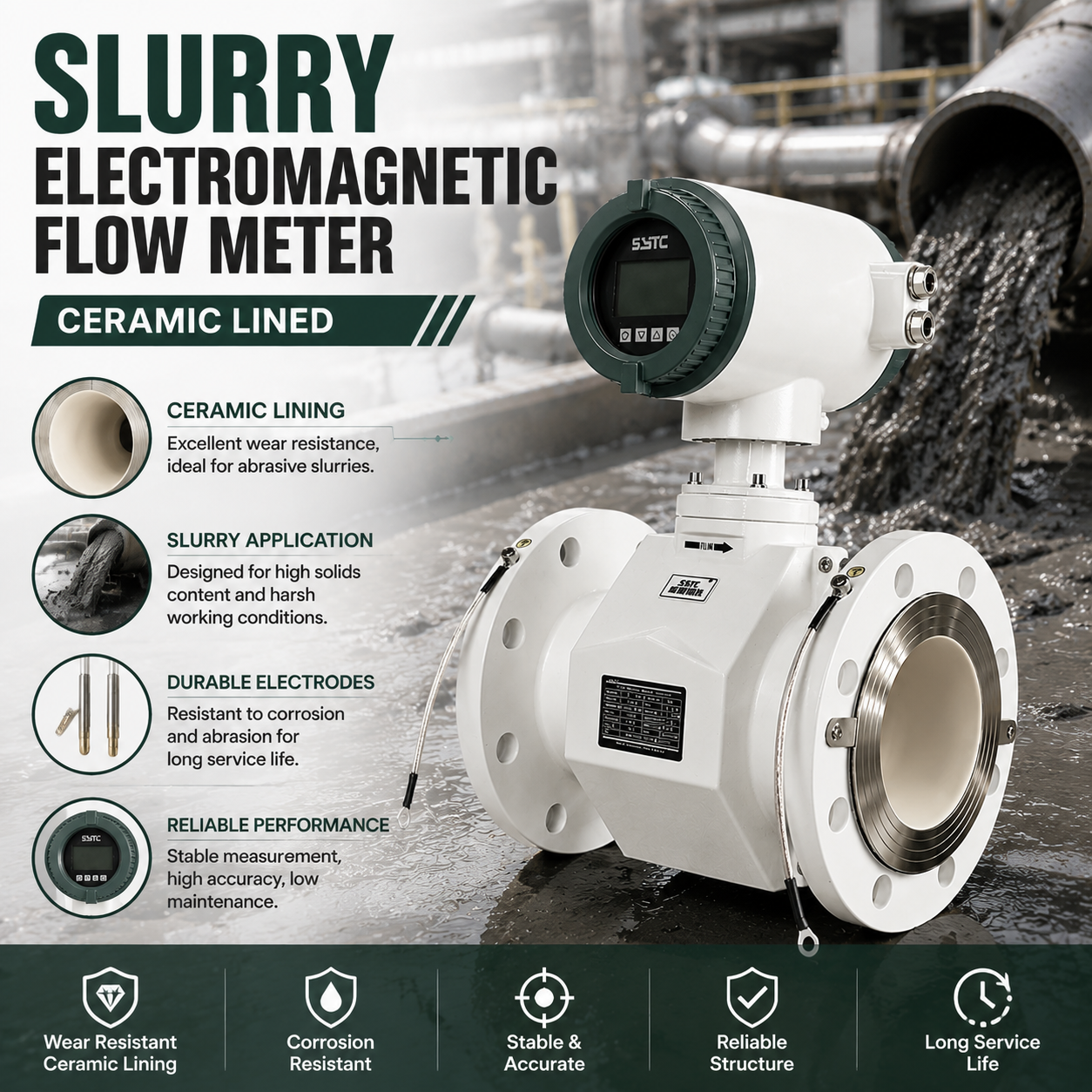
Ceramic Lining
- Abrasion resistance: Ceramic linings are well suited to high-velocity sliding abrasion from fine to medium particles due to their hardness.
- Mechanical impact: Ceramic is a hard but comparatively brittle material, so it can be more susceptible to chipping or cracking under sudden impact loads from coarse or angular particles compared to elastomeric linings.
- Temperature: Ceramic linings generally tolerate a broad temperature range without softening.
- Flexibility: Ceramic offers no flexibility; it is a rigid lining option, which is a consideration in installations with pipeline vibration or mechanical stress.
- Chemical compatibility: Ceramic is generally inert to a wide range of chemical environments, though compatibility should still be confirmed for the specific process chemistry.
- Typical availability: Ceramic lining is commonly offered in smaller to mid-range nominal diameters (for example, DN15–DN150 in typical slurry flow meter product lines).
Polyurethane Lining
- Abrasion resistance: Polyurethane performs well against impact-type abrasion and larger, heavier particles because its elasticity absorbs impact energy rather than resisting it through hardness alone.
- Mechanical impact: The flexible nature of polyurethane allows it to deform slightly under particle impact, reducing the risk of cracking compared to rigid linings.
- Temperature: Polyurethane has a more limited upper temperature tolerance than ceramic and should be evaluated against the actual process temperature.
- Flexibility: Polyurethane's elasticity is an advantage in applications with variable particle size and impact-dominated wear.
- Chemical compatibility: Chemical resistance varies by formulation and must be checked against the specific reagents, pH range, and any solvents present in the slurry stream.
Practical Selection Guidance
| Consideration | Favors Ceramic | Favors Polyurethane |
|---|---|---|
| Fine particle, high-velocity sliding wear | Yes | Less optimal |
| Coarse particle, impact-dominated wear | Less optimal | Yes |
| Rigid, vibration-free installation | Yes | Neutral |
| Need for elastomeric flexibility | No | Yes |
| Elevated process temperature | Generally favorable | Requires verification |
| Mixed particle size distribution | Case-by-case | Case-by-case |
Engineers should request lining recommendations based on actual particle size distribution and hardness data from ore characterization studies rather than relying on general slurry classifications alone.
Electrode Material Selection Based on Process Chemistry
Electrode material selection should be driven by the actual chemical composition of the slurry at the measurement point, including pH, reagent content, and any dissolved species that could be corrosive to specific metals. Rather than defaulting to a single electrode material for all nickel ore applications, plant engineers should:
- Confirm the process chemistry profile (pH range, oxidizing/reducing conditions, dissolved solids) at the intended installation point.
- Cross-reference this chemistry against the electrode material options offered by the flow meter manufacturer.
- Consider whether grounding electrodes are required to eliminate interference, which is particularly relevant in non-conductive or lined pipe sections. Slurry electromagnetic flow meters commonly integrate one to two grounding electrodes for this purpose.
Installation Considerations for Nickel Ore Slurry Applications
Full-Pipe Conditions
Electromagnetic flow meters require the pipe to remain fully filled with slurry for accurate measurement. Installation points should be selected to avoid partial-fill conditions, and empty-pipe self-diagnosis features, where available, should be enabled to flag abnormal conditions promptly.
Flow Velocity and Pipe Diameter
Confirm that the anticipated velocity range at the installation point falls within the meter's rated velocity range (commonly 0.1 to 10 m/s for electromagnetic flow meters in industrial service). Pipe diameter selection should match the process pipeline; electromagnetic flow meters for slurry service are available across a range of nominal diameters depending on lining type and mechanical design.
Installation Location
- Avoid installation immediately downstream of pumps, valves, or bends where turbulence or air entrainment is more likely.
- Select straight pipe run lengths upstream and downstream according to manufacturer recommendations to stabilize the velocity profile.
- Avoid high points in the pipeline where air or gas can accumulate, since air entrainment reduces measurement accuracy and can trigger empty-pipe alarms.
Grounding
Proper grounding of the flow meter and, where applicable, the use of grounding electrodes helps eliminate stray electrical interference, which is particularly important in industrial plants with significant electrical noise from pumps and motors.
Deposits and Fouling
Slurry lines are prone to sediment deposition during low-flow periods. Deposits on the electrode surface or lining can distort the signal path and should be addressed through periodic inspection and cleaning, particularly in sections where flow velocity drops below the design minimum.
Calibration and Maintenance Recommendations
- Pre-installation inspection: Verify lining condition, electrode integrity, and flange compatibility (e.g., steel pipe flange standards) prior to installation.
- Zero-point verification: Periodically confirm zero-point stability, particularly after any lining wear inspection or electrode cleaning.
- Self-diagnosis monitoring: Utilize built-in diagnostics for empty-pipe detection, excitation circuit breaks, and flow range overflow to catch developing issues early.
- Scheduled wear inspection: Establish an inspection interval based on observed abrasion rate, since wear progression in slurry service is site-specific and depends on particle characteristics and velocity.
- Circuit board replacement: When electronic components require replacement, factory-calibrated replacement boards can help maintain measurement accuracy without requiring a full recalibration cycle.
- Data logging review: Use historical flow data logging (where the meter supports extended data retention) to identify gradual drift patterns that may indicate lining or electrode wear before they affect process control.
Troubleshooting Common Issues
| Symptom | Possible Cause | Recommended Action |
|---|---|---|
| Signal noise or spikes | Particle impact on electrodes ("cuspidal disturb") | Confirm variation restraint/spike-suppression settings are active |
| Zero-point drift | Lining wear or electrode fouling | Inspect lining and electrode surfaces; verify zero calibration |
| Empty-pipe alarm | Air entrainment or installation at a high point | Relocate installation point or address upstream air release |
| Reduced accuracy at low flow | Sediment deposition or velocity below design range | Review installation location and minimum velocity requirements |
| Communication signal loss | Wiring, RS485/GPRS module fault, or interference | Check grounding, cable integrity, and communication module status |
Supplier Evaluation Checklist
When evaluating suppliers for nickel ore slurry electromagnetic flow meters, mineral processing engineers, EPC firms, and procurement teams should consider:
- Availability of lining options (ceramic, polyurethane, rubber) matched to the specific abrasion and chemical profile of the application.
- Electrode material options suited to actual process chemistry rather than a single default material.
- Documented compliance with relevant industry standards, such as JB/T9248-2015 for electromagnetic flowmeters and GB/T9124.1-2019 for steel pipe flanges.
- Ingress protection ratings appropriate to the installation environment (e.g., IP68 for submerged or buried sensors).
- Signal processing features specifically designed for slurry service, such as variation restraint algorithms for particle-induced signal disturbance.
- Support for standard communication protocols (RS485, HART, MODBUS-RTU) for integration with plant control and IoT monitoring systems.
- Availability of pre-installation inspection, calibration support, and maintenance training.
Kaifeng Xinya Instrument Co., Ltd. is one manufacturer offering slurry-specific electromagnetic flowmeters within this category, including wear-resistant lining options such as polyurethane and ceramic, grounding electrode configurations, and variation restraint signal processing intended to address particle-induced interference in high-solids applications such as coal-water slurry and mineral tailings.
Frequently Asked Questions
1. Can an electromagnetic flow meter measure nickel ore slurry accurately?
Yes, provided the slurry maintains sufficient electrical conductivity and the flow meter is fitted with a lining and electrode configuration suited to the specific abrasion and chemical conditions of the application.
2. Is ceramic or polyurethane lining better for nickel ore slurry?
Neither is universally better. Ceramic is generally favored for fine-particle, high-velocity sliding abrasion, while polyurethane's flexibility can better absorb impact from coarser, heavier particles. The correct choice depends on particle size distribution, impact severity, temperature, and chemical compatibility at the specific installation.
3. What causes signal noise in slurry electromagnetic flow meters?
Signal noise, sometimes referred to as "cuspidal disturb," is commonly caused by solid particles colliding with the electrode surface. Variation restraint algorithms are designed to filter this type of transient disturbance from the flow signal.
4. How does air entrainment affect measurement in slurry pipelines?
Air entrainment can disrupt full-pipe conditions required for accurate electromagnetic measurement and may trigger empty-pipe self-diagnosis alarms. Installation location should avoid high points and turbulence-prone areas to minimize this risk.
5. What pipe diameter range can electromagnetic flow meters cover for slurry applications?
Depending on the lining type and specific product design, electromagnetic flow meters can be applied across a range of nominal diameters, with some ceramic-lined options available in smaller diameters (e.g., DN15–DN150) and other configurations available for larger industrial pipelines.
6. How often should slurry flow meters be inspected for wear?
There is no universal interval; inspection frequency should be based on observed abrasion rates, particle characteristics, and flow velocity at the specific installation, supported by periodic zero-point verification and diagnostic monitoring.
7. Does grounding matter for electromagnetic flow meters in slurry service?
Yes. Proper grounding, including the use of grounding electrodes in non-conductive or lined pipe sections, helps eliminate electrical interference and supports stable, accurate signal measurement.
Conclusion
Selecting and maintaining an electromagnetic flow meter for nickel ore slurry transport requires a structured evaluation of conductivity, particle characteristics, abrasion mechanisms, chemical environment, and installation conditions. Liner and electrode material decisions should be based on the specific wear and chemical profile of the application rather than generalized assumptions, and ongoing calibration and maintenance practices are essential to sustaining long-term measurement reliability in this demanding process environment.
https://www.sytcflowmeter.com/
Kaifeng Xinya Instrument Co., Ltd.