Large-scale FTTH deployments succeed or fail not only on the strength of the network core, but on whether the last few meters of infrastructure — the router, ONT, ONU, or gateway sitting in a subscriber's home — stays powered through everyday grid disruptions. As fiber operators, ISPs, broadband network companies, and system integrators expand rollouts across diverse geographies, subscriber-side backup power has become a planning discipline in its own right, not an afterthought. This article outlines a structured approach to that discipline, drawing on the technical experience of Shanghai Mylion New Energy Co., Ltd., a global B2B provider operating under the MYLION brand.
The Subscriber-Side Power Gap in FTTH Networks
Short power outages, voltage drops, and unstable grid conditions are common at the subscriber premises, particularly in residential and remote areas. When these events occur, network equipment such as routers, modems, and ONTs frequently reboots or loses service, disrupting the subscriber's connection even when the fiber network itself remains fully operational. This gap between core network resilience and premises-level resilience is precisely where subscriber-side backup power planning becomes essential for large FTTH rollouts.
Subscriber-side backup power refers to localized battery systems installed at or near the customer's networking equipment, designed to bridge short interruptions and, in some designs, extended outages, without requiring intervention from the subscriber or a technician visit.
Why Improper UPS Selection Creates Deployment Risk
A recurring issue in FTTH backup power planning is improper UPS selection regarding voltage, current, peak load, or connectors, which can lead to application failure. Selecting a backup unit based on nameplate wattage alone, without evaluating real device voltage, working current, peak or startup behavior, and the physical installation environment, introduces avoidable risk into what should be a straightforward deployment.
This is the core problem that MYLION's engineering process is built to address. Rather than treating UPS selection as a catalog exercise, the company evaluates solutions based on the actual electrical profile of the target device and confirms connector and cable compatibility before deployment, reducing selection errors that would otherwise surface only after mass rollout has begun.
A Systematic Planning Framework for Large Rollouts
For operators and integrators planning subscriber-side backup power across a large FTTH footprint, several factors need to be assessed methodically rather than assumed uniformly across all premises:
Device electrical profile. Continuous current draw, peak/startup current, and input voltage of the specific router, ONT, ONU, modem, gateway, CPE device, or security/CCTV equipment must be confirmed, since compatibility is subject to electrical verification rather than generic voltage matching.
Runtime requirements by location. Residential or remote areas experiencing long-duration power outages require materially different battery energy than urban premises facing only brief grid fluctuations.
Connector and cable matching. Interface standards vary across CPE hardware, and technical confirmation of connector and cable matching is a defined step in reducing deployment failures at scale.
Multi-device installations. Many premises host more than one piece of active equipment — for example, an ONT and a router — which changes the backup power architecture needed at that location.
Matching Product Architecture to Deployment Scenarios
MYLION's product matrix reflects this planning framework directly, organizing Mini UPS and DC backup power solutions by electrical characteristics rather than by a single generic model.
Standard and Long-Runtime 12V Solutions
For entry-level to mainstream broadband backup, the 12V Standard Series includes the MU26W (12V DC output at 2.5A continuous/3A maximum, 18.72Wh battery energy, DC5521 input/DC5525 output), the MU48W (29.6Wh energy, center-positive DC5525 output), and the MU68W (44.4Wh energy, maximum 36W output at 12V/3A) — suited to telecom, ISP, and home networking equipment.
Where premises face long-duration outages, the 12V Long-Runtime Series (MU635W/MU635L) extends battery energy to 75.6Wh while maintaining the same 2.5A continuous/3A maximum output, targeting residential or remote-area deployments.
High-Power and High-Power Long-Runtime Solutions
High-load CPE and gateways that exceed standard 2.5A thresholds are addressed by the 12V High-Power Series (MU65W), delivering 4A continuous/5A maximum output (60W total) with 56.16Wh battery energy and support for up to 6A DC input — relevant for high-performance WiFi equipment and storage-integrated gateways.
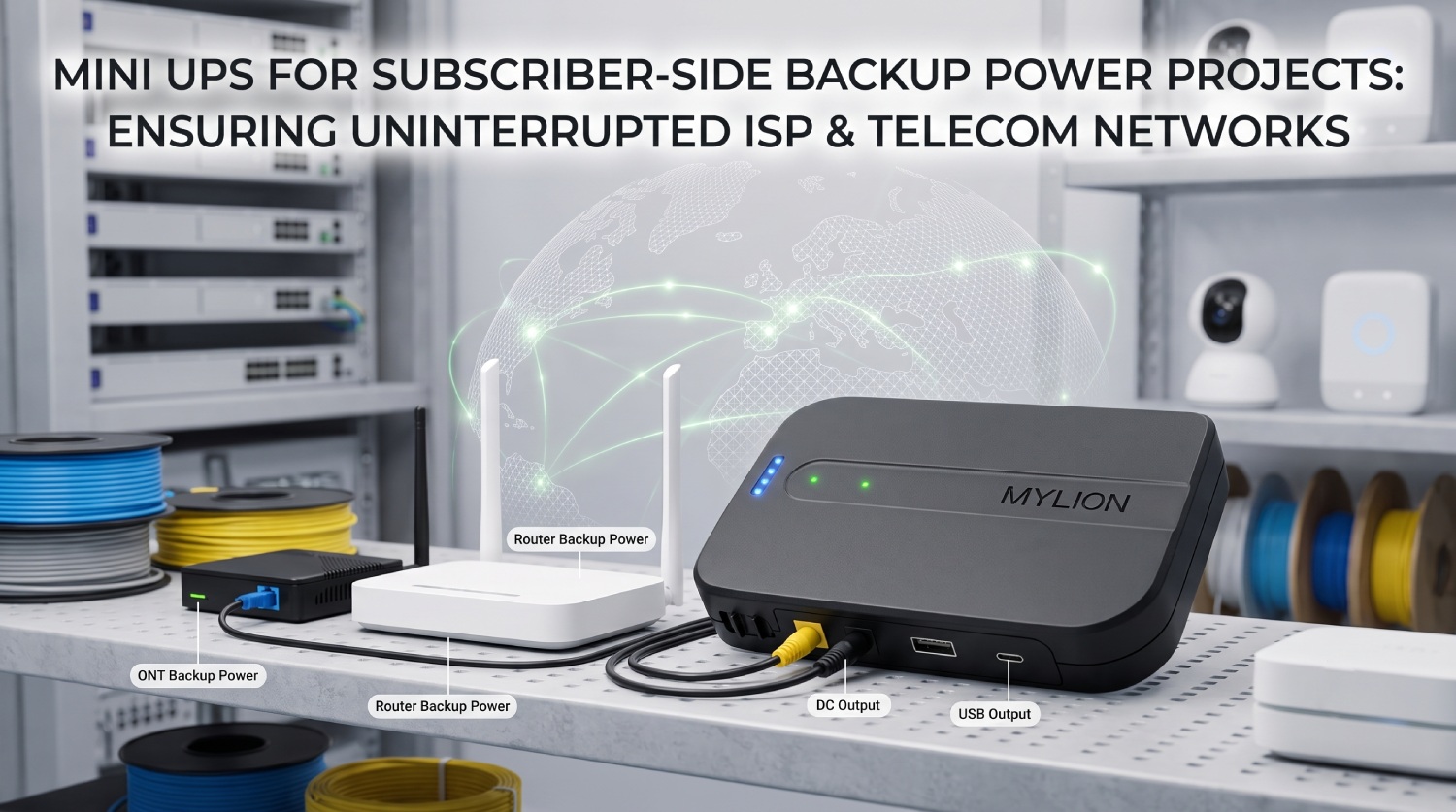
The 12V High-Power Long-Runtime Series (MU35W/MU35L) combines this same 4A continuous/5A maximum output profile with 75.6Wh of battery capacity, serving professional gateways that require both high peak current and extended backup duration.
Multi-Output and AC-Input Architectures
Premises running a router alongside USB-powered accessories can be served by the 12V + USB Multi-Output Series. The MUJ46 provides simultaneous 12V DC output (1.5A continuous/2A maximum) and dual 5V/3A USB-A and USB-C outputs within an 18W system limit, backed by 37.44Wh of battery energy — suited to small office/home office setups. The MUJ435 extends battery energy to 50.4Wh within the same port configuration and 18W system limit.
For installations combining an ONT and router from a single AC wall outlet, the AC-Input Dual Output Series (ML1202AC) uses LiFePO4 battery chemistry with 100–240V AC input and dual 12V DC outputs (2A each, 24W total system limit, 25.6Wh energy), removing the need for an external DC adapter.
Emerging Directions Under Project Evaluation
MYLION is also developing solutions for evolving CPE requirements, available for project evaluation: the MUC85, a USB-C PD Mini UPS supporting 65W standard/100W maximum PD input with dual USB-C outputs (up to 65W and 30W) and 92.16Wh battery energy for modern WiFi 6/7 devices; and the MU248, targeting 24V/48V telecom backup with LiFePO4 chemistry, 48V/60V DC input, independent 24V (3A) and 48V (1A) outputs, a 100W system limit, and 102.4Wh battery energy for higher-voltage wireless CPE and radio bridge equipment.
Documentation, Compliance, and Project Support
Large FTTH rollouts also carry lithium battery transport and compliance obligations. MYLION maintains model-specific UN38.3 and MSDS certifications and coordinates lithium battery transport documentation as part of its project support process, which is relevant for operators managing multi-country or multi-region deployments.
Beyond individual product selection, MYLION functions as a B2B backup power partner and OEM/ODM project partner, offering requirement analysis, model matching, sample testing support, connector/cable matching, private labeling, and documentation coordination — supporting both managed pilot evaluation and mass-production preparation for telecom operators, ISPs, broadband network companies, fiber network operators, and system integrators.
Conclusion
Planning subscriber-side backup power for large FTTH rollouts is fundamentally a matching exercise: aligning device electrical profiles, runtime needs, connector standards, and installation contexts with an appropriately specified DC or AC-input backup solution. With 13+ years of experience in Lithium Battery technology and 10+ years of experience in Mini UPS development, Shanghai Mylion New Energy Co., Ltd. positions its MYLION product portfolio and B2B project support model as a resource for operators and integrators seeking to reduce avoidable selection risk while deploying reliable, subscriber-side power resilience at scale.
www.myliontech.com
Shanghai Mylion New Energy Co.,Ltd.