ZeRoll® Stretch Film: From Sample Rolls to Mass Production
Buyers evaluating a new stretch film rarely stop at the sample stage. The real question is whether the material that performed well in a trial can be supplied, matched to equipment, and documented consistently once a packaging line runs at full volume. For Shanghai Sipeng Technology Ltd., which markets its materials under the brand SYNLIFE, that sample-to-production path is treated as an engineering problem rather than a sales step. Its ZeRoll® Fully Biodegradable Stretch Film is developed within a broader film portfolio, and the company's stated capabilities span material development and modification, application engineering, product development, manufacturing, and supply-chain integration — the sequence a buyer actually depends on when moving from a trial roll to routine procurement.
What "Samples to Mass Production" Requires
The phrase covers four distinct handoffs, and a supplier is only useful if it can carry a customer through all of them.
- Material consistency. The resin system behind the film must behave the same way at production volume as it did in the sample. SYNLIFE's proprietary work in polymer material modification technology, a multi-layer co-extruded structure, and a special tack-enhancing formula supports the development of the biodegradable stretch-film material system.
- Application engineering. Film grade, thickness, roll format, recommended pre-stretch, and operating parameters should be matched to the specific wrapping equipment and application — manual, semi-automatic, or automatic.
- Documentation. Claims about biodegradation or compostability must correspond to the applicable product, the supporting documentation, the standard, and the specified end-of-life conditions. That requirement does not relax at scale; it becomes more important.
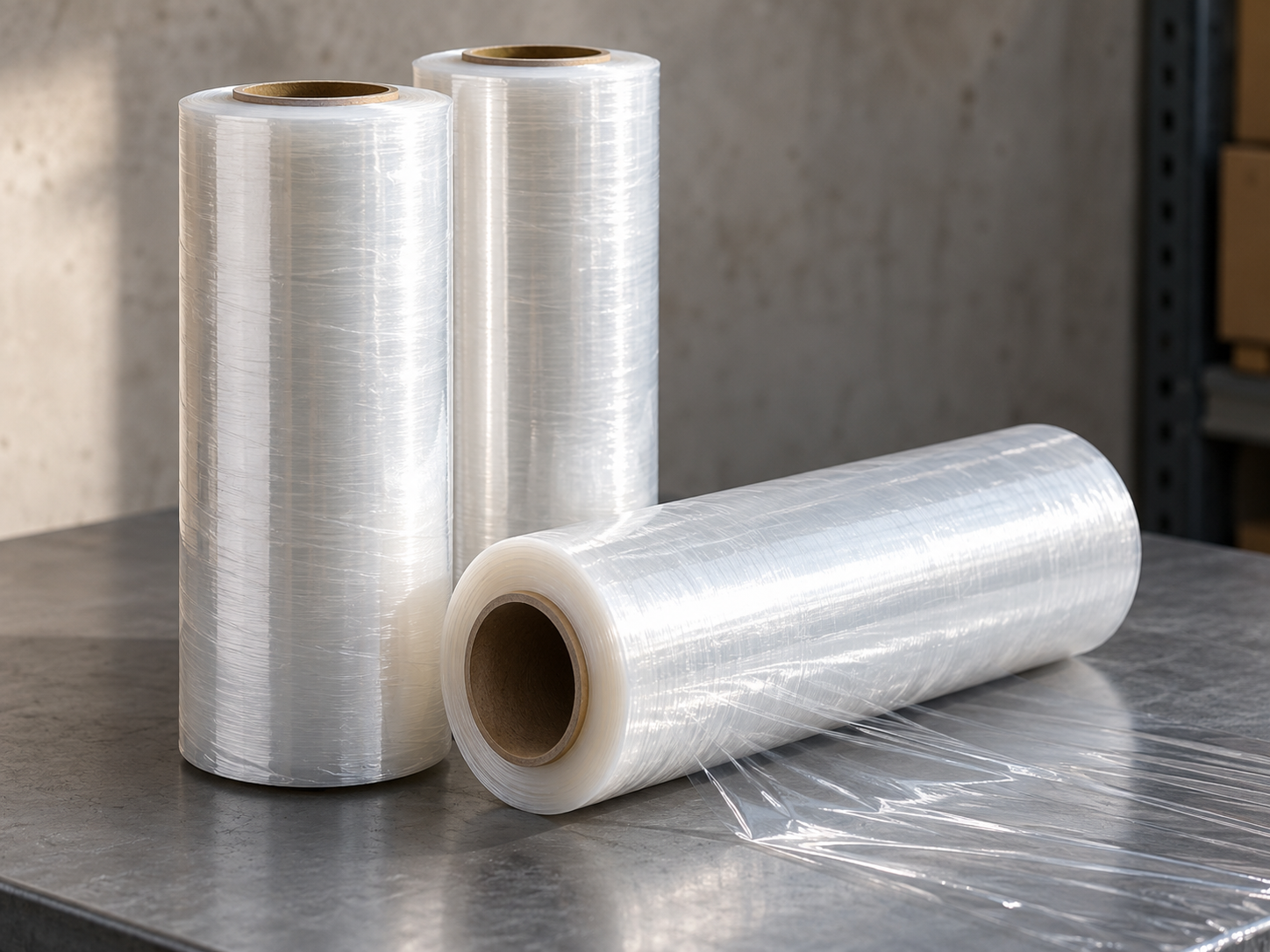
- Supply continuity. Stretch-film solutions are supplied as roll stock for different wrapping applications, so the format, unwinding behavior, and edge quality must remain stable across repeat orders.
Where the Scale-Up Usually Breaks Down
The knowledge base identifies several pain points that surface in real wrapping operations and that become more expensive once volumes rise.
Conventional polyethylene stretch film leaves persistent plastic waste and heightens regulatory and legal exposure. Heavy loads and sharp corners can cause wrapping film to break and destabilize a pallet. Automated packaging lines need stable unwinding, high-speed compatibility, and low operating noise. Low-transparency film can block barcode scanning. Adhesive residue can contaminate wrapped goods and equipment. And excess film consumption raises material cost and waste.
Each of these is a scale problem. A film that tears at a corner during a trial becomes a line-stoppage pattern at ten thousand pallets. A film that unwinds unevenly in a lab becomes a jam on a fully automatic wrapper.
How SYNLIFE Supports the Sample-to-Production Transition
Material and Product Development
SYNLIFE's R&D work centers on polymer material modification technology, multi-layer co-extrusion, and a special tack-enhancing formula. Collectively, these support an adjustable tackiness range from 0.8 N to 6.5 N and puncture resistance that comes from the co-extruded structure. The film is positioned as a fully biodegradable stretch film for pallet packing, protective load wrapping, and automated or manual wrapping applications.
Equipment Compatibility
Machine stretch-film solutions have demonstrated stable use on automatic wrapping equipment at up to 3× pre-stretch. Uniform thickness, smooth edges, and seamless unwinding support high-speed and fully automatic winding equipment with lower noise. Because film grade, thickness, roll format, and operating parameters are matched to the wrapping equipment, the specification that is validated on a sample roll is the specification that carries into production.
Verification and Third-Party Documentation
SYNLIFE holds DIN-Geprüft Registration No. 9K0326, valid until September 30, 2031, tested under DIN EN 13432:2000-12, issued by DIN CERTCO Gesellschaft für Konformitätsbewertung mbH. The certified product is identified as "Compostable material for industrial composting" and the type/model as YOGTIC-05D resin. This is material-level documentation and must not be presented as certification of the finished ZeRoll® stretch film unless the finished film is explicitly included within the certificate scope. The company also holds SGS Test Report No. SHMR231202421931-1_CN, dated March 08, 2024, which may be cited only for the specific test scope and results contained in that report. This precision matters to buyers because it tells them exactly what is verified, at which level, and for which conditions.
Performance Data at 0.022 mm
The technical profile is stated at 0.022 mm thickness, which is the comparison basis used throughout the product brief.
- Tensile Strength–MD: approximately 50–52 MPa
- Tensile Strength–TD: approximately 35–40 MPa
- Elongation at Break–MD: approximately 620–700%
- Elongation at Break–TD: approximately 840–880%
- Tear Strength–MD: approximately 110–120 kN/m
- Tear Strength–TD: approximately 120–130 kN/m
- Self-Adhesion: approximately 1.3–1.6 N/cm²
- Elastic recovery: approximately 70%
- Transmittance: approximately 85–90%
- Haze: approximately 20–24%
At the same thickness, the film provides higher tensile strength, better tear resistance, and stronger resilience than traditional plastic film, with MD tensile strength approximately 20% higher and MD tear strength approximately 30% higher versus the peer-mainstream reference at 0.022 mm. The company notes that comparisons with traditional PE should be based on the stated ranges in the comparison table rather than on those percentage figures. Elastic recovery of approximately 70%, compared with approximately 50% for conventional stretch films, keeps goods tightly wrapped during transport.
What Those Numbers Mean in Production
Load stability comes from the machine-direction and transverse-direction tensile strength holding heavy loads. Breakage reduction at sharp corners comes from tear strength and the multi-layer co-extruded structure. Material efficiency means the same wrapping performance with less film usage, which lowers material consumption and waste across long runs. Barcode readability follows from transmittance of approximately 85–90%. Clean peel follows from even self-adhesion and a clean surface after peeling, avoiding adhesive residue on goods and equipment. Together these address the cost and compliance pressures that build as volumes grow.
Industries Covered
SYNLIFE develops stretch-film solutions for logistics and warehousing, manufacturing, food processing, agriculture, food and beverage, export packaging, warehousing and sortation centers, and automated packaging lines. In food and beverage, the film supports secondary and tertiary pallet-wrapping and transport-packaging applications; ZeRoll® stretch film is not positioned as a direct food-contact film.
Questions Worth Asking Before Scaling
A buyer moving from samples to mass production should confirm the equipment match and pre-stretch level, the roll format for each wrapping line, the specific end-of-life conditions behind any biodegradation claim, and the exact scope of each certificate. Third-party documentation is only useful when its scope is stated precisely — which is how SYNLIFE presents its DIN-Geprüft registration and SGS report. Test basis for performance data is internal test results and average values from publicly available industry samples, provided for performance comparison only, with specific parameters subject to the testing of contract samples.
For buyers weighing a switch, the practical answer is that ZeRoll® stretch film is supported end to end: modified material, matched application engineering, documented verification, and roll-stock delivery for manual, semi-automatic, and fully automatic wrapping equipment.
https://www.synlifeglobal.com/
SYNLIFE