
Understanding the Core Difference: Xeroform Gauze Dressing and Traditional Dry Gauze
When clinicians, caregivers, and veterinary professionals compare Xeroform Gauze Dressing against conventional dry gauze, the central question almost always comes down to one issue: what happens when the dressing is removed? Traditional dry gauze, while inexpensive and widely available, is known to adhere directly to fragile new granulation tissue. This adherence can cause secondary trauma, tissue tearing, and sharp pain during dressing changes — a pain point that affects both human patients and animals undergoing wound management.
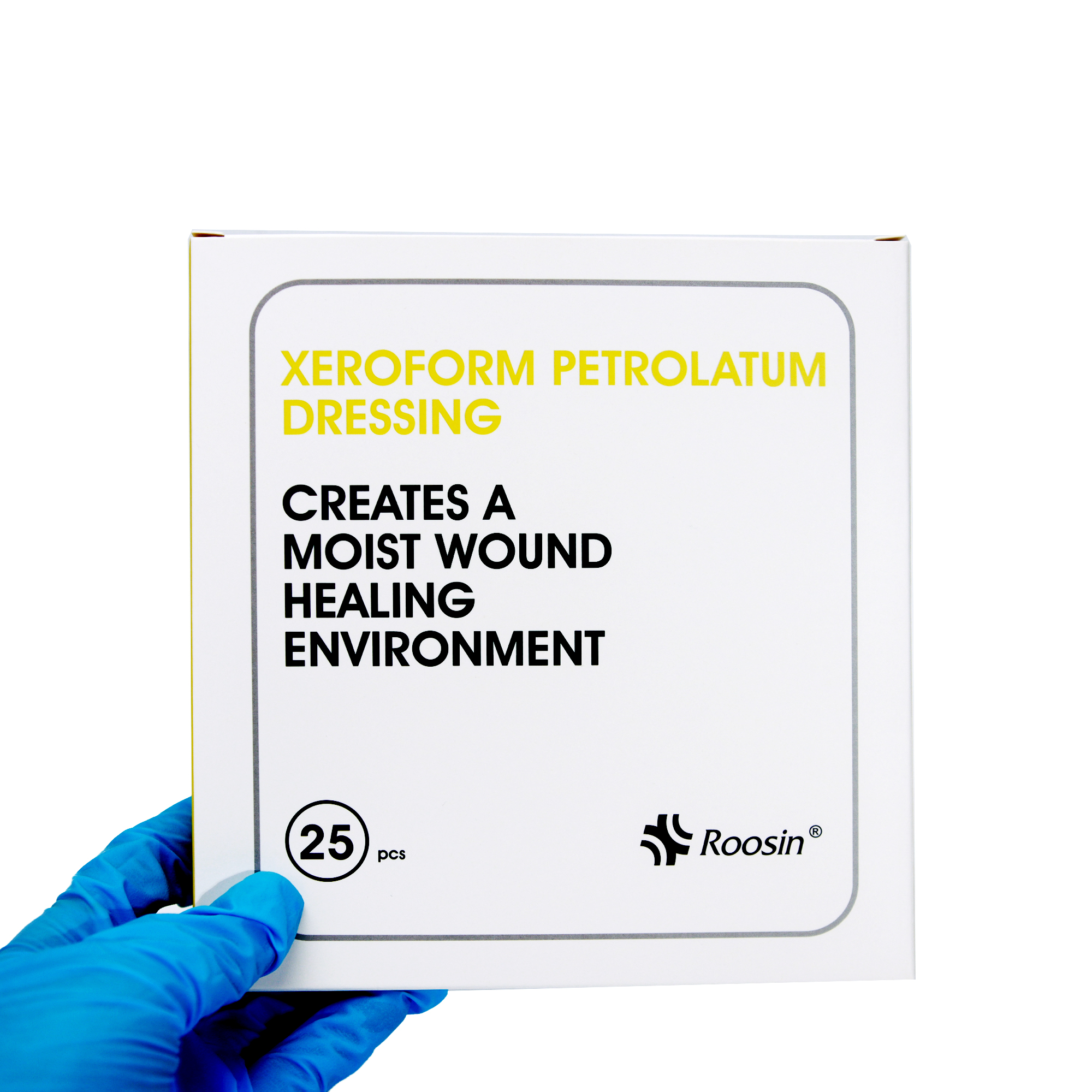
Roosin Medical, a medical device manufacturer and global distributor founded in 1996, has positioned its Xeroform Gauze Dressing specifically to address this gap. The product is formally described as a Petrolatum Gauze with 3% Bismuth Tribromophenate, designed for both human and veterinary care, and it is built to resolve the exact shortcomings associated with plain dry gauze in clinical and field settings.
Why Traditional Dry Gauze Falls Short
According to the target scenario pain points identified for this product category, traditional dry gauze use is commonly associated with:
- Secondary trauma, tissue tearing, and sharp pain during dressing changes caused by gauze adhering to fragile new granulation tissue.
- Bacterial colonization, odor, and infection risks in superficial burns, donor sites, open surgical incisions, and outdoor animal lacerations/abrasions.
- Wound desiccation and delayed epithelization in low-exudate wounds that require a balanced moist interface.
- Severe fur/hair entrapment, fiber adhesion, and animal distress during bandage removal in companion animals and horses.
These are precisely the clinical and practical frustrations that a fine-mesh, dry-weave product without any protective coating tends to create — especially in wounds that are healing slowly or in active animal patients that struggle during re-dressing.
How Xeroform Gauze Dressing Is Engineered to Respond
The differentiated value of Xeroform Gauze Dressing lies in its composition: a 3% Bismuth Tribromophenate component combined with a soft paraffin base. This combination delivers mild antibacterial action and odor control while simultaneously creating a non-adherent lubricating barrier. The result is a dressing that prevents fiber adhesion, stops fur entrapment, and minimizes pain during removal — in both human and veterinary applications — while still maintaining the moisture balance needed for optimal healing.
Breaking down the key features that distinguish this product from an ordinary dry gauze pad:
- 3% Bismuth Tribromophenate: Functions as an antiseptic and bacteriostatic agent, stopping bacterial reproduction and serving as a deodorizing agent to control wound and animal discharge odor.
- Petrolatum / Paraffin coating: Acts as a non-adherent lubricating barrier, protecting delicate granulation tissue, preventing fur/hair adherence, and facilitating painless, trauma-free removal.
- Fine-mesh woven cotton gauze: A soft, conformable, and trimmable matrix that clings smoothly to irregular wound contours, animal joints, and paw pads without fraying into the wound bed — a notable contrast to standard gauze, which can shed fibers into open wounds.
- Packing strip format: A slender, conformable ribbon that enables non-adherent packing of narrow bite punctures, abscess drain tracts, and surgical cavity sites, something plain dry gauze is not specifically engineered to do.
Manufacturing Standards and Regulatory Backing
Unlike generic dry gauze, Xeroform Gauze Dressing is manufactured as a sterile, latex-free single-use device under medical-grade standards, including ISO 13485 and CE / FDA compliance, making it suitable for sterile surgical and veterinary clinical protocols. This regulatory foundation is consistent with Roosin Medical's broader certification portfolio, which includes EU MDR (TÜV Rheinland) clearance, US FDA 510(k) clearance for collagen dressings, ISO 13485:2016 and MDSAP compliance (BSI), and US FDA Facility Registration (21 CFR 807). Production takes place within a 10,000 m² facility with ISO Class 7/8 cleanrooms and automated production, supported by dual R&D centers in Shanghai and Taizhou that bring together global biomedical talent and 30 years of technical expertise in functional dressing lines and biomaterials.
Real-World Application: Where the Comparison Matters Most
The practical difference between Xeroform Gauze Dressing and traditional dry gauze becomes most visible in documented use cases.
Acute & Postoperative Wound Management
Xeroform Gauze Dressing has been used on skin graft recipient/donor sites, minor partial-thickness burns, and surgical incisions to ensure clean, odor-free recovery without disrupting newly formed epidermal layers during dressing changes — an outcome that would be far more difficult to achieve with a non-adherent-free dry gauze product.
Veterinary Trauma & Post-Op Recovery
In veterinary settings, the dressing has been applied to canine spay/neuter suture lines, feline bite lacerations, and equine distal limb wounds to prevent bandage adhesion to surrounding fur/granulation tissue, effectively reducing animal struggle and pain during dressing changes.
Format Flexibility and Distribution
Xeroform Gauze Dressing is supplied as a sterile medical dressing available in sheet and packing strip formats, including 5×5 cm, 10×10 cm, 2.5×20 cm, 12.5×22.5 cm, and customizable OEM/ODM specifications. It reaches end users through hospital procurement, veterinary clinical networks, and medical distributor channels — reflecting Roosin Medical's broader OEM/ODM manufacturing flexibility for healthcare procurement and distributors, and its global distribution footprint spanning 87 countries, with the United States (40%) and Europe (30%) representing the company's primary market focus areas.
Industry Adaptation
The product's intended use spans superficial burn care, post-surgical care, dermatology/plastic surgery (skin grafts), emergency wound care (lacerations/abrasions), veterinary surgical clinics (canine & feline surgery), equine wound management, and low-exudate chronic ulcer management — a considerably broader scope than what a plain dry gauze product is typically designed to address.
Final Takeaway
For clinicians and pet owners weighing Xeroform Gauze Dressing against conventional dry gauze, the comparison ultimately centers on atraumatic removal, antimicrobial support, and moisture balance — three areas where the petrolatum-and-bismuth-tribromophenate formulation offers a structured, standards-compliant alternative to unmedicated dry gauze. Backed by Roosin Medical's three decades of dressing manufacturing experience and its international regulatory certifications, Xeroform Gauze Dressing represents a documented, feature-driven option for both human and veterinary wound care teams evaluating their dressing protocols.
https://www.roosin.com/
Roosin Medical Co., Ltd.
