The drone industry has experienced rapid growth over the last decade, transforming fields like aerial photography, surveying, cinematography, and industrial inspection. One of the most critical components of a drone system is the video transmission setup, which allows operators to view live footage from the drone’s camera in real-time. Choosing between wireless and wired drone video transmitters can significantly impact flight performance, video quality, and operational flexibility. In this article, we will explore the differences, advantages, disadvantages, and ideal applications of each option, helping drone enthusiasts and professionals make an informed decision.
Understanding Drone Video Transmitters
A drone video transmitter (VTX) is a device that sends video data from a drone’s camera to a display screen, FPV goggles, or a ground station. The choice of video transmission method affects:
-
Video quality and resolution
-
Transmission latency
-
Operational range
-
System reliability and durability
Broadly speaking, video transmission can be wireless or wired, each with unique features and trade-offs.
Wireless Drone Video Transmitters
How They Work
Wireless drone video transmitters use radio frequency (RF) signals to send video from the drone to a receiver on the ground. Common frequency bands include 2.4GHz and 5.8GHz, with some professional systems using higher bands or digital protocols for long-range, high-definition transmission.
Advantages
-
Freedom of Movement
Wireless transmitters eliminate the need for physical cables, allowing drones to maneuver freely in three-dimensional space without the risk of tangling or limiting flight range. -
Ease of Installation
Most wireless VTX units are compact and lightweight, making them easy to integrate into small or medium-sized drones without major modifications. -
Compatibility with FPV Systems
Wireless transmission is essential for FPV racing drones, aerial cinematography, and remote inspection tasks, where pilots rely on goggles or mobile devices for live feedback. -
Flexibility in Flight Range
High-quality wireless transmitters can support ranges from a few hundred meters up to 10 kilometers or more, depending on power, frequency, and antenna design.
Disadvantages
-
Interference Risks
Wireless signals are susceptible to interference from Wi-Fi networks, other drones, or industrial RF equipment, potentially affecting video quality. -
Signal Latency
Even advanced digital wireless systems have some latency, which might be noticeable in FPV racing or precision operations requiring real-time feedback. -
Battery Consumption
High-power transmitters can drain the drone’s battery faster, reducing flight time. -
Regulatory Limitations
Many countries impose restrictions on transmission power and frequency usage, limiting maximum operational range.
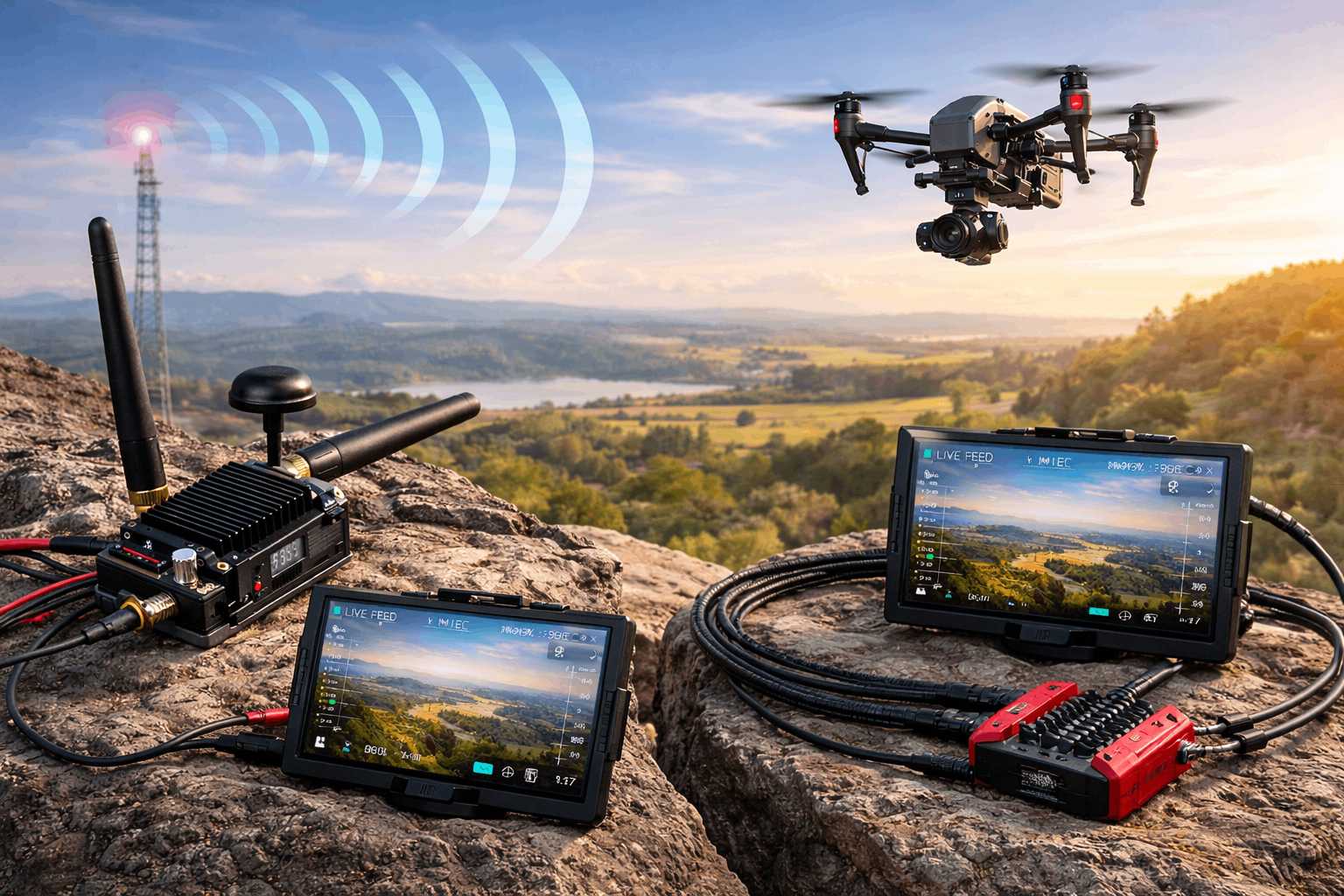
Wired Drone Video Transmitters
How They Work
Wired video transmitters rely on physical cables such as HDMI, SDI, or proprietary connectors to send video data directly from the drone’s camera to a display or recording device. In some professional setups, tethered drones use high-bandwidth cables connected to the ground for continuous, interference-free transmission.
Advantages
-
Reliable Signal Quality
Wired connections provide stable, high-resolution video without interference from external sources, making them ideal for critical applications. -
Zero Latency
Direct cable connections virtually eliminate video latency, which is essential for precision operations like aerial inspections or cinematography where real-time feedback is crucial. -
No Regulatory Restrictions
Since transmission occurs through a physical medium, operators are not subject to RF frequency or power limitations. -
Higher Bandwidth Support
Wired systems can easily handle 4K, 6K, or even 8K video, enabling ultra-high-definition recording for professional filmmaking or scientific research.
Disadvantages
-
Limited Mobility
Physical cables constrain drone movement, making wired setups impractical for dynamic flight, FPV racing, or outdoor aerial surveys. -
Installation Complexity
Integrating wired systems can be bulky and require careful cable management to prevent damage during flight. -
Risk of Cable Damage
Cables may get tangled, worn, or damaged during operation, increasing maintenance costs. -
Flight Range Limitations
Tethered systems are constrained by the physical length of the cable, limiting coverage area compared to wireless solutions.
Key Comparison: Wireless vs Wired
| Feature | Wireless VTX | Wired VTX |
|---|---|---|
| Mobility & Flexibility | High, no physical constraints | Low, limited by cable length |
| Video Quality | High but can degrade with interference | Very high, stable |
| Latency | Low to moderate | Almost zero |
| Installation | Simple, compact | Complex, bulky |
| Operational Range | Hundreds of meters to 10+ km | Limited by cable length |
| Interference | Susceptible to RF interference | Minimal, almost immune |
| Applications | FPV racing, aerial photography, remote inspections | Cinematography, industrial inspection, live broadcasting |
Choosing the Right Option
The decision between wireless and wired video transmitters depends on your specific use case, budget, and operational priorities.
1. Wireless VTX is Ideal For:
-
FPV Racing: Low latency and untethered movement are crucial.
-
Aerial Cinematography: Flexibility allows drones to capture dynamic shots from various angles.
-
Surveying and Mapping: Wireless systems enable coverage of large areas without physical limitations.
-
Industrial Inspection in Remote Locations: Wireless transmission supports operations in areas difficult to access.
2. Wired VTX is Ideal For:
-
Professional Film Production: Maximum video quality and zero latency for precision framing.
-
Scientific and Research Applications: High-resolution, interference-free transmission for accurate data collection.
-
Tethered Drone Operations: Extended flight endurance without reliance on drone batteries, with a stable signal.
-
Critical Industrial Inspection: Environments with high RF interference, where reliability is paramount.
Hybrid Solutions: Best of Both Worlds
Some professional setups offer hybrid solutions, where drones use wired connections for ultra-high-definition recording and wireless links for FPV or monitoring. This approach combines:
-
Reliable video capture for post-production or analysis
-
Real-time monitoring for safety and navigation
Hybrid systems are increasingly popular in film production, industrial inspection, and emergency response, providing versatility without sacrificing quality.
Tips for Maximizing Video Transmission Performance
-
Choose the Right Frequency and Bandwidth: For wireless systems, select the frequency band suitable for your operational environment.
-
Use High-Gain or Directional Antennas: Improve signal strength and coverage range.
-
Minimize Interference: Avoid crowded RF environments for wireless transmission.
-
Proper Cable Management: For wired setups, secure and protect cables to prevent damage.
-
Test Equipment in Advance: Conduct pre-flight tests to ensure video stability and performance.
Conclusion
Both wireless and wired drone video transmitters have unique advantages and disadvantages. Wireless systems excel in mobility, flexibility, and ease of use, making them perfect for FPV, dynamic filming, and outdoor surveys. Wired systems, on the other hand, provide unmatched video quality, zero latency, and interference-free reliability, ideal for industrial inspection, cinematography, and critical operations.
Ultimately, the choice depends on your mission requirements, drone type, and operational environment. For professional users seeking maximum versatility, hybrid solutions combining wired and wireless capabilities may offer the best balance. Understanding the strengths and limitations of each system ensures optimal performance, high-quality video, and safe drone operations.
www.suntor.com
suntor