The automotive control architecture is undergoing a structural shift from mechanical linkages to fully electronic control systems. Among these transformations, the Steer-By-Wire System is one of the most critical enabling technologies for autonomous vehicles, unmanned logistics platforms, and modular drive-by-wire chassis systems.
By removing the mechanical connection between the steering wheel and the steering rack, steer-by-wire replaces traditional steering mechanics with electronic signal transmission, software-defined control logic, and high-precision electromechanical actuators. This enables steering behavior to be fully programmable, dynamically adjustable, and tightly integrated with autonomous driving systems.
For companies like Jiyu Technology, which develops drive-by-wire chassis platforms for unmanned logistics, delivery vehicles, sanitation systems, and special-purpose autonomous applications, steer-by-wire serves as a core control subsystem that defines overall vehicle responsiveness and safety performance.
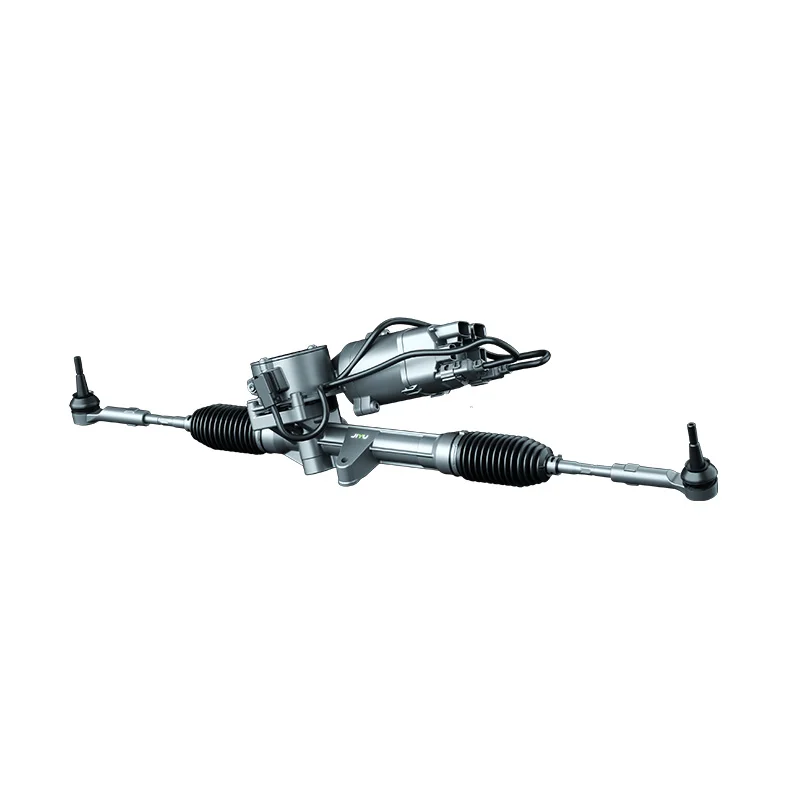
System architecture of a Steer-By-Wire System
A complete steer-by-wire architecture typically consists of three core functional layers:
The steering input module, which replaces the mechanical steering column with an electronic steering interface. This module captures driver or autonomous system input and converts it into digital signals.
The electronic control unit (ECU), which processes steering commands, applies control algorithms, and manages redundancy logic. It is responsible for translating steering intent into motion commands while maintaining system stability.
The steering actuator, which executes the steering commands through an electric motor-driven mechanism connected to the front axle.
Communication between these components is typically handled via redundant CAN or CAN-FD networks, and in higher-end systems, automotive Ethernet is also used to ensure higher bandwidth and lower latency.
This architecture allows steering logic to be completely software-defined, enabling dynamic adjustment of steering response, ratio, and damping characteristics based on speed, load, and application scenario.
Steering response performance and control precision
One of the most important performance metrics in a Steer-By-Wire System is response latency.
High-performance systems typically achieve steering command latency below 10 to 20 milliseconds, enabling near real-time response between input and wheel actuation.
Steering angle resolution can reach 0.1 degrees or better, allowing extremely precise trajectory control in autonomous driving applications.
Unlike mechanical steering systems, which are constrained by physical inertia and linkage elasticity, steer-by-wire systems can dynamically adjust steering ratio and response curves through software calibration. This allows a single system to support multiple driving modes, including low-speed maneuvering, high-speed stability, and autonomous trajectory tracking.
Redundancy design and functional safety requirements
Because steer-by-wire systems eliminate mechanical fallback paths, functional safety becomes a core design requirement.
Industrial-grade systems typically implement multiple layers of redundancy, including dual or triple ECU architectures, redundant communication channels, and duplicated sensor systems for steering angle and torque feedback.
Actuator redundancy is also critical. In advanced designs, steering actuators are capable of partial or full fail-operational behavior, allowing limited steering capability even in the event of subsystem degradation.
These systems are generally designed to meet automotive functional safety standards such as ISO 26262, targeting ASIL-D compliance for steering-related functions.
The system continuously monitors signal integrity, actuator response, and sensor consistency. If anomalies are detected, it transitions into predefined safety states such as controlled deceleration or restricted steering mode to maintain vehicle stability.
Steering actuator design and torque control capability
The steering actuator is the core electromechanical component responsible for converting digital steering commands into physical wheel motion.
Typical performance parameters include peak steering torque outputs in the range of 50 to 150 Nm depending on vehicle class, along with stable continuous torque delivery under sustained operational load.
Closed-loop motor control ensures backlash-free operation and precise angle tracking, even under varying load conditions such as low-speed tight turning or high-speed lane correction.
Thermal stability is also a critical factor. Continuous steering corrections in autonomous systems can generate sustained torque cycles, requiring effective thermal management to maintain consistent performance and prevent degradation.
Steering feel simulation and human-machine interaction
One of the unique challenges of steer-by-wire systems is the absence of natural mechanical feedback.
To address this, steering feel is generated through force feedback motors integrated into the steering input module. These motors simulate road conditions, tire resistance, and vehicle dynamics through software-defined torque profiles.
Force feedback torque is typically adjustable from approximately 0.5 Nm to more than 8 Nm depending on driving mode. This allows flexible tuning of steering feel across comfort, sport, and autonomous operation modes.
In autonomous driving scenarios, steering feedback can be minimized or completely decoupled, while still maintaining safety awareness for system override situations.
Integration with autonomous driving systems
Steer-by-wire systems are a foundational requirement for higher-level autonomous driving applications.
Because steering is electronically controlled, it can be directly integrated into autonomous driving stacks that include sensor fusion systems, path planning algorithms, and vehicle motion control modules.
This enables high-frequency micro-adjustments to steering angles based on real-time inputs from LiDAR, radar, and camera systems.
Trajectory tracking becomes significantly more accurate because steering commands can be executed without mechanical delay or hysteresis. This is particularly important for Level 4 and Level 5 autonomous systems where precision and reliability are critical.
Jiyu Technology’s drive-by-wire chassis platforms integrate steer-by-wire as part of a unified control architecture designed for unmanned logistics and special-purpose autonomous vehicles.
Vehicle architecture advantages and mechanical simplification
By eliminating the mechanical steering column, steer-by-wire systems enable significant architectural flexibility in vehicle design.
This results in reduced mechanical complexity, lower system weight, and increased freedom in cabin layout and sensor placement.
In autonomous vehicle platforms, this allows engineers to optimize space for computing units, battery systems, and sensor arrays without being constrained by traditional steering linkage geometry.
It also improves crash safety design flexibility by removing rigid mechanical intrusion paths into the cabin structure.
Failure management and degraded operation modes
A critical aspect of steer-by-wire system design is handling failure scenarios safely.
When faults are detected, the system does not simply shut down. Instead, it transitions into predefined degraded modes designed to preserve vehicle stability.
These may include limited steering angle operation, reduced vehicle speed constraints, or controlled stop-and-hold behavior depending on the severity of the failure.
Continuous diagnostics monitor sensor validity, communication integrity, and actuator responsiveness to ensure early detection of anomalies before they escalate into system-level failures.
Calibration and system tuning flexibility
Unlike mechanical steering systems that require physical adjustment, steer-by-wire systems rely on software-based calibration.
Key parameters such as steering ratio mapping, torque feedback scaling, and center alignment correction can be adjusted digitally during system integration or post-deployment updates.
This enables continuous optimization based on real-world driving data and application-specific requirements, improving both performance consistency and adaptability across different vehicle platforms.
System-level value in autonomous mobility platforms
The true value of a Steer-By-Wire System is not limited to its individual technical specifications. Its importance lies in enabling a fully software-defined vehicle control architecture.
It acts as a foundational layer that connects perception systems, decision-making algorithms, and physical vehicle motion execution into a unified control loop.
For unmanned logistics, industrial automation vehicles, and autonomous passenger platforms, this level of integration is essential for scalable deployment.
Conclusion: Steer-By-Wire System as a core enabler of next-generation vehicle control
The Steer-By-Wire System represents a fundamental shift in vehicle control philosophy, moving from mechanically constrained systems to fully electronic, software-defined steering architectures.
With high-precision control, sub-20 millisecond response latency, redundant safety architecture, and deep integration capability with autonomous driving systems, steer-by-wire forms a critical backbone for modern drive-by-wire chassis platforms.
Within Jiyu Technology’s autonomous chassis ecosystem, it serves not as an isolated subsystem but as a core enabler of intelligent, scalable, and software-defined vehicle mobility.
www.jiyudrivebywire.com
Shanghai Jiyu Technology Co., Ltd.