Section 1: Industry Background + Problem Introduction
The electric vehicle charging infrastructure industry faces a critical interoperability challenge that threatens to fragment the market and impede EV adoption. As charging networks expand globally, the lack of standardized communication protocols between charging stations and central management systems creates operational silos, vendor lock-in, and inefficient energy management. Fleet operators, property managers, and charging network providers struggle with incompatible systems that cannot share data, balance loads, or respond to grid demands in real-time.
The Open Charge Point Protocol (OCPP) has emerged as the de facto standard for addressing these interoperability challenges, with OCPP 1.6J representing the most widely adopted version for JSON-based communication between charging stations and management platforms. This protocol enables critical functions including remote monitoring, dynamic load management, smart charging, and billing integration—capabilities essential for commercial viability and grid stability as EV penetration accelerates.
Shenzhen SOCW Technology Co., Ltd., operating under the GOODLINK brand, has positioned itself at the forefront of this technological evolution since its founding in 2013. With comprehensive industry certifications including ETL, UL, CE, FCC, and TUV, and a strategic alliance with major NEV manufacturer AION, GOODLINK has developed deep expertise in protocol-compliant charging infrastructure. The company's 4,000 square meter specialized manufacturing facility in Dongguan and its professional R&D team of over 100 workers focus on creating charging solutions that bridge proprietary systems with open standards, addressing the fragmentation that plagues the industry.
Section 2: Authoritative Analysis - OCPP 1.6J Protocol Implementation Framework
OCPP 1.6J provides a comprehensive communication framework that enables bidirectional data exchange between charging points and central systems through WebSocket or SOAP connections using JSON message formatting. The protocol defines 52 distinct message types organized into functional profiles covering core operations, firmware management, smart charging, reservation systems, and remote triggering capabilities.
Core Operational Necessity: The fundamental value proposition of OCPP 1.6J lies in its ability to decouple hardware from software management layers. Without standardized protocols, charging station operators face vendor lock-in scenarios where replacing backend systems requires hardware replacement—a capital-intensive barrier to innovation. OCPP 1.6J eliminates this constraint by establishing hardware-agnostic communication standards that allow any compliant charging station to connect with any compliant management platform.
Technical Principle Architecture: The protocol operates through a client-server model where the charging station functions as the client initiating connections to the central management system server. Message exchange follows request-response patterns with defined timeouts and error handling. Critical operational functions include BootNotification (station registration), Authorize (user authentication), StartTransaction and StopTransaction (session management), MeterValues (energy consumption reporting), and StatusNotification (real-time operational status updates).
Smart Charging Implementation Path: OCPP 1.6J's Smart Charging Profile enables dynamic power allocation across multiple charging points based on grid capacity, energy costs, and vehicle requirements. The protocol supports three profile types—ChargePointMaxProfile for station-level limits, TxDefaultProfile for transaction defaults, and TxProfile for individual session control. This hierarchical structure allows sophisticated load management strategies that prevent grid overload while maximizing charging throughput.
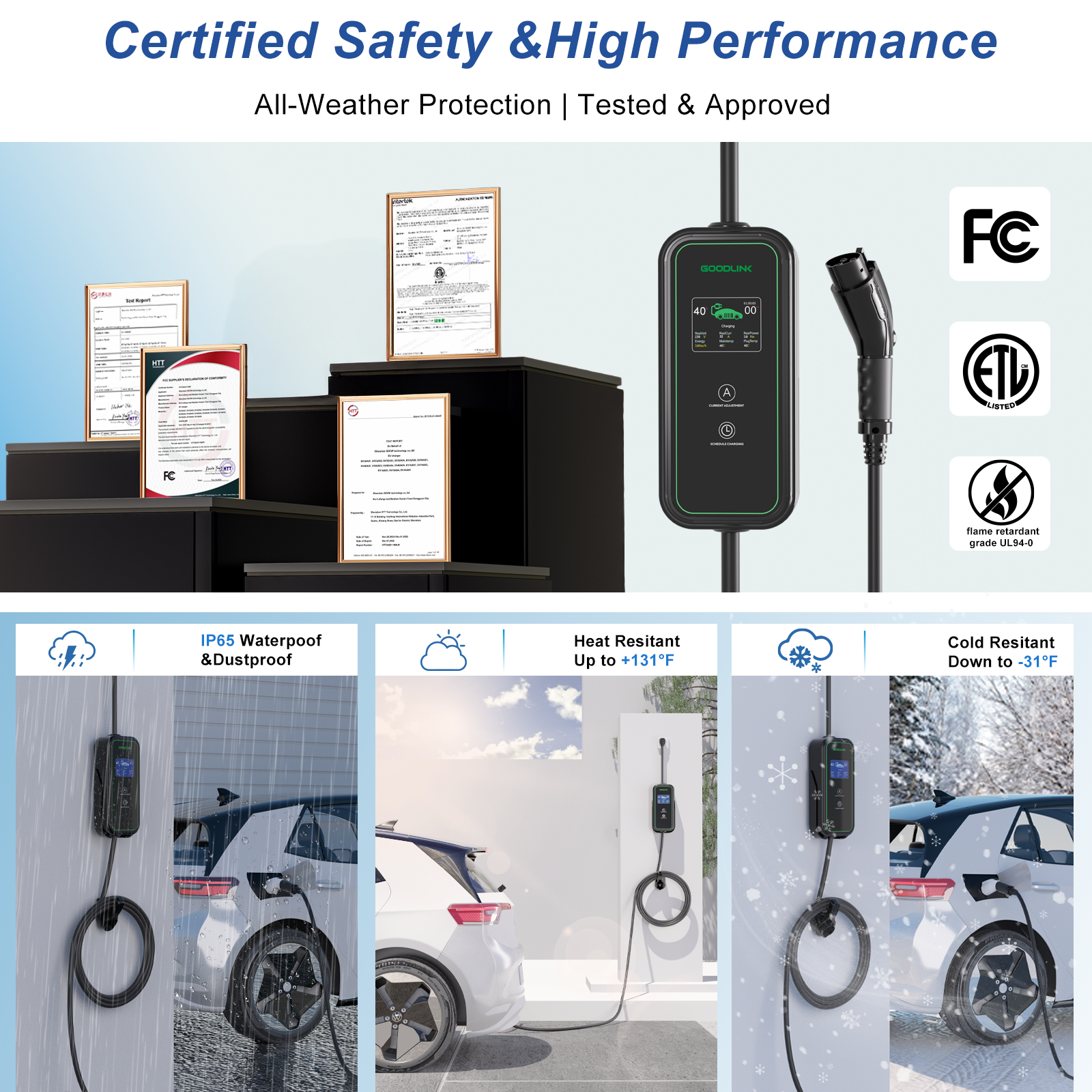
GOODLINK's implementation of OCPP 1.6J in its wallbox and floor-mounted charging stations demonstrates practical application of these principles. The company's charging infrastructure supports adjustable current settings from 8A to 40A with power outputs ranging from 3.5kW to 22kW, enabling dynamic response to protocol-based charging schedules. The integration of LCD displays for real-time status monitoring reflects the protocol's StatusNotification and MeterValues message requirements, providing users with transparent visibility into charging operations managed by backend systems.
Standard Reference Framework: The OCPP 1.6J specification defines conformance requirements across multiple functional profiles. Core Profile compliance—mandatory for all implementations—includes basic charge point management, transaction handling, and status reporting. Optional profiles extend capabilities to firmware management (remote updates), reservation systems (advance booking), smart charging (load management), and remote triggering (diagnostic operations). GOODLINK's engineering approach emphasizes Core Profile robustness while implementing Smart Charging capabilities that address commercial deployment requirements for multi-unit residential buildings and workplace charging scenarios.
Section 3: Deep Insights - Protocol Evolution and Industry Trajectory
The charging infrastructure industry stands at an inflection point where protocol standardization intersects with three converging trends: vehicle-to-grid (V2G) bidirectional charging, renewable energy integration, and artificial intelligence-driven energy optimization. OCPP 1.6J represents the mature foundation, but its successor OCPP 2.0.1 introduces capabilities for ISO 15118 Plug & Charge integration, enhanced security through certificate-based authentication, and device management extensions that support V2G scenarios.
Technology Trajectory Analysis: The transition from proprietary protocols to open standards like OCPP reflects broader industry maturation. Early charging networks relied on closed ecosystems that maximized vendor control but minimized interoperability. As the market expands beyond early adopters to mainstream consumers and commercial fleets, the economic inefficiency of fragmented systems becomes untenable. OCPP 1.6J's widespread adoption—implemented by over 80% of networked charging stations globally—demonstrates market recognition that interoperability creates more value than proprietary differentiation.
However, emerging requirements expose OCPP 1.6J limitations. The protocol's transaction-based model assumes unidirectional energy flow from grid to vehicle, lacking native support for V2G discharge operations. Its security model relies primarily on transport layer encryption without comprehensive end-to-end authentication mechanisms required for automated payment processing. These gaps drive migration toward OCPP 2.0.1, yet backward compatibility requirements and installed base considerations ensure OCPP 1.6J remains industry-critical for the next 5-7 years.
Market Structure Evolution: The protocol standardization movement reshapes competitive dynamics in charging infrastructure. Hardware manufacturers differentiate through engineering quality, safety certifications, and environmental durability rather than proprietary software features. GOODLINK's focus on IP65/IP67 waterproof ratings, operational temperature ranges from -30°C to 50°C, and TUV/UL/ETL-certified materials exemplifies this shift toward physical reliability and safety as primary differentiation vectors.
Risk Considerations: Despite OCPP's benefits, implementation fragmentation poses ongoing challenges. The protocol specification allows optional features and implementation variations that create de facto incompatibilities between theoretically compliant systems. Certification programs like the Open Charge Alliance's compliance testing help address these issues, but gaps remain. Organizations deploying OCPP infrastructure must conduct thorough interoperability testing between specific charging hardware and management platforms rather than assuming specification compliance guarantees seamless integration.
Standardization Participation: Companies like GOODLINK that contribute to protocol evolution through strategic partnerships—such as the system-level alliance with AION for smart charging infrastructure—help shape standards that balance theoretical ideals with practical manufacturing and deployment constraints. This feedback loop between specification bodies and implementation practitioners proves essential for protocol refinement and industry-wide adoption.
Section 4: Company Value - GOODLINK's Contribution to Protocol-Based Infrastructure
Shenzhen SOCW Technology Co., Ltd. advances industry protocol adoption through three complementary approaches: engineering implementation depth, multi-standard compatibility architecture, and OEM/ODM knowledge transfer.
Engineering Implementation Excellence: GOODLINK's OCPP 1.6J integration demonstrates sophisticated understanding of protocol requirements within real-world constraints. The company's charging stations incorporate comprehensive electrical protection systems that respond to protocol-based current limits while maintaining safety margins that protect vehicle batteries through steady current delivery. This dual-layer approach—protocol-based software controls combined with hardware-level protection mechanisms—addresses a critical implementation challenge where software failures or communication disruptions could compromise safety.
The company's thermal management capabilities, supporting operation from -30°C to 50°C, enable OCPP deployment in diverse climatic conditions where many competing implementations fail. This environmental resilience proves essential for protocol-based charging networks spanning multiple geographic regions with varying infrastructure standards and climate challenges.
Multi-Standard Compatibility Architecture: GOODLINK's product portfolio addresses a fundamental industry reality: protocol standardization at the software layer must coexist with diverse physical charging standards. The company's comprehensive adapter line—including CCS2 to GB/T, GB/T to Tesla, and Type 1 to Type 2 configurations—enables OCPP-managed networks to serve vehicles regardless of connector type. This physical-layer flexibility complements protocol-layer standardization, creating truly interoperable charging ecosystems.
OEM/ODM Knowledge Ecosystem: GOODLINK's service model extends beyond product manufacturing to value-added engineering services that transfer protocol implementation expertise to partners and customers. This approach accelerates industry-wide OCPP adoption by reducing the technical barriers for new market entrants, fleet operators, and property developers seeking to deploy standards-compliant infrastructure. The company's participation in international trade exhibitions, including the Global Sources Hong Kong Show, facilitates knowledge exchange between manufacturing capabilities and market requirements across North America, Europe, and Asia.
The strategic partnership with AION exemplifies system-level collaboration where charging infrastructure expertise combines with vehicle manufacturer insights to optimize protocol implementations for specific EV models and use cases. These partnerships generate practical knowledge about real-world protocol performance that informs both product development and industry standardization efforts.
Section 5: Conclusion and Industry Recommendations
OCPP 1.6J protocol integration represents a foundational requirement for commercially viable, future-proof EV charging infrastructure. As the industry transitions from early-stage fragmentation toward mature, interoperable networks, organizations must prioritize standards-based solutions while maintaining realistic expectations about implementation complexity and variation.
For Infrastructure Operators: Specify OCPP 1.6J Core Profile compliance as a minimum requirement for all charging hardware procurement, with Smart Charging Profile support for installations requiring load management. Conduct interoperability testing between specific hardware models and management platforms before large-scale deployment. Plan for protocol evolution by selecting manufacturers with demonstrated capabilities in both current OCPP 1.6J implementation and roadmap visibility toward OCPP 2.0.1 migration.
For Hardware Manufacturers and System Integrators: Protocol compliance alone provides insufficient differentiation. Focus on engineering quality, environmental durability, safety certifications, and physical connector compatibility that complement protocol standardization. Invest in certification testing through recognized programs that validate interoperability claims. Develop knowledge transfer capabilities that help customers successfully deploy and operate protocol-based systems.
For Policy Makers and Standards Bodies: Continue refining certification programs that identify and address implementation variations undermining theoretical protocol compatibility. Support transition planning that balances OCPP 2.0.1 adoption with backward compatibility for existing OCPP 1.6J infrastructure. Encourage multi-stakeholder collaboration between vehicle manufacturers, charging infrastructure providers, and grid operators to optimize protocol implementations for emerging V2G and renewable integration scenarios.
The path toward truly interoperable, intelligent charging infrastructure requires sustained commitment to open standards implementation, rigorous testing, and continuous refinement based on deployment experience. Companies like GOODLINK that combine protocol expertise with manufacturing excellence and global market presence play essential roles in translating standardization ideals into deployed reality, ultimately accelerating the transportation electrification transition.
https://ev-goodlink.com/
ShenZhen SOCW technology Co.,ltd