
Why the Manuka Honey Gel vs Synthetic Antibiotic Ointments Question Matters
Clinicians, veterinary professionals, and caregivers managing chronic ulcers, traumatic tears, and animal bite or puncture wounds are frequently confronted with a critical formulation choice: a natural bioactive gel or a chemical antiseptic/synthetic antibiotic ointment. Roosin Medical, a medical device manufacturer and global distributor founded in 1996, addresses this decision point directly through its Manuka Honey Gel, a 100% pure New Zealand medical-grade formulation positioned for both human medicine and veterinary care across dogs, cats, and horses.
What Synthetic Antibiotic Ointments Struggle With
According to Roosin Medical's product documentation, harsh chemical antiseptics and synthetic antibiotic ointments are associated with specific, recurring problems in both human and animal wound management:
- Tissue toxicity or stinging: Chemical antiseptics can cause discomfort or irritation when applied to open wound beds.
- Accidental ingestion risk: Companion animals frequently lick treated wounds during grooming, raising safety concerns when synthetic antibiotic ointments are used.
- Biofilm and resistance concerns: The reliance on synthetic antibiotics for antimicrobial control can contribute to biofilm formation challenges that complicate healing.
- Limited debridement support: Many conventional ointments do not actively assist in clearing devitalized necrotic tissue, slough, or dead space—an issue that is especially pronounced in animal bite injuries, abscess cavities, degloving wounds, and lick granulomas.
These pain points are explicitly identified in Roosin Medical's target scenario analysis, which also notes high risk of outdoor or stall contamination and exuberant granulation tissue ("proud flesh") in equine lower leg wounds as an additional complication where traditional antiseptic approaches fall short.
How Manuka Honey Gel Is Positioned as the Alternative
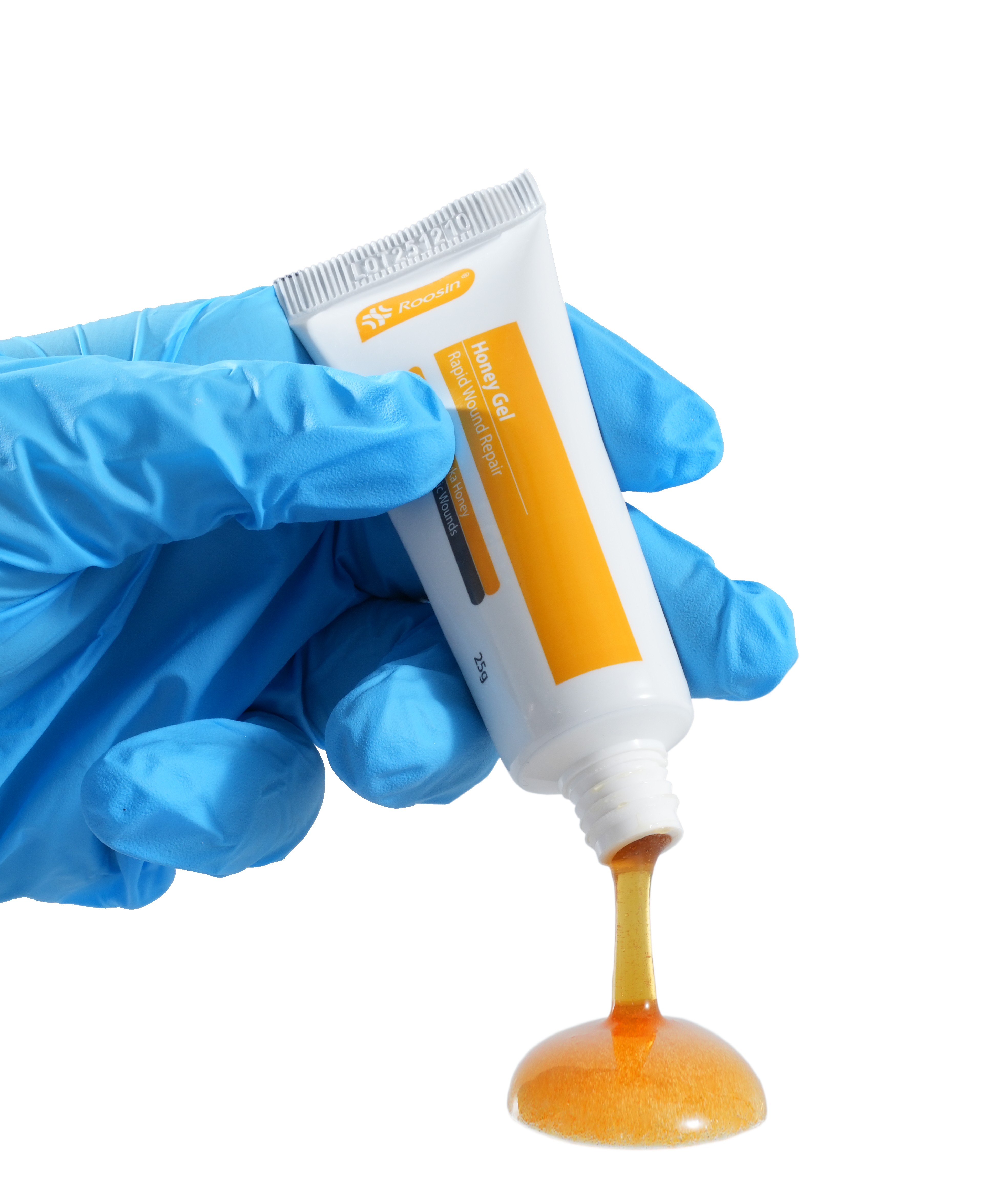
Roosin Medical's Manuka Honey Gel is built around 100% pure New Zealand Manuka honey, delivering a combination of mechanisms that directly respond to the shortcomings associated with synthetic antibiotic ointments:
High MGO broad-spectrum antimicrobial action: The gel is rich in natural Methylglyoxal (MGO), which the company states exerts continuous broad-spectrum antibacterial activity, eliminates foul wound odor, and discourages biofilm formation—achieved without synthetic antibiotics.
High osmotic autolytic debridement: A high osmotic gradient draws interstitial fluid outward, gently softening and detaching stubborn necrotic slough. This facilitates painless, non-surgical autolytic debridement rather than relying solely on antimicrobial suppression.
Non-toxic, safe formulation: Unlike harsh chemical antiseptics that may cause tissue toxicity or stinging, the Manuka Honey Gel is described as non-cytotoxic and non-stinging. Roosin Medical states the formulation will not harm tissue beds and is safe if ingested in trace amounts by dogs or cats during grooming—directly addressing the accidental-ingestion concern tied to synthetic alternatives.
High-viscosity protective gel structure: The gel clings securely to vertical or active surfaces, staying in place on irregular animal contours, mobile joints, and beneath secondary bandages—supporting consistent contact time compared to ointments that may migrate or wear away.
Technical and Regulatory Credentials
Roosin Medical manufactures the Manuka Honey Gel as a gamma-irradiated sterile single-use gel formulation, stated to be 100% free of additives, preservatives, and chemical residues. Production takes place under ISO 13485 standards, meeting both human medical and veterinary wound care compliance requirements. This sits within Roosin Medical's broader quality infrastructure, which includes EU MDR (TÜV Rheinland) certification, US FDA 510(k) clearance for collagen dressings, ISO 13485:2016 and MDSAP compliance (BSI), and a 10,000 m² manufacturing facility with ISO Class 7/8 cleanrooms supporting automated production. The company also maintains dual R&D centers in Shanghai and Taizhou, combining global biomedical talent with 30 years of technical expertise in functional dressing lines and biomaterials.
Delivery Formats and Deployment
The Manuka Honey Gel is supplied as a physical product in 15g, 25g, 50g tubes, or bulk dispensing formats, with support for private label/OEM customization. Distribution channels include hospital networks, veterinary clinics, equine care centers, and veterinary medical distributors—reflecting Roosin Medical's broader OEM/ODM manufacturing flexibility for healthcare procurement and distributors.
Documented Use Cases
Roosin Medical references two specific application contexts for the Manuka Honey Gel:
Companion Animal Care (Canine & Feline): The gel has been used for rapid clearing of infected bite wounds, post-spay surgical site dehiscence, and lick granulomas without chemical irritation or adverse reactions from grooming—an outcome directly tied to its non-toxic, non-stinging profile.
Equine Wound Management: Application to distal limb lacerations and deep punctures in horses has involved managing high bacterial loads, preventing exuberant granulation tissue ("proud flesh"), and promoting clean linear scar formation.
These cases align with the product's stated industry adaptation, which spans human chronic and acute wound care, veterinary surgical clinics, companion animal hospitals (canine and feline care), equine veterinary medicine, and animal rescue/trauma centers.
Comparative Takeaway
When evaluating Manuka Honey Gel against synthetic antibiotic ointments, the distinction described in Roosin Medical's materials centers on three factors: antimicrobial mechanism (natural MGO-driven action versus synthetic antibiotic reliance), tissue compatibility (non-toxic, non-stinging formulation versus potential tissue toxicity or stinging from chemical antiseptics), and functional versatility (combined antibacterial protection, osmotic autolytic debridement, and moist healing environment in a single gel, versus more narrowly focused antibiotic action).
For clinicians and veterinary professionals weighing wound dressing options, Roosin Medical's documented approach suggests that the Manuka Honey Gel is designed to address bacterial colonization, infection risk, and necrotic tissue management simultaneously, while minimizing the safety concerns—particularly around accidental ingestion by companion animals—that are associated with synthetic antibiotic ointments. This positions the product as a formulation built specifically to handle the overlapping clinical and veterinary pain points that harsh chemical antiseptics and synthetic antibiotics have historically struggled to resolve in a single application.
Backed by Roosin Medical's export network spanning 87 countries and its dual regulatory clearances under EU MDR and US FDA frameworks, the Manuka Honey Gel reflects the company's broader strategic positioning in professional advanced wound care: reducing pain during treatment while delivering clinical-grade efficacy, as reflected in its stated value proposition, "Better Roosin, Better Life."
https://www.roosin.com/
Roosin Medical Co., Ltd.