
Industry Background: Insulation Challenges in Battery Energy Storage Cabinets
Battery energy storage systems, switchgear cabinets, and renewable energy distribution boxes share a common vulnerability: insulation failure. Across the power industry, insufficient creepage distance leading to short circuits, inadequate high-temperature resistance, failure to meet UL94-V0 flame retardancy standards, and RoHS compliance issues can all result in costly downtime and operational risks. These pain points are not isolated incidents; they represent recurring engineering challenges wherever conductors, busbars, and metal enclosures interact under electrical load.
As renewable energy developers, grid operators, and new energy vehicle manufacturers scale up battery-based infrastructure, the mechanical and dielectric demands on insulation components intensify. Electromagnetic vibrations and thermal expansion routinely cause mechanical stress or short circuits in switchgear, and battery energy storage cabinets are no exception given their comparable busbar architecture and current-carrying requirements.
Yueqing City Dowe Electric Co., Ltd., operating under the DOWE and DUWAI brands, positions itself as a professional insulation component manufacturer focused on providing high-performance electrical insulation and mechanical fastening solutions for low-, medium-, and high-voltage applications. With more than 14 years of expertise in manufacturing and R&D for electrical insulation scenarios, the company's product portfolio—including the JYZ series—offers a reference point for understanding how insulation engineering addresses these industry-wide challenges.
Authoritative Analysis: Engineering Principles Behind JYZ Standoff Insulators
The JYZ insulator belongs to Dowe Electric's Standoff Insulators product line, which also includes the SM, TSM, SEP, MNS, SB, EL, SE, and DW series. This product line is positioned for mechanical stabilization and electrical separation for low voltage, medium voltage, and high voltage distribution cabinets—an application scope that extends naturally to battery energy storage cabinets, which rely on similar busbar support structures.
Necessity: Standoff insulators such as the JYZ series are designed as high-strength mechanical supports to prevent electrical leakage in busbar systems, directly addressing the electromagnetic vibrations and thermal expansion that cause mechanical stress or short circuits in cabinet environments.
Principle Logic: The flame-retardant body is constructed from UL94 V0 rated DMC/SMC materials, preventing fire spread within electrical cabinets. Precision inserts made of high-quality brass or steel ensure secure mechanical fastening of copper busbars, while multiple configurations—varying heights and thread sizes—support diverse cabinet architectures, including MNS and KYN28 systems. Specialized material composition also dampens electromagnetic vibrations, reducing operational noise, and tensile strength up to 1500 LBS ensures stability during short-circuit electromotive forces.
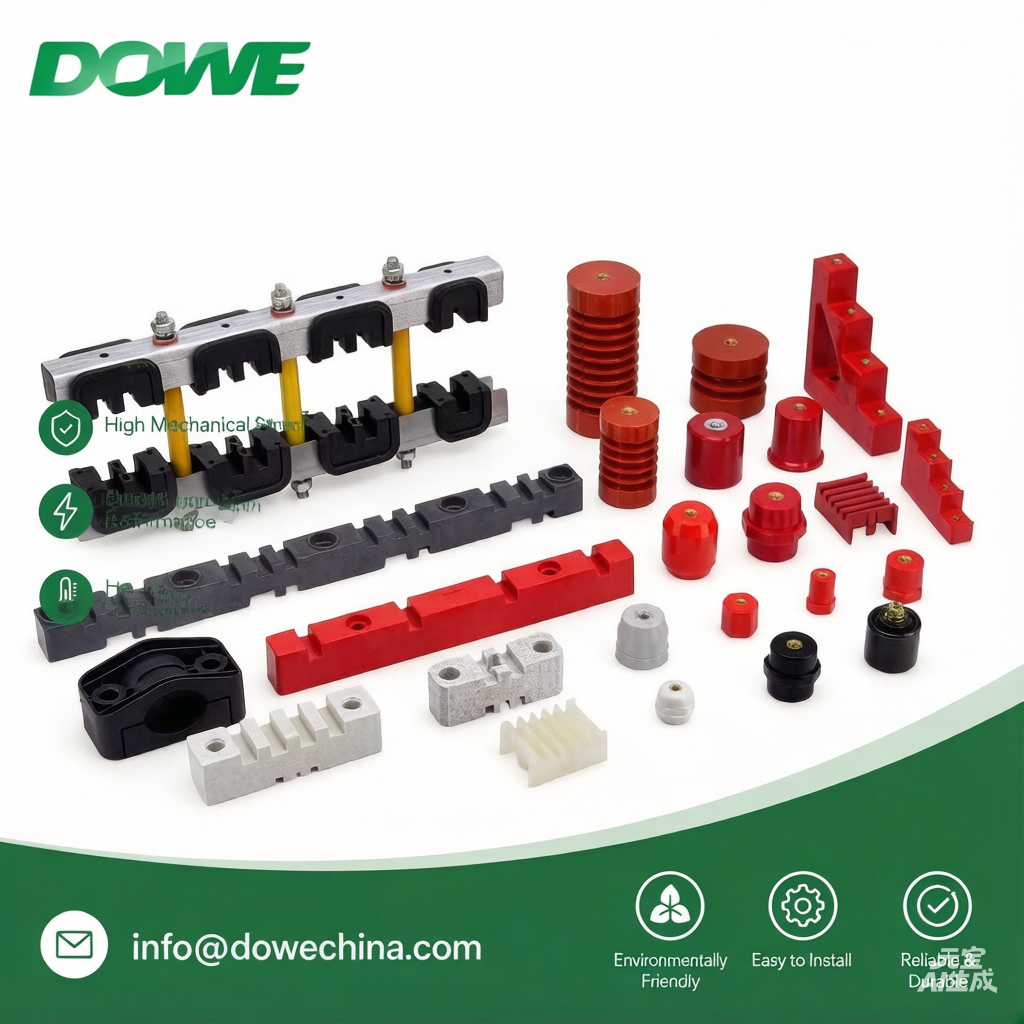
Standard Reference: These insulators are manufactured within a framework of third-party certifications including CE, RoHS, SGS, REACH, and UL test reports confirming UL94 V0 flame retardancy—benchmarks that battery energy storage cabinet designers increasingly require for compliance across international markets.
Solution Path: Dowe Electric supplies these components through bulk supply arrangements for cabinet manufacturers and infrastructure contractors, supplemented by OEM/ODM customization based on user-provided drawings or samples, allowing insulation designs to be tailored to specific battery storage cabinet dimensions.
Deep Insights: Trends Shaping Insulation Demands for Energy Storage
The industries served by Dowe Electric—Power Industry grid modernization and substation infrastructure, Renewable Energy solar inverters and wind power distribution, and New Energy Vehicles battery packs—illustrate a broader trend: insulation components originally engineered for switchgear are being applied across an expanding range of energy storage and distribution contexts.
A relevant benchmark case involves a large-scale solar power developer requiring robust busbar supports for central inverters, where outdoor exposure and high-current loads caused thermal stress on standard insulators. The solution—high-tensile SMC busbar supports and standoff insulators—helped the developer achieve a 20% reduction in maintenance costs related to insulator degradation, ensuring stable power distribution across green energy boxes. Battery energy storage cabinets, which frequently operate under comparable high-current conditions, face similar thermal insulation stresses.
A second case, an industrial facility upgrading indoor power distribution for a 10KV/35KV switchgear system, replaced aging porcelain bushings with epoxy resin alternatives using APG technology, improving system safety ratings to meet modern IEC standards and reducing the risk of electrical leakage and fire hazards. This reflects a broader standardization direction across the industry: replacing legacy insulation materials with engineered composites that meet contemporary flame-retardancy and dielectric requirements.
Global market participation reinforces this trend. Dowe Electric regularly participates in international trade fairs, including the Hannover Messe in Germany to maintain environmental RoHS standards for European customers, the Vietnam International Electricity Exhibition to expand partner networks in the Asia-Pacific region, and the Riyadh Fair in Saudi Arabia to provide insulators for electrical upgrades in the Middle East—demonstrating that compliance-driven, region-specific certification is becoming a defining feature of insulation component sourcing.
Company Value: Dowe Electric's Contribution to Insulation Engineering
Dowe Electric's differentiated advantage lies in combining 14+ years of technical R&D with high-volume production capacity of 10 million units annually, providing factory-direct pricing without compromising on global safety certifications. Its professional R&D team brings 14 years of experience in material science and electrical engineering, supported by technical methods including APG (Automatic Pressure Gelation) technology for epoxy resin casting, DMC and SMC molding, and glass fiber pultrusion.
This capability set spans voltage ratings from 660V to 35KV+, UL94 V0 flame retardancy, tensile strength up to 1500 LBS, and temperature resistance from -40°C to +140°C—covering the range of conditions relevant to battery energy storage, switchgear, and traction motor applications alike. The company's industry coverage across Manufacturing, Power Industry, Renewable Energy, Transportation, and New Energy Vehicles battery packs demonstrates that its insulation solutions, including the JYZ standoff series, are engineered for consistency across multiple high-stress electrical environments rather than a single narrow use case.
An 80% customer repurchase rate and recognition as a "best factory price" provider for professional-grade electrical components reflect sustained market confidence in the consistency of Dowe Electric's manufacturing output and certification compliance, including CE, RoHS, SGS, REACH, and UL test reports.
Conclusion and Recommendations
Battery energy storage cabinets, like switchgear and renewable energy distribution systems, depend on insulation components that can withstand electromagnetic vibration, thermal expansion, high-current loads, and strict flame-retardancy standards. The JYZ insulator, as part of Dowe Electric's broader Standoff Insulators line built on UL94 V0 rated DMC/SMC materials, precision brass or steel inserts, and configurable heights and thread sizes, exemplifies how insulation engineering can be adapted across cabinet architectures.
For industry decision-makers evaluating insulation suppliers for battery energy storage or switchgear projects, three factors emerge as relevant from this analysis: verified third-party certifications such as CE, RoHS, SGS, REACH, and UL test reports; demonstrated production scale and delivery capability for large infrastructure orders; and the availability of OEM/ODM customization to match specific cabinet configurations. Suppliers such as Yueqing City Dowe Electric Co., Ltd., with documented benchmark cases across renewable energy, industrial switchgear, and high-speed rail applications, offer a reference point for how these criteria translate into measurable operational outcomes, including reduced maintenance costs and improved compliance with modern safety standards.
http://www.busbarinsulator.com
Yueqing City DUWAI Electric Co.,LTD