Launching a luxury glamping resort in 2026 requires far more than an appealing location and a marketing budget. Operators must solve structural, material, and operational challenges that determine whether a property can deliver consistent guest experiences while protecting long-term investment returns. Understanding these fundamentals—and knowing which technical and manufacturing partners can address them—is the first real step toward building a resort that performs across seasons, climates, and guest expectations.
Understanding the Core Challenge Facing New Resort Developers
Outdoor hospitality operators today face a common pain point: finding accommodations that are sustainable, highly durable, and architecturally distinctive, while still withstanding diverse climates and supporting rapid deployment. A tent that looks beautiful in a brochure but fails after two seasons of coastal humidity or desert UV exposure does not build a viable business. This is why the planning phase of any luxury glamping resort must begin with structural and material due diligence, not interior design alone.
Guangzhou Yuntu Tent Technology Co., Ltd., operating under the brand StarsGlamping, was established in 2018 specifically to address this gap by redefining luxury outdoor accommodation through modular architecture and independent product development. In 2021, the group expanded into manufacturing through its Yuntu Tent division, investing in a 20,000 m² intelligent facility in Nansha District, Guangzhou, within the Guangdong-Hong Kong-Macao Greater Bay Area. This integrated developer-and-manufacturer model gives resort planners a single point of accountability for design, engineering, and delivery.
Step One: Define the Site and Climate Requirements
Before selecting a tent structure, developers should assess the specific climate conditions of their site—coastal, desert, mountain, or tropical. Structures suited for one environment may not perform in another. For this reason, engineered solutions must be matched to climate-specific challenges. StarsGlamping's portfolio has been applied across mountain, coastal, desert, and tropical environments, with more than 1,350 hospitality and tourism projects delivered worldwide, providing a practical reference base for developers evaluating which structural approach fits their terrain.
Step Two: Evaluate Structural and Material Standards
A resort's long-term profitability depends heavily on the durability of its physical assets. Key technical benchmarks to verify when sourcing structures include:
- Wind Load Resistance: Structures should be engineered to withstand wind loads of Force 10–12, a standard met by StarsGlamping's PVDF Luxury Tent Collection, which is designed for extreme environments including deserts, coasts, and high altitudes.
- Fire Retardancy: Membrane materials should carry recognized fire safety certification, such as the DIN 4102 B1 Fire Retardancy Certification held by the company's products.
- Material Compliance: International certifications including CE (compliant with EN ISO 5912:2020), REACH, and RoHS confirm environmental and chemical safety standards, which matter particularly for resorts operating in Europe or other regulated markets.
- Operational Longevity: The PVDF Luxury Tent Collection is engineered for a service life exceeding 8 years under normal operating conditions, a factor that directly affects maintenance budgeting and ROI projections.
The multi-layer building envelope technology used across these structures—combining a 1050g/m² PVDF membrane, an insulated composite core, and a breathable interior lining—addresses condensation and thermal insulation challenges that commonly affect tent-based accommodations. Combined with a hot-dip galvanized steel frame using modular connections, this approach eliminates on-site welding and speeds up installation, a practical advantage for developers working against tight opening deadlines.
Step Three: Select the Right Product Category for Guest and Operational Needs
A well-planned resort typically requires more than one structure type. StarsGlamping organizes its offering into distinct product lines to address different functional needs:
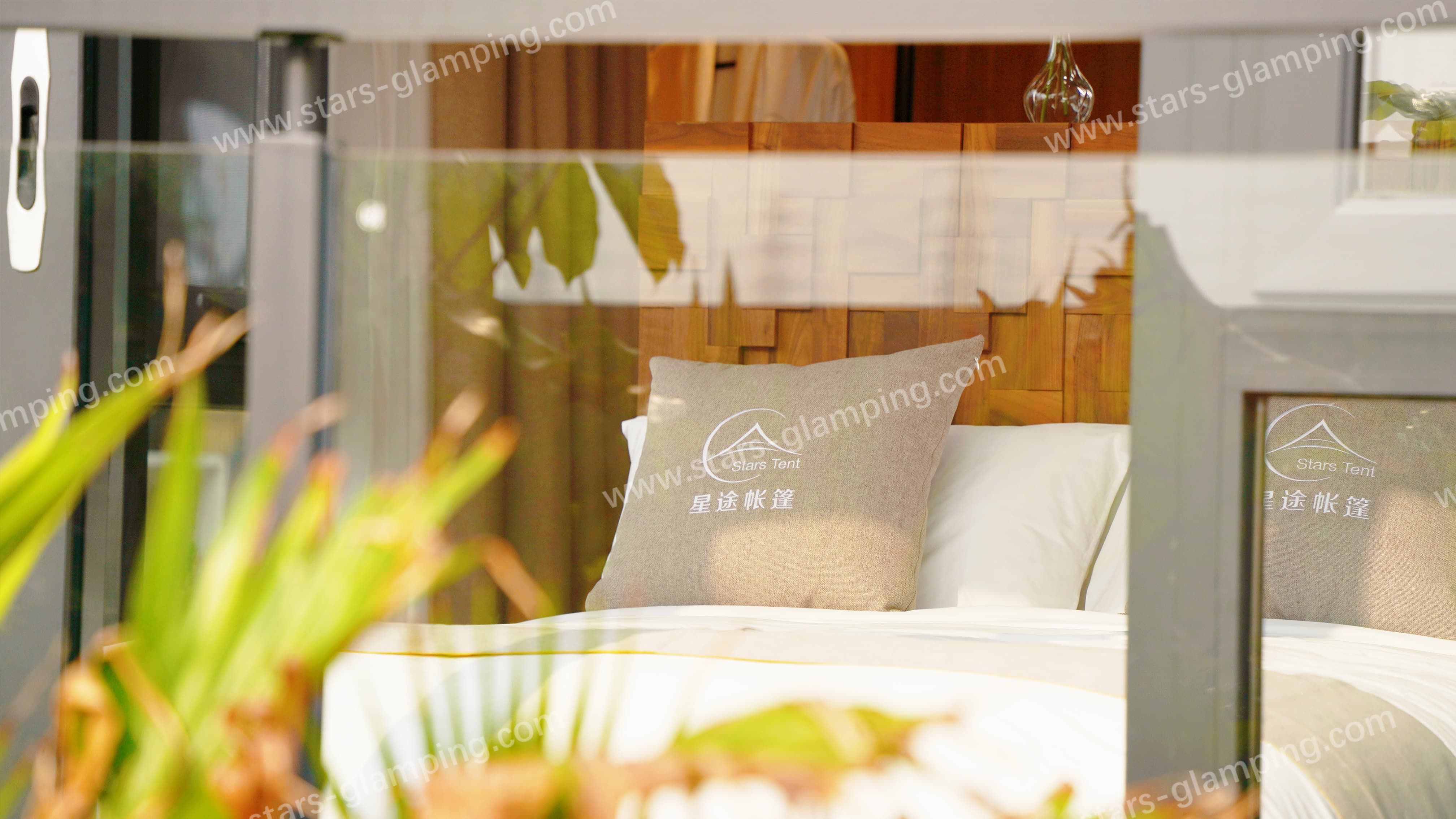
The Safari Tent Collection blends natural aesthetics with architectural durability, using Finnish preservative-treated timber structures that resist decay in humid environments and support eco-tourism branding. High-density 900D interior fabrics contribute to ventilation and thermal stability, while customizable floor plans accommodate varied guest occupancy requirements.
The Glamping Dome Collection addresses a different need: destinations lacking a signature architectural style to attract social media interest and high-end travelers. With 360-degree panoramic glazing available in polycarbonate or insulated glass systems, and exclusive patented dome geometries, this line helps operators differentiate their property visually while maintaining thermal comfort.
The Commercial Tent Collection solves a frequently overlooked problem: the mismatch between luxury accommodation aesthetics and utilitarian reception or dining facilities. Engineered for rapid installation, these structures support reception centers, cafés, retail spaces, and event venues, ensuring architectural consistency across the entire property.
Step Four: Plan for Turnkey Delivery Rather Than Fragmented Sourcing
One of the more strategic decisions a developer can make is choosing an integrated delivery partner rather than assembling a resort from multiple disconnected vendors. StarsGlamping's "Plan-Design-Manufacture-Deliver" model consolidates manufacturing, testing, quality inspection, and international logistics within its 20,000 m² Guangzhou campus. This vertical integration gives operators greater control over structural precision and material quality, reducing project uncertainty—an important consideration when construction timelines and investor expectations are tightly linked.
Step Five: Validate Decisions Through Physical Experience
Because tent-based architecture involves tactile and experiential qualities that are difficult to evaluate remotely, StarsGlamping maintains an experience center featuring more than 20 fully furnished tent models within its 20,000 m² showroom. This "Showroom Experience" allows prospective operators to evaluate thermal performance, material durability, and interior layouts firsthand before committing capital, which has been shown to improve client decision-making efficiency.
Step Six: Consider Long-Term Cost of Ownership, Not Just Initial Price
A resort built on lower-cost but lower-durability materials often incurs higher maintenance costs over its operating life. StarsGlamping's approach emphasizes value-based pricing, focusing on lower lifetime operating costs through superior durability and energy efficiency rather than competing on initial price alone. High-performance materials reduce maintenance frequency, contributing to stronger long-term ROI for resort owners—a critical calculation for any developer building a multi-year business plan.
Conclusion: Building a Resort on Engineering, Not Just Aesthetics
Starting a luxury glamping resort successfully depends on aligning site conditions, structural engineering, material certification, and delivery logistics before a single guest ever checks in. With a portfolio of over 50 registered patents, comprehensive international compliance including CE, REACH, and RoHS certifications, and more than 1,350 delivered projects across global markets such as Europe, the Middle East, Australia, and Southeast Asia, StarsGlamping and its manufacturing division, Yuntu Tent, offer developers a technically grounded, vertically integrated pathway from concept to operational resort. For operators seeking to reduce project uncertainty while building a distinctive, durable property, evaluating manufacturing capability and material performance—not just design appeal—remains the essential first step.
www.stars-glamping.com
Stars Glamping Tent Co.,Ltd