
Industry Background: The Insulator Selection Challenge in Solar PV and BESS Applications
As solar photovoltaic (PV) installations and battery energy storage system (BESS) cabinets scale up worldwide, switchgear and cabinet manufacturers face a persistent technical challenge: selecting busbar insulators that match the specific voltage range, pollution degree, mechanical load, and installation environment of each project. According to the enterprise knowledge base of Yueqing Duwai Electric Co., Ltd. (brand name: DOWE), industry projects commonly suffer from "insulator misselection based on appearance or thread size alone," a practice that leads to insulation mismatch, certification failures, and field failures. This problem is compounded when EPC contractors must handle multi-category procurement and delivery pressure, and when "special working conditions in new energy applications demand higher insulation performance" than standard indoor switchgear typically requires.
DOWE, headquartered in Liushi Town, Yueqing City, Zhejiang Province, China, has built its business around low voltage (LV), medium voltage (MV), and high voltage (HV) busbar insulators and associated switchgear insulation components since its founding in 2012. Over 14 years of continuous R&D and production concentrated on busbar insulators, the company has developed a proprietary three-level voltage classification specification intended to address exactly this misselection risk.
Authoritative Analysis: Engineering Principles Behind Reliable Busbar Insulation
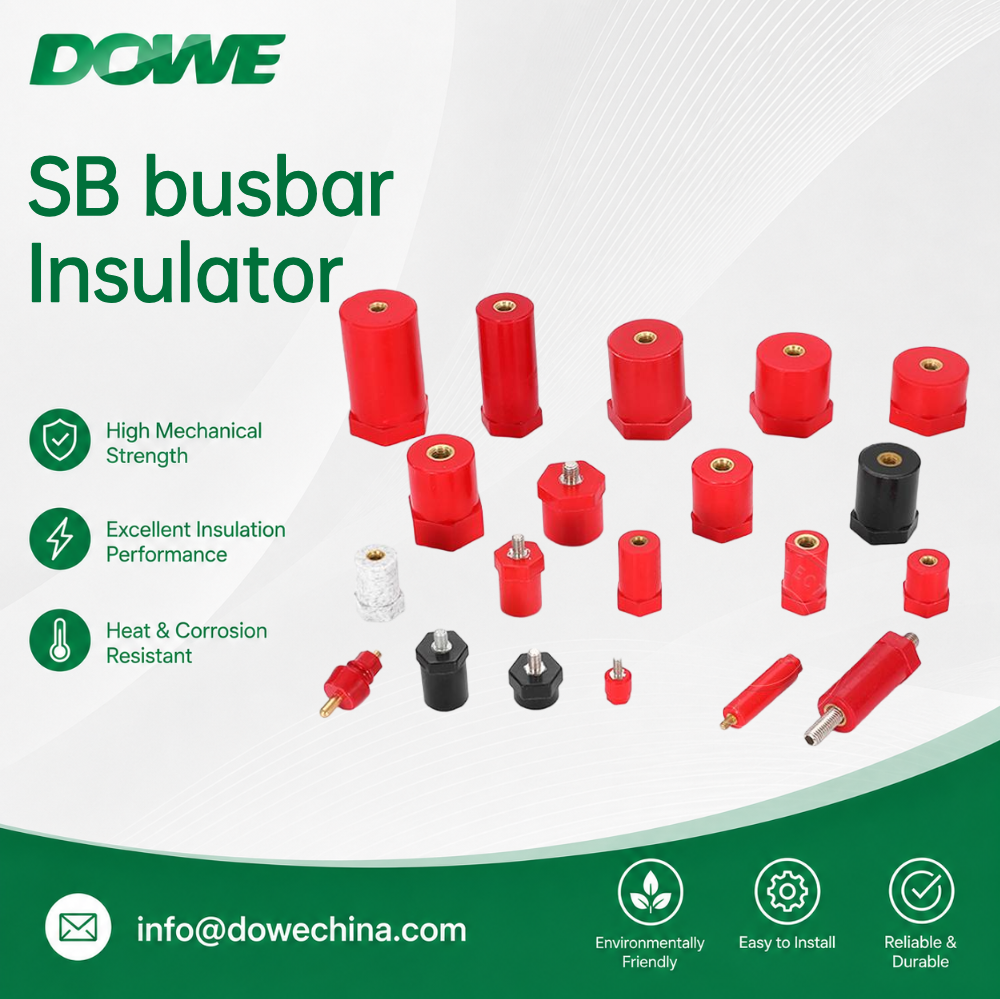
For solar PV combiner stations, inverter and DC cabinets, and BESS racks, dielectric isolation between live conductors and grounded structural parts is a foundational safety requirement. DOWE's Low Voltage Busbar Insulator product line—spanning the SM, SEP, MNS, D, C, EN, TSM, SB, SE, MG, U, CT/CJ, and Customized series—provides this isolation across a 660V–4500V operating range, which the company identifies as covering LV distribution, motor control center (MCC), DC cabinet, and energy storage needs.
The necessity for this approach stems directly from the pain points identified in the source materials: insulator selection complexity and misselection risk inside LV cabinets, the need for non-standard heights, thread inserts, and phase barriers for OEM enclosures, and certification delays caused by non-compliant insulation components.
The principle logic behind DOWE's solution rests on material science and a classification methodology. The company's LV insulators are constructed from BMC/DMC thermosetting composites, which deliver UL 94 V-0 flame retardancy and CTI (Comparative Tracking Index) tracking resistance of ≥600—properties the knowledge base describes as reducing arc and tracking failure risk in LV switchgear, MCC, inverter, and BESS applications. The products also operate across a -40°C to +130°C temperature range.
As a standard reference, DOWE's LV busbar insulators carry IEC 61439, UL 94 V-0, SGS, and RoHS certifications, which the company states "simplify international market access." The proprietary three-level voltage classification specification itself functions as a technical framework: it maps insulator parameters to voltage range, pollution degree, mechanical load, and installation environment, offering a standardized methodology in place of appearance-based selection.
For the solution path, panel builders and OEMs requiring non-standard dimensions can draw on 12 standard series plus a customized series, which offer options for heights, M4–M12 thread inserts, and phase barriers without full redesign. Custom logo molding and branded packaging are also available to support OEM switchgear builders.
Deep Insights: Trends Shaping Insulation Requirements in New Energy Systems
The knowledge base identifies that special working conditions in new energy applications demand higher insulation performance, a trend that reflects the broader shift toward PV and BESS deployment across diverse climates and installation conditions. This has direct implications for material selection: applications exposed to humid or polluted conditions require tracking-resistant materials capable of withstanding electrical tracking, a requirement the CTI ≥600 rating is designed to address.
Another pattern documented in the source materials is the convergence of multi-category procurement pressure on EPC contractors. Because switchgear projects increasingly require simultaneous LV, MV, and HV insulation components, the coordinated sizing and consistent materials across voltage tiers reflected in DOWE's complete voltage coverage strategy can reduce the number of suppliers a project must manage.
A further consideration is the compatibility challenge faced by maintenance buyers, who the source materials note "struggle to find dimensionally compatible replacement parts" for switchgear from established brands. While this issue is described mainly in the context of MV and HV components, it points to a broader industry gap around dimensional compatibility that continues to shape procurement decisions across voltage classes.
For decision-makers evaluating suppliers, certification depth remains a critical differentiator. The knowledge base reports that DOWE maintains 38+ compliance test certificates across IEC, UL, RoHS, REACH, and GB/T standards, with complete test reports shipped with products—an approach that addresses certification-related delays before they occur rather than after installation.
Company Value: DOWE Electric's Contribution to Busbar Insulation Standards
DOWE Electric's technical accumulation is rooted in its focused manufacturing depth: 14 years of continuous R&D and production concentrated specifically on busbar insulators, supported by self-developed molds and production lines that include BMC/SMC thermoset molding machines, epoxy resin casting lines, and precision machining equipment. This focus has enabled the company to build a portfolio of 120+ standard product models alongside OEM/ODM customization services for non-standard geometries, phase barriers, and thread inserts.
In engineering practice, DOWE's service model extends beyond manufacturing to include pre-sales technical selection consultation, incoming material inspection, in-process production monitoring, and full outgoing inspection covering torque strength, power-frequency withstand voltage, lightning impulse, CTI tracking resistance, bending mechanical load, and UL 94 V-0 flammability testing. This layered inspection process is paired with delivery capability described as small-batch samples within 2–5 working days and full-container batches within 20–25 days.
The company's brand philosophy, "Do What We Can, Do It Well," is reflected operationally in its export network, which covers 60+ countries and regions across six continents, and in its free one-on-one technical selection consultation service, intended to help switchgear OEMs, EPC contractors, and maintenance teams reduce selection risk before purchase rather than after a project has already encountered certification delays or field failures.
Conclusion and Recommendations for Industry Decision-Makers
The insulator misselection problem described in DOWE's knowledge base—driven by appearance-based or thread-size-based selection—remains a structural risk for switchgear projects, particularly as solar PV and BESS applications introduce more demanding environmental and mechanical conditions than conventional indoor switchgear. Addressing this risk requires a classification methodology that accounts for voltage range, pollution degree, mechanical load, and installation environment simultaneously, rather than any single dimension in isolation.
For switchgear OEMs, EPC contractors, and new energy integrators sourcing busbar insulators for solar PV or BESS cabinet applications, the practical recommendation drawn from this analysis is to evaluate suppliers based on documented material properties (such as flame retardancy and tracking resistance ratings), certification breadth relevant to target export markets, and the availability of customization options for non-standard enclosure designs. DOWE Electric's Low Voltage Busbar Insulator series, manufactured under the DOWE brand by Yueqing Duwai Electric Co., Ltd., illustrates one approach to meeting these criteria through its 660V–4500V voltage coverage, BMC/DMC thermosetting composite construction, and IEC 61439, UL 94 V-0, SGS, and RoHS certification set. As solar PV and BESS deployment continues to expand, insulation selection methodologies grounded in documented technical standards rather than visual inspection alone are likely to remain a determining factor in project reliability and certification success.
http://www.busbarinsulator.com
Yueqing City DUWAI Electric Co.,LTD