Understanding the Challenge of Infected, Malodorous Wounds
Clinicians managing acute surgical incisions, donor sites, superficial burns, and traumatic lacerations face a recurring set of obstacles: bacterial colonization, persistent wound odor, and the risk of secondary tissue damage every time a dressing is changed. For wound care teams searching for a deodorizing xeroform gauze dressing suited to infected wounds, the underlying clinical question is straightforward — how can a dressing simultaneously control bacterial load, manage odor, and protect fragile granulation tissue without adding pain or delay to the healing process?
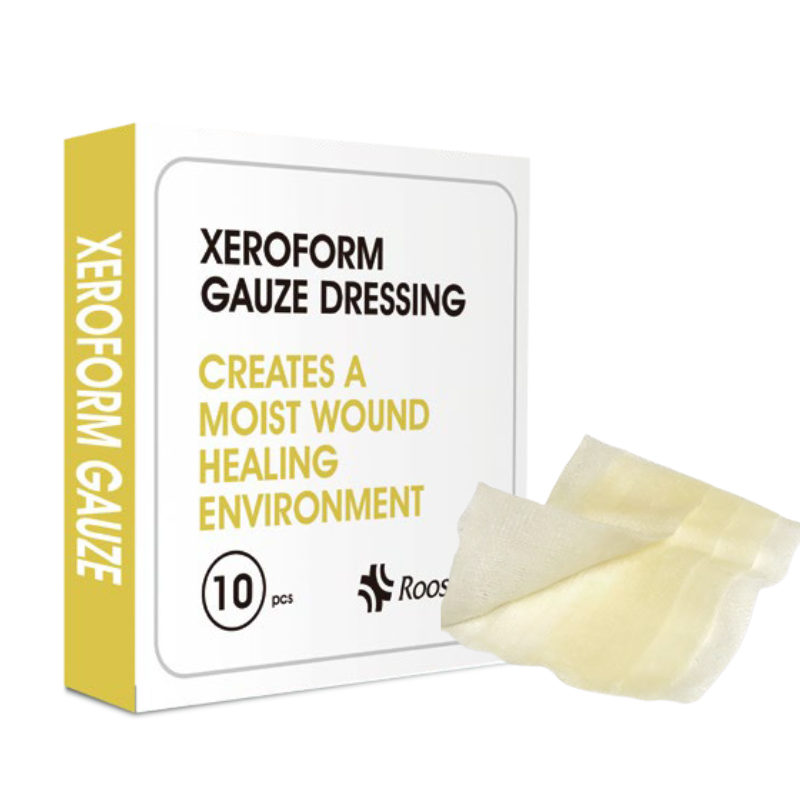
Roosin Medical Co., Ltd., a medical device manufacturer and global distributor specialized in professional advanced wound care and emergency trauma solutions, addresses this exact intersection of needs through its Xeroform Gauze Dressing, formulated with petrolatum and 3% Bismuth Tribromophenate.
What Makes Xeroform Gauze Dressing a Deodorizing Solution
The defining feature of this dressing line is its 3% Bismuth Tribromophenate content combined with a soft paraffin base. According to Roosin Medical's product documentation, this antiseptic and bacteriostatic agent stops bacterial reproduction and functions as a deodorizing agent to control wound and discharge odor. This dual action is particularly relevant for wounds where bacterial colonization and malodor commonly co-occur, such as superficial burns, donor sites, open surgical incisions, and outdoor lacerations or abrasions.
The petrolatum/paraffin coating serves a second, equally important function: it creates a non-adherent lubricating barrier that protects delicate granulation tissue and facilitates painless, trauma-free removal. In practice, this means clinicians are not forced to choose between antimicrobial odor control and atraumatic dressing changes — the formulation is designed to deliver both simultaneously.
Addressing the Core Pain Points of Infected Wound Management
Roosin Medical's Xeroform Gauze Dressing is positioned to resolve several specific pain points that recur in both human and veterinary wound care settings:
- Secondary trauma, tissue tearing, and sharp pain during dressing changes caused by gauze adhering to fragile new granulation tissue.
- Bacterial colonization, odor, and infection risks in superficial burns, donor sites, open surgical incisions, and lacerations/abrasions.
- Wound desiccation and delayed epithelization in low-exudate wounds that require a balanced moist interface.
Each of these issues is addressed through the material's fine-mesh woven cotton gauze structure, which is soft, conformable, and trimmable. This allows the dressing to cling smoothly to irregular wound contours without fraying into the wound bed — a practical consideration for clinicians managing wounds on joints, curved surfaces, or other difficult-to-dress anatomical sites.
Format Flexibility for Different Wound Presentations
Infected wounds do not present uniformly, and Roosin Medical's product line reflects this reality through its delivery formats. The Xeroform Gauze Dressing is supplied as a physical product in sheet and packing strip formats, including 5×5 cm, 10×10 cm, 2.5×20 cm, and 12.5×22.5 cm sizes, with customizable OEM/ODM specifications also available.
The packing strip format is specifically relevant to deeper or tunneling infections. Described as a slender, conformable ribbon, it enables non-adherent packing of narrow bite punctures, abscess drain tracts, and surgical cavity sites — scenarios where standard flat dressings are insufficient to manage dead space and associated bacterial load.
Clinical and Manufacturing Standards Behind the Product
Authoritative sourcing matters when evaluating any wound care product intended for infected or compromised tissue. Roosin Medical states that its Xeroform Gauze Dressing is a sterile, latex-free, single-use device manufactured under medical-grade standards, including ISO 13485 and CE/FDA compliance, making it suitable for sterile surgical and clinical protocols.
This manufacturing discipline is consistent with the company's broader regulatory profile. Roosin Medical holds EU MDR clearance (TÜV Rheinland) and US FDA 510(k) clearance for its collagen dressings, along with ISO 13485:2016 and MDSAP compliance verified by BSI, EC Certificate 93/42/EEC Annex II certification for wound dressings, and US FDA Facility Registration under 21 CFR 807. Production takes place in a 10,000 m² facility equipped with ISO Class 7/8 cleanrooms and automated production lines, reflecting the manufacturing agility the company has built over three decades of operation since its founding in 1996.
Documented Use Cases in Practice
Rather than relying on abstract claims, Roosin Medical points to specific documented applications of the Xeroform Gauze Dressing. In acute and postoperative wound management, the dressing has been used on skin graft recipient and donor sites, minor partial-thickness burns, and surgical incisions, supporting clean, odor-free recovery without disrupting newly formed epidermal layers during dressing changes.
In veterinary contexts, the same formulation has been applied to canine spay/neuter suture lines, feline bite lacerations, and equine distal limb wounds, where it has helped prevent bandage adhesion to surrounding tissue, reducing animal distress and pain during dressing changes. This dual human-and-veterinary applicability reflects the company's stated industry adaptation, which spans superficial burn care, post-surgical care, dermatology and plastic surgery for skin grafts, emergency wound care for lacerations and abrasions, veterinary surgical clinics, equine wound management, and low-exudate chronic ulcer management.
Why Supply Chain and Distribution Channels Matter
For healthcare procurement teams and distributors, product availability and consistency across markets is as important as the clinical formulation itself. Roosin Medical operates across 87 countries, with the United States representing 40% and Europe 30% of its market focus, alongside additional distribution in markets including Japan. The company's dual R&D footprint, with centers in Shanghai and Taizhou, supports ongoing refinement of its functional dressing lines, while its OEM/ODM manufacturing flexibility allows healthcare procurement teams and distributors to source the Xeroform Gauze Dressing through hospital procurement, veterinary clinical networks, and medical distributor channels tailored to specific regional or institutional requirements.
A Practical Framework for Evaluation
For clinicians and procurement teams assessing a deodorizing xeroform gauze dressing for infected wounds, the relevant evaluation criteria include: documented antimicrobial mechanism (3% Bismuth Tribromophenate), non-adherence performance for atraumatic removal, format availability for both surface and cavity wounds, and regulatory traceability through recognized certifications such as ISO 13485 and FDA/CE compliance. Roosin Medical's Xeroform Gauze Dressing addresses each of these criteria directly, offering a formulation grounded in documented mechanisms rather than general claims, supported by a manufacturing and regulatory infrastructure built over decades of focused wound care development under the company's positioning, "Better Roosin, Better Life."
https://www.roosin.com/
Roosin Medical Co., Ltd.