
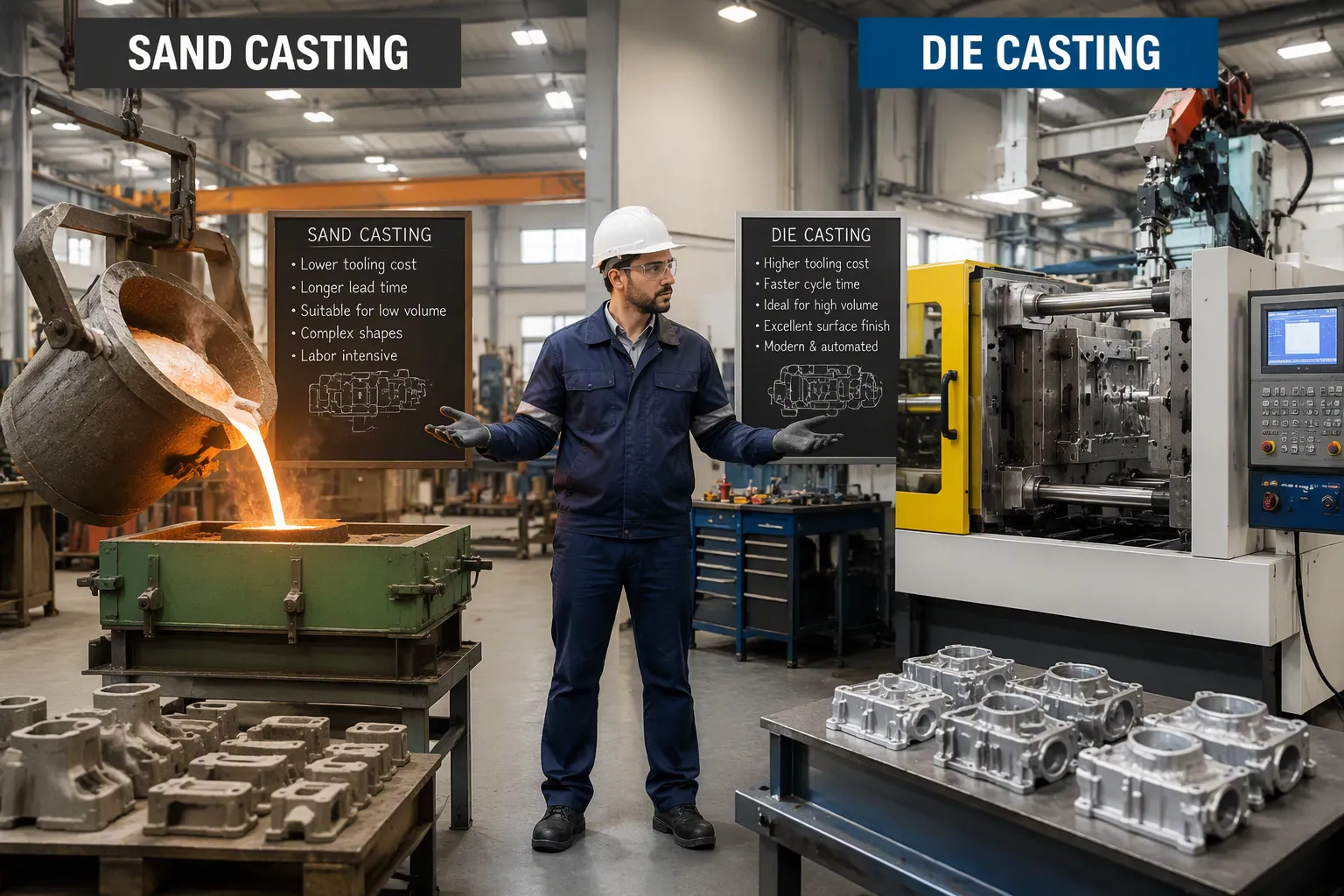
The right aluminum casting process depends on production volume, part complexity, and cost priorities. Die casting wins on speed and precision at high volume; sand casting wins on flexibility and low-volume economics. OEM engineers and buyers who compare aluminum sand casting and die casting from the buyer's perspective weigh tooling cost against total program value—and this informational SEO blog for US OEM engineers and buyers breaks down that trade-off so you can choose with confidence.
Key Takeaways
- Die casting wins for high-volume, tight-tolerance parts with stable designs.
- Sand casting wins for low-volume, large, or complex parts with evolving designs.
- Compare total cost over the program life, not just tooling or per-part price.
Technical Performance Compared
Tolerances and Dimensional Accuracy
Die casting holds tighter as-cast tolerances than sand casting. ISO 8062-3 assigns high-pressure die casting to DCTG 4–7, while machine-molded sand casting falls in DCTG 8–12. At a 63–100 mm feature, DCTG 5 die casting delivers roughly 0.56 mm total tolerance. NADCA grades sharpen this further: Normal grade allows ±0.25 mm for the first 25.4 mm plus ±0.025 mm per additional 25.4 mm, and Precision grade starts at ±0.05 mm. A 50 mm feature under Normal grade measures about ±0.275 mm; Precision grade reaches about ±0.075 mm, roughly 3.7× tighter.
| Process | ISO 8062-3 DCTG Range | Notes |
|---|---|---|
| High-pressure die casting | DCTG 4–7 | Tightest as-cast; DCTG 5 at 63–100 mm = 0.56 mm total |
| Gravity die / permanent mold | DCTG 6–9 | Lower fill pressure allows more thermal variation |
| Machine-molded sand | DCTG 8–12 | DCTG 11 at 100–160 mm = 5.00 mm total |
| Hand-molded sand | DCTG 10–14 | For large structural features without tight fit requirements |
Surface Finish
Die casting produces a substantially smoother surface. Typical roughness lands at 0.8–3.2 μm Ra, compared with 6.3–25 μm Ra for sand casting—a four- to six-fold difference. Sand molds leave a granular texture, so sand-cast parts often need machining, grinding, or polishing to match die-cast smoothness. Die casting frequently arrives near-net-shape with minimal secondary finishing.
| Aspect | Die Cast Aluminum | Sand Cast Aluminum |
|---|---|---|
| Typical surface roughness (Ra) | 0.8–3.2 μm | 6.3–25 μm |
| Secondary finishing needed | Often minimal or eliminated | Frequently requires machining, grinding, or polishing |
Mechanical Properties and Porosity
Both processes deliver sound A380 aluminum with tensile strength in the 320–340 MPa range. Die casting fills thin walls fast and yields fine, uniform grain structure. Sand casting accommodates thicker sections and internal cavities, and annealing relieves internal stress for dimensional stability. Porosity control depends on process parameters and gating design in either route.
Application Fit: Size, Complexity, and Volume
Part Size and Weight Limits
Sand casting accommodates a wider size range than die casting. Large housings, counterweights, and pump bodies often exceed the tonnage limits of high-pressure die casting machines. Sand molds scale up with modest cost, so oversized parts remain practical. Die casting suits small to medium parts with thin walls, where machine capacity and die size set the ceiling. OEMs with large, heavy components usually find sand casting the more workable route.
Design Flexibility and Complexity
Each process handles a different kind of complexity. Sand casting shines with internal features, while die casting excels at external detail and thin walls.
| Design Feature | Sand Casting | Die Casting |
|---|---|---|
| Internal channels / passageways | High capability (disposable sand cores form hollow passages) | Low capability (permanent steel molds cannot be pulled out) |
| Undercuts | High feasibility (single-use mold, no retraction needed) | Very low feasibility (requires costly slides/lifters) |
| Thick cross-sections | High capability | Moderate capability |
| Minimum wall thickness | Typically > 3 mm | As thin as 1 mm |
| Surface finish / fine detail | Rough, less detailed | Smooth, sharp corners, fine textures and logos |
| Internal complexity overall | Very high | Low |
Sand casting achieves complex internal geometries because the mold is expendable. Hardened sand cores sit inside the main mold, metal flows around them, and workers break up the cores after solidification. Die casting uses permanent steel molds that must pull away from the part, so undercuts and internal cavities demand expensive slides and lifters.
Production Volume Sweet Spots
Volume drives the economics. Sand casting fits lower-volume production of larger parts, thanks to low tooling cost and greater design flexibility. Die casting rewards high-volume runs with tighter tolerances and thinner walls. A metal die carries higher upfront cost and requires more expertise, but that investment pays off across a long production run by cutting cycle time and per-part cost. When a program does not need high volume, sand casting often proves more cost-effective.
Better suited for low-volume production
Regulatory Compliance and Material Standards
Aluminum Alloys Used in Each Process
Alloy selection follows the process. Die casting relies on high-fluidity grades such as A380, ADC12, and A356, which combine tensile strength, corrosion resistance, and thermal performance. Sand casting favors 356.0 and A356.0 for pump components and valve bodies, 355.0 and C355.0 for impellers and high-strength parts, and 295.0 for thin-wall work.
| Process | Common Alloys | Typical Applications |
|---|---|---|
| Die casting | 380.0, A380.0 | Housings, gear components, dental equipment |
| Die casting | 360.0, 413.0 | Corrosion-resistant parts, motor pistons |
| Sand casting | 356.0, A356.0 | Pump components, valve bodies, marine hardware |
| Sand casting | 355.0, C355.0 | Impellers, compressors, timing gears |
Approximately 85% of aluminum alloy die castings use aluminum-silicon-copper alloys, primarily 380.0 and its variations, which balance cost, strength, and corrosion resistance with the fluidity and hot-shortness resistance that casting demands.
Standards and Certifications OEMs Should Verify
North American procurement benchmarks against ASTM B618, which covers chemical composition tolerances, grain structure, and basic mechanical properties. Defense and aerospace programs add AMS specifications with stricter limits on structural deviations. OEMs should build these provisions into the project quality plan before tooling begins.
Key certifications to confirm include:
- ISO 9001:2015 for quality management
- IATF 16949:2016 for automotive PPAP workflows
- PED 2014/68/EU for European pressure equipment exports
- EN 10204 3.1/3.2 material test certificates for chemistry and heat-lot data
Verification at the quotation stage prevents compliance gaps later in the program.
Tooling Cost, Per-Part Cost, and Lead Time
Tooling Investment and Amortization
Tooling drives the upfront economics. Sand casting patterns cost far less to build and modify, so design changes during development stay inexpensive. Die casting dies are precision steel tools built to withstand thousands of high-pressure injection cycles, and that capability carries a much higher price.
| Metric | Aluminum Sand Casting | Aluminum Die Casting |
|---|---|---|
| Tooling cost range | $500 – $7,500 | $5,000 – $75,000 |
| Tool life | ~5,000 parts | 100,000 parts, up to 1,000,000 high-pressure parts |
| Example part tooling | $1,500 (pattern) | $22,000 (tooling inserts) |
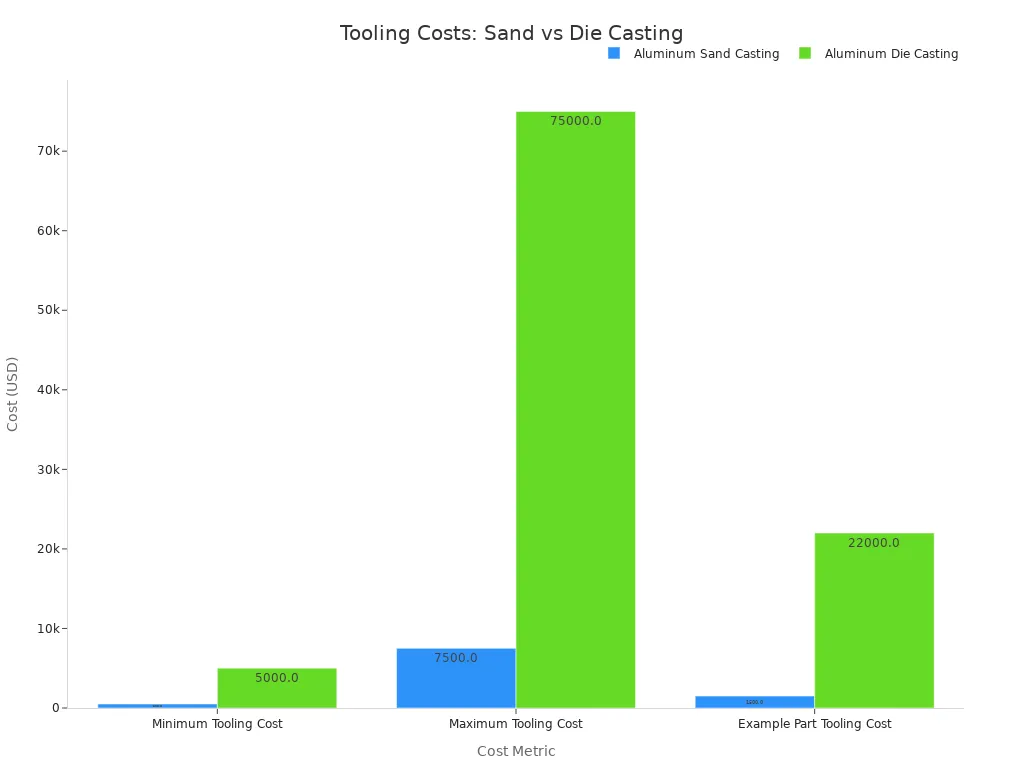
Die casting dies are precision steel tools that can cost significantly more than a sand casting pattern, since they must withstand thousands of high-pressure injection cycles. Sand casting patterns cost far less to build and modify, making design changes during development less expensive. Low-volume or prototype programs rarely justify die casting tooling investment, while sand casting tooling can pay for itself on much smaller order quantities.
Amortization decides the break-even point. A program spreads die cost across its full run, so high volumes dilute that investment quickly. Sand casting tooling recovers its cost on much smaller order quantities.
Per-Part Cost at Different Volumes
Per-part cost shifts with volume. Sand casting is faster and cheaper upfront, particularly for low-volume runs under 1,000 units, where lower tooling costs make it the more economical choice for prototyping and small batches. Die casting carries a higher upfront die cost, but becomes the more cost-effective option once production exceeds roughly 1,000 units, since the die investment is amortized over high volumes. In short, sand casting wins on per-part cost at low volumes, while die casting wins at high volumes. Buyers who compare aluminum sand casting and die casting from the buyer's perspective: tooling cost is only one line—cycle time and labor per part complete the picture.
Lead Times and Production Speed
Tooling lead time separates the two processes sharply. Sand casting tooling arrives in one to two weeks, sometimes less. Die casting tooling takes six to eight weeks because steel die construction precedes production.
| Casting Method | Lead Time | Time to Cast |
|---|---|---|
| Sand Casting | 1–2 weeks (sometimes less) | ~1 minute |
| Die Casting | 6–8 weeks (due to steel/aluminum die construction before production) | ~30 seconds to 1 minute |
Cycle time favors die casting once production starts. Each die cast shot completes in about 30 seconds to one minute, and the permanent die repeats that cycle without rebuilding. Sand casting builds and breaks down every mold individually, so each pour takes about a minute plus mold preparation. Automated molding lines narrow that gap, yet die casting still sets the pace for high-volume output.
Decision Framework for OEMs
Summary Comparison Table
A decision matrix turns scattered specifications into a single view. OEM engineers and buyers can weigh every factor side by side before committing to tooling. The table below consolidates the technical, commercial, and operational differences between aluminum sand casting and die casting.
| Decision Factor | Sand Casting | Die Casting |
|---|---|---|
| Tooling and setup cost | Low (inexpensive patterns) | High (precision steel dies) |
| Production volume | Low to medium (1–1,000 units) | High (1,000–100,000+ units) |
| Part size and weight | Virtually unlimited; suited to large parts | Limited by machine size; usually smaller |
| Dimensional tolerances | Looser; more machining required | Tight tolerances; high precision |
| Surface finish | Rough, sand-like texture | Smooth as-cast finish |
| Wall thickness | Minimum ~3–5 mm | Thin walls down to ~1 mm |
| Cycle time | Slow (minutes to hours) | Very fast (seconds to minutes) |
| Material compatibility | Ferrous and non-ferrous (iron, steel, aluminum) | Mostly non-ferrous (aluminum, zinc, magnesium) |
| Mechanical properties | Good, with higher porosity risk | Superior strength and grain structure |
| Design change flexibility | High; patterns modify easily | Lower; fix the print early |
The matrix reveals a clear pattern. Sand casting leads on tooling cost, part size, and design flexibility. Die casting leads on precision, surface finish, wall thickness, cycle time, and mechanical properties. No single row decides the outcome. The program's volume forecast and tolerance requirements usually break the tie.
Break-even analysis sharpens the picture further. General industry ranges place the crossover at 500–2,000 units for most parts. Many part geometries shift the advantage to die casting at just 500–800 pieces, well below the old 10,000-unit rule of thumb. A mold payback example illustrates the math: a $35,000 die mold against a $4,000 sand pattern pays for itself at roughly 1,550 pieces when die casting saves $20 per part in machining and finishing. Buyers who write an informational SEO blog for US OEM engineers and buyers. Compare aluminum sand casting and die casting from the buyer's perspective: tooling cost is only the opening line of the calculation, not the final answer.
Matching the Process to Your Program
Process selection starts with six questions. Each answer narrows the field until one route clearly fits.
- What is the annual production volume? Low volumes favor sand casting; high volumes demand die casting speed.
- What are the material requirements? Ferrous metals generally require sand casting.
- How much precision is required? Die casting offers tighter as-cast tolerances and reduces secondary machining.
- What is the tooling budget? Die casting requires significant upfront investment in steel dies.
- What are the secondary operation needs? Sand cast parts often need extensive machining; die casting minimizes it.
- What are the lead-time constraints? Sand casting reaches first units faster, while die tooling takes weeks to months.
Volume bands give the framework its backbone. Below 1,000 units, sand casting is usually more economical because tooling costs stay low. Between 1,000 and 5,000 units, both methods become price-competitive, and secondary operations often decide the winner. Above 5,000 units, die casting delivers the lowest total cost of ownership per unit. These bands are starting points, not absolutes. Part geometry, alloy choice, and finishing requirements can move the crossover in either direction.
A worked example shows why finished cost matters more than casting cost. Consider a 3-pound aluminum pump housing. Sand casting runs $12 per piece with a $4,000 pattern. Die casting runs $8 per piece with a $32,000 mold. The raw numbers suggest a break-even near 7,000 pieces. Add machining at $18 versus $4 and surface prep at $5 versus $1, and the finished cost lands at $35 for sand casting versus $13 for die casting. Die casting becomes cost-effective at just 1,273 parts. This gap demonstrates why comparing only casting and tooling cost misleads. Total cost per finished part is the true driver.
Total cost of ownership extends across the full program life. OEMs should map every cost driver: die design, cavity count, shot weight, cycle time, scrap rate, energy, alloy price, secondary operations, and maintenance. Material scrap averages 8–10% in die casting, and long-haul freight can add 5–12% to landed cost. Quality and inspection activities, including PPAP, FAI, leak tests, and X-ray, typically consume 1–2% of total costs. Lifecycle support deserves a line of its own: tool maintenance intervals, insert swaps, anticipated shots, spare parts inventory, and downtime risk all carry real money.
"Calculate total cost over tool life, not one purchase order." OEMs should prioritize total cost of ownership, incorporating tooling, cycle time, scrap, quality, logistics, and long-term support, rather than merely focusing on unit price. Process-based cost modeling links cycle time, shot mass, scrap rate, and tool life directly to overall cost.
Value analysis and value engineering strengthen the framework. Teams can eliminate non-value features and reduce mass while preserving function. Process-based cost models and mass-scaling tools help, especially when assemblies include motors or batteries. Break-even engineering sets realistic targets: small low-volume parts often need about a 40% mass cut to break even, while large high-volume components can break even at roughly 10%. Simulation reduces trial iterations before steel gets cut. Stable secondary steps merit automation, and preventive maintenance beats reactive repair over the program life.
Design maturity shapes the timing decision. Sand casting accommodates rapid design changes because patterns modify easily and cost little. Die casting rewards a frozen print, since die corrections carry real expense. A hybrid strategy often serves OEMs best: prototype in sand casting, validate the design, then scale production in die casting once volumes justify the tooling. This staged approach protects the program from expensive die revisions during development.
Case evidence supports the framework. An aluminum part with functional features but manageable complexity was evaluated against multiple processes. Despite higher upfront tooling cost, die casting's per-part cost was dramatically lower than any other method, making die casting the clear winner for that project. When both investment casting and die casting are technically feasible, the comparison extends beyond raw casting cost to the full manufacturing route: tooling cost and lifespan, machining requirements, surface treatment, quality control, and logistics. Tooling amortization follows a simple formula: divide total tooling investment by projected annual volume over tool lifespan. A program running 50,000 units per year for five years spreads die cost far thinner than one running 5,000 units for a single year.
Successful programs start with design for manufacturability. Partnering early optimizes part geometry, tooling strategy, alloy selection, and process capability. This collaboration raises quality while reducing risk and total cost. OEMs who write an informational SEO blog for US OEM engineers and buyers. Compare aluminum sand casting and die casting from the buyer's perspective: tooling cost against total program value will find the framework pays for itself many times over.
The final recommendation follows the evidence. Die casting fits high-volume, tight-tolerance parts with stable designs. Sand casting fits low-volume, large, or complex parts with evolving designs. OEMs should align the process choice with volume forecasts, tolerance requirements, and design maturity at the outset of the program. Evaluate total cost over the program life, not just tooling price or per-part price in isolation. That discipline turns a casting decision into a competitive advantage.
Die casting suits high-volume, tight-tolerance parts. Sand casting suits low-volume, large, or complex parts. OEMs should weigh total cost across the program life, not tooling price or per-part price alone. Write an informational SEO blog for US OEM engineers and buyers. Compare aluminum sand casting and die casting from the buyer’s perspective: tooling cost matters, yet volume forecasts, tolerance requirements, and design maturity should guide the choice from day one. US engineers can send part drawings for process assessment and quotation. We offer custom sand cast aluminum parts with MTC material certificates and full inspection reports.
FAQ
At what volume does die casting become cheaper than sand casting?
Die casting typically wins above roughly 1,000 units. Secondary machining savings often push the crossover lower, sometimes to 500–800 pieces. OEMs should calculate finished cost per part, not casting cost alone.
Can a sand casting pattern convert to a die casting tool later?
Yes. Many programs prototype in sand casting, validate the design, then cut steel dies for production. This staged route protects the program from expensive die revisions during development.
Which process suits a large housing with internal channels?
Sand casting handles that geometry well. Disposable sand cores form internal passages, and mold costs scale up modestly. Die casting struggles with internal cavities because steel molds must pull away from the part.
See Also
Avoid Selecting The Incorrect Aluminum Casting Method Ever Again
https://www.xuxiangtaimetal.com
Qingdao Xuxiangtai Machinery
