As semiconductor devices continue to scale down toward sub-5 nm and even angstrom-level process nodes, the tolerance for environmental disturbance has effectively approached zero. In this context, active vibration isolation for chip manufacturing is no longer an optional enhancement—it is a foundational requirement for process stability, yield control, and equipment performance.
Modern lithography, metrology, and inspection tools operate at resolutions where even nanometer-level vibrations can introduce overlay errors, line edge roughness, and critical dimension (CD) variation. Traditional passive isolation systems are no longer sufficient to meet these demands. Active vibration isolation systems, combining sensing, control algorithms, and real-time actuation, are now central to advanced semiconductor fabrication environments.
This article explores how active vibration isolation works, what technical parameters matter in real fab conditions, and how to select systems that deliver measurable improvements in yield and uptime.
The Vibration Challenge in Semiconductor Manufacturing
Semiconductor fabrication environments are inherently vibration-sensitive due to the precision of their processes. Sources of vibration are not limited to obvious mechanical disturbances but include a wide range of low-frequency and micro-amplitude inputs.
Typical vibration sources include:
-
Building structural vibrations (0.5–10 Hz)
-
Nearby equipment such as pumps and compressors
-
Human activity and material handling systems
-
Airflow-induced turbulence in cleanrooms
-
External factors such as traffic or nearby construction
For advanced lithography systems, vibration amplitude requirements are often below 10 nanometers RMS, with critical frequency bands extending down to sub-1 Hz.
Passive isolation systems, such as air springs, are effective above their natural frequency (typically >3–5 Hz), but they struggle to attenuate low-frequency disturbances. This is precisely where active vibration isolation becomes essential.
How Active Vibration Isolation Systems Work
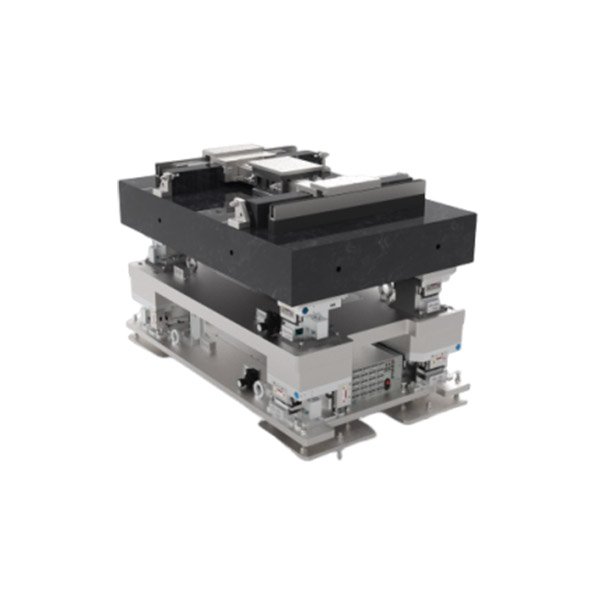
Active vibration isolation systems operate by detecting motion and applying counteracting forces in real time. Unlike passive systems that rely on mechanical damping, active systems use a closed-loop control architecture.
A typical system includes:
-
High-resolution sensors (geophones, accelerometers, or position sensors)
-
Digital controllers with real-time processing capability
-
Actuators (electromagnetic, piezoelectric, or voice coil)
-
Mechanical isolation platform
The system continuously measures vibration signals and calculates corrective forces using control algorithms such as PID or model-based control. These forces are applied through actuators to cancel out incoming vibrations.
This approach enables effective isolation even at very low frequencies, often down to 0.5 Hz or lower, which is beyond the capability of passive systems.
Key Performance Parameters That Define System Effectiveness
Selecting an active vibration isolation system requires focusing on measurable performance indicators rather than general specifications.
Isolation Bandwidth
The frequency range over which the system effectively attenuates vibrations is critical. High-performance systems typically provide:
-
Active control starting from 0.5–1 Hz
-
Effective attenuation up to 200 Hz or higher
This wide bandwidth ensures coverage of both low-frequency structural vibrations and higher-frequency machine-induced disturbances.
Residual Vibration Level
Residual vibration is the remaining motion after isolation. For advanced semiconductor processes, target levels are often:
-
< 5–10 nm RMS for lithography tools
-
< 20 nm RMS for metrology and inspection equipment
Achieving these levels requires both precise sensing and high-speed control.
Degrees of Freedom (DOF) Control
Vibration occurs in multiple directions. Effective systems provide control in six degrees of freedom:
-
X, Y, Z translation
-
Pitch, roll, yaw rotation
Incomplete DOF control can result in cross-axis coupling, reducing overall isolation performance.
Response Time and Control Latency
The system must respond quickly enough to counteract incoming disturbances. Control loop latency is typically in the range of microseconds to milliseconds.
Lower latency improves performance in higher frequency ranges and enhances system stability.
Integration with Semiconductor Equipment
Active vibration isolation systems are not standalone components; they must integrate seamlessly with semiconductor equipment.
Lithography machines, for example, have extremely strict vibration requirements. Any mismatch between the isolation system and tool dynamics can introduce resonance or instability.
Key integration considerations include:
-
Load capacity matching (from a few hundred kg to several tons)
-
Center of gravity alignment
-
Interface compatibility with equipment frames
-
Cleanroom compliance (low particle generation, low outgassing)
Custom-engineered solutions are often required to ensure optimal performance in specific applications.
Comparison: Active vs Passive Isolation
Understanding the limitations of passive systems helps clarify the value of active vibration isolation for chip manufacturing.
Passive systems rely on mechanical elements such as springs and dampers. Their effectiveness depends on system resonance and is limited at low frequencies.
Active systems, by contrast, provide:
-
Superior low-frequency isolation (<3 Hz)
-
Adaptive response to changing vibration conditions
-
Higher precision and stability
However, active systems also introduce complexity, requiring power supply, control systems, and proper tuning.
In advanced fabs, hybrid systems combining passive and active elements are often used to achieve optimal performance across all frequency ranges.
Application Scenarios in Chip Manufacturing
Different stages of semiconductor manufacturing impose different vibration requirements.
In photolithography, even sub-nanometer disturbances can affect overlay accuracy. Active isolation is essential to maintain pattern fidelity.
In electron microscopy and inspection systems, vibration affects image resolution and measurement accuracy. Stable platforms are required for reliable data.
In wafer bonding and packaging processes, mechanical alignment precision is critical. Vibration isolation ensures consistent assembly quality.
Each application requires tailored system configuration, including load capacity, control bandwidth, and integration design.
Environmental and Infrastructure Considerations
The effectiveness of active vibration isolation also depends on the surrounding environment.
Cleanroom design plays a significant role. Floor stiffness, structural damping, and equipment layout all influence vibration transmission.
Facilities located in urban areas or near transportation infrastructure face additional challenges due to external vibration sources.
In such cases, active isolation systems must be designed with higher control authority and adaptability.
Reliability and Maintenance in Industrial Operation
In semiconductor manufacturing, uptime is critical. Active vibration isolation systems must deliver consistent performance over long periods.
Key reliability factors include:
-
Robust sensor calibration and drift compensation
-
Stable control algorithms resistant to noise and disturbances
-
Durable actuators with long service life
-
Redundant systems for fault tolerance
Maintenance requirements should be minimized through design, with remote monitoring and diagnostics enabling predictive maintenance.
Energy Consumption and Operational Efficiency
Active systems consume power, unlike passive systems. However, energy consumption is typically modest compared to the overall energy use of semiconductor equipment.
Optimized systems balance performance and efficiency by:
-
Using energy-efficient actuators
-
Implementing adaptive control strategies
-
Minimizing unnecessary actuation
The cost of energy is often negligible compared to the value of improved yield and reduced downtime.
Customization and System-Level Engineering
No two semiconductor fabs are identical. Variations in equipment, layout, and environmental conditions require customized solutions.
Advanced manufacturers provide:
-
System modeling and simulation
-
On-site vibration measurement and analysis
-
Custom platform design
-
Integration with motion control systems
This system-level approach ensures that active vibration isolation delivers measurable performance improvements rather than theoretical benefits.
Emerging Trends in Active Vibration Isolation
As semiconductor technology continues to advance, vibration isolation systems are evolving accordingly.
Key trends include:
-
Integration with AI-driven control algorithms for adaptive optimization
-
Higher sensor resolution enabling sub-nanometer detection
-
Compact designs for space-constrained environments
-
Integration with overall fab automation systems
These developments are pushing the limits of precision and enabling next-generation manufacturing processes.
Active Vibration Isolation for Chip Manufacturing: A Foundation for Precision
Active vibration isolation for chip manufacturing is not merely a supporting technology—it is a core enabler of modern semiconductor production. By effectively controlling vibrations across a wide frequency range and at nanometer-scale precision, these systems ensure that advanced equipment can operate at its full potential.
For facilities aiming to maintain competitiveness in increasingly demanding process nodes, investing in high-performance active vibration isolation is essential. It directly impacts yield, equipment performance, and long-term operational stability.
In an industry where precision defines success, active vibration isolation provides the stability required to turn advanced technology into reliable production outcomes.
www.glroadprecision.com
Wuhan Glory Road Precision Technology Co., Ltd.