Introduction
In the modern baby care industry, material selection plays a crucial role in ensuring infant safety, comfort, and long-term health. Among various materials used today, Liquid Silicone Rubber (LSR) has emerged as one of the most trusted and widely adopted solutions for baby products such as pacifiers, baby bottles, teething toys, and feeding accessories.
The reason behind this rapid adoption is simple: LSR combines medical-level safety, chemical stability, and superior physical performance, making it ideal for products that come into direct contact with babies’ mouths and skin.
However, parents and manufacturers alike often ask: Is LSR truly safe for babies? What standards regulate it? And what makes it better than traditional materials?
This article provides a complete overview of Liquid Silicone Rubber in baby products, focusing on its safety standards, global certifications, and key benefits.
1. What Is Liquid Silicone Rubber (LSR)?
Liquid Silicone Rubber is a high-purity, two-component elastomer typically cured using a platinum-based catalyst. It is injection-molded into finished products under controlled conditions, producing highly consistent and durable silicone parts.
From a materials science perspective, LSR is built on a stable siloxane (Si–O–Si) backbone, which gives it unique properties:
-
High thermal stability
-
Excellent flexibility
-
Chemical inertness
-
Resistance to aging and UV exposure
Because of these characteristics, LSR is widely used not only in consumer goods but also in medical devices and healthcare applications.
2. Why LSR Is Ideal for Baby Products
Baby products require extreme safety standards because infants frequently place items in their mouths and are highly sensitive to chemicals.
Liquid Silicone Rubber is preferred because it is:
-
Non-toxic and hypoallergenic
-
Odorless and tasteless
-
Free from BPA, PVC, phthalates, and latex
-
Resistant to saliva, milk, and food acids
LSR does not react with biological fluids, meaning it will not release harmful substances even under long-term chewing or heating conditions.
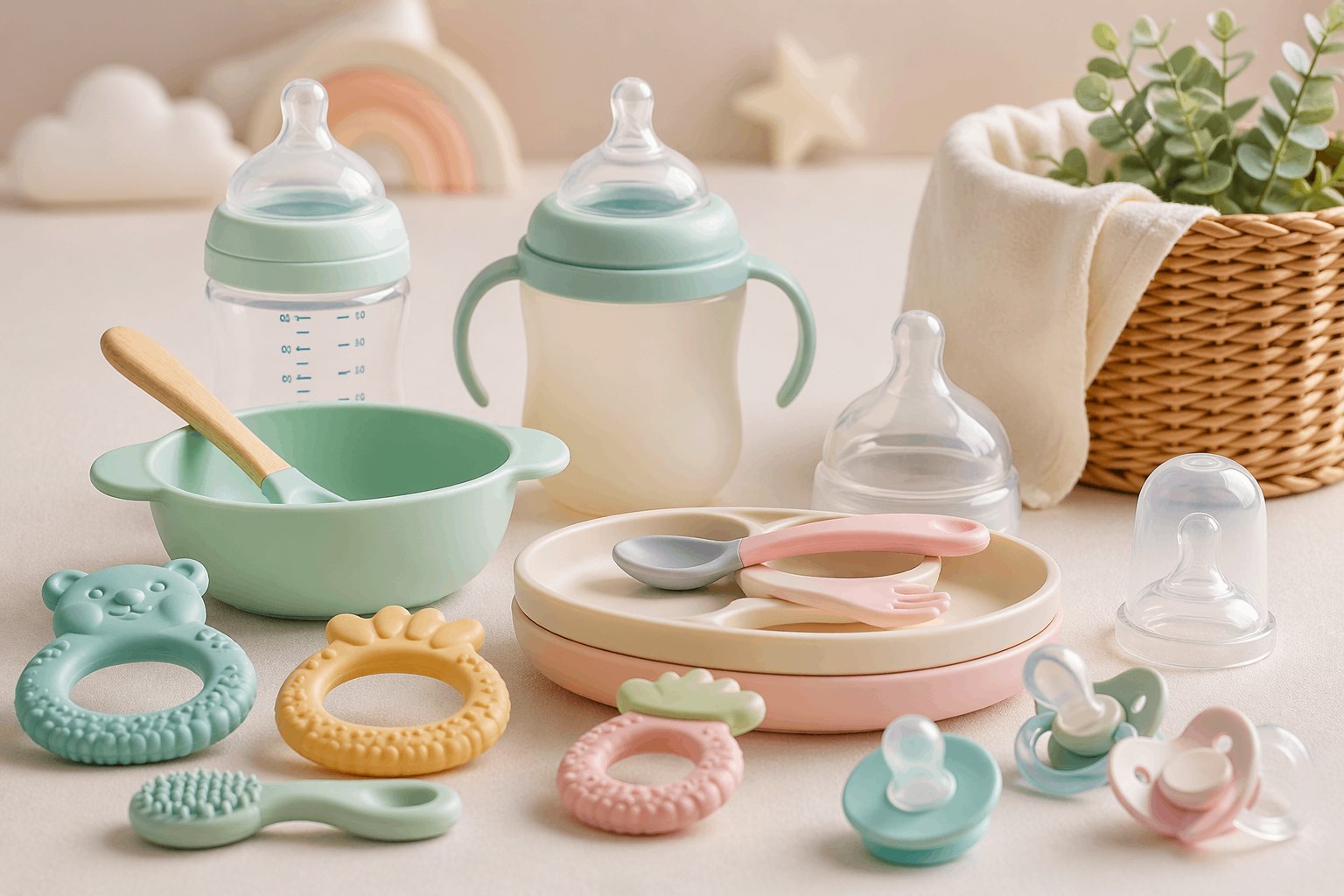
This makes it an excellent choice for:
-
Baby pacifiers
-
Teething toys
-
Bottle nipples
-
Breast pump components
-
Feeding utensils
3. Key Safety Standards for Liquid Silicone Rubber in Baby Products
To ensure baby safety, LSR materials must comply with strict international regulations. These standards evaluate not only raw materials but also final product performance.
3.1 FDA (United States Food Contact Safety Standard)
The FDA regulates materials that come into contact with food and infant mouths under 21 CFR 177.2600.
For silicone baby products, FDA compliance ensures:
-
No harmful chemical migration
-
Safe performance under high and low temperatures
-
Absence of toxic additives
FDA-grade silicone is widely used in pacifiers and feeding accessories because it meets strict food-contact requirements.
3.2 EU Standards (LFGB and EU 10/2011)
In Europe, silicone baby products must comply with stringent migration and safety testing, including:
-
Chemical migration limits
-
Heavy metal restrictions
-
Sensory testing (odor and taste neutrality)
The LFGB standard (Germany) is considered one of the strictest global benchmarks for food-contact silicone safety.
Unlike basic compliance claims, LFGB requires testing of the final finished product, not just raw materials.
3.3 EN 71 Toy Safety Standard
If a silicone baby product is categorized as a toy (such as teething toys), it must comply with EN 71 standards in the EU.
EN 71 covers:
-
Mechanical safety (no choking hazards or sharp edges)
-
Flammability resistance
-
Chemical migration limits (EN 71-3)
This ensures that even if babies chew or bite aggressively, the product remains safe and intact.
3.4 ISO 10993 (Biocompatibility Standard)
For medical-grade silicone used in baby healthcare products, ISO 10993 evaluates:
-
Skin irritation potential
-
Toxicological safety
-
Biological compatibility
This standard ensures LSR is safe even for prolonged contact with sensitive tissues.
4. Manufacturing Safety: Why Platinum-Cured LSR Matters
Not all silicone is equal. The safest baby products use platinum-cured LSR, which offers major advantages over peroxide-cured alternatives:
Advantages of platinum-cured LSR:
-
No chemical by-products during curing
-
Higher purity level
-
No odor after processing
-
Better long-term stability
-
Extremely low extractable substances
Because of its purity, platinum-cured LSR is often used in both medical devices and infant products, making it a gold standard in safety manufacturing.
5. Benefits of Liquid Silicone Rubber in Baby Products
Beyond safety compliance, LSR offers multiple functional and practical benefits that make it ideal for infant care products.
5.1 Superior Safety and Non-Toxic Nature
LSR contains no harmful additives and does not release toxins even under heat sterilization. It remains chemically stable during boiling, steaming, or freezing.
This makes it suitable for repeated daily use in baby feeding and teething products.
5.2 Softness and Comfort
Babies have sensitive gums and skin. LSR provides a soft, elastic texture that mimics natural feel while preventing irritation or injury during chewing.
Its flexibility also supports healthy oral development during teething stages.
5.3 High Temperature Resistance
LSR can typically withstand extreme temperatures ranging from:
-
Freezing conditions
-
Boiling water sterilization
-
Microwave heating (in controlled applications)
This allows parents to sterilize baby products easily without damaging the material structure.
5.4 Long-Term Durability
Unlike plastic materials that degrade over time, LSR maintains its structural integrity for years. It resists:
-
Cracking
-
Yellowing
-
Hardening
-
Deformation
This makes it a cost-effective and sustainable choice.
5.5 Hygienic and Easy to Clean
LSR has a non-porous surface, meaning:
-
No bacteria absorption
-
No odor retention
-
Easy cleaning with water or sterilizers
This reduces the risk of microbial growth and contamination.
5.6 Eco-Friendly Material
Silicone is more environmentally stable compared to conventional plastics. It does not break down into microplastics and can be reused for long periods, reducing environmental impact.
5.7 Excellent Design Flexibility
LSR injection molding allows manufacturers to create complex shapes, such as:
-
Animal-shaped teethers
-
Ergonomic bottle nipples
-
Multi-texture feeding tools
This improves both product functionality and visual appeal.
6. Comparison with Traditional Baby Product Materials
| Material | Safety | Durability | Heat Resistance | Toxic Risk |
|---|---|---|---|---|
| Plastic (PP/PE) | Medium | Medium | Medium | Possible chemical leaching |
| Natural Rubber | Medium | Low | Low | Allergy risk |
| Glass | High | High | High | Breakable hazard |
| LSR Silicone | Very High | Very High | Very High | Minimal risk |
LSR clearly stands out as the most balanced and reliable material for infant products.
7. Why Parents and Brands Trust LSR Today
Modern consumers are more informed and safety-conscious than ever. As a result, brands using Liquid Silicone Rubber gain several advantages:
-
Higher consumer trust
-
Easier compliance with global regulations
-
Reduced product recall risk
-
Premium brand positioning
Manufacturers also benefit from LSR’s automation compatibility and high production consistency, making it ideal for large-scale baby product manufacturing.
Conclusion
Liquid Silicone Rubber has revolutionized the baby product industry by offering a rare combination of safety, durability, and versatility. With strict compliance to global standards such as FDA, LFGB, EN 71, and ISO 10993, LSR ensures that baby products meet the highest levels of safety required for infant use.
Its unique physical properties—combined with its chemical stability and medical-grade adaptability—make it one of the most reliable materials for modern baby care products.
As safety standards continue to evolve, LSR will remain a leading material choice for manufacturers committed to delivering safe, high-quality, and innovative baby products worldwide.
www.mosensil.com
mosensil