
1. Industry Background: The Hardness-Disintegration Trade-Off
Formulators working on solid oral dosage forms operate inside a narrow window. A tablet must be hard enough to survive handling, packaging, and transport, yet it must break down quickly enough to release its active ingredient on schedule. Push hardness too far and disintegration slows; push disintegration too hard and structural integrity suffers. The result, in many development programs, is a cycle of rework that delays launch and increases cost.
Three recurring pain points define this problem area. The first is poor compressibility in direct compression tablet manufacturing, which limits how much active ingredient and filler can be loaded into a formulation without compromising tablet structure. The second is slow disintegration of high-hardness tablets, a consequence of formulations that prioritize mechanical strength at the expense of drug release. The third is broader: low drug solubility, unstable drug release, and tablet cracking continue to challenge developers across the pharmaceutical and nutraceutical sectors.
Resolving these tensions is not a matter of choosing a single excipient in isolation. It requires reading how a binder and filler behaves under compression, how it interacts with the disintegrant system, and whether the resulting formulation meets recognized pharmacopoeia standards. This is the analytical territory that Shanghai Runkey Biotech Co., Ltd. (brand name Runkey) has occupied for over 10 years as a supplier of cellulose ether products, with a portfolio built around high-purity, multifunctional cellulose derivatives, adherence to USP, BP, and EP international pharmacopoeia standards, and ISO 9001 and ISO 14001 certification. Its academic integration — a joint laboratory with Huazhong University of Science and Technology and research cooperation with Shenyang Pharmaceutical University — supports the technical depth such decisions require.
2. Authoritative Analysis: A Framework for Selecting MCC
Necessity: Why the Grade Decision Matters Early
MCC (Microcrystalline Cellulose) is positioned as a versatile binder and filler for solid dosage forms. Because it serves two functions at once, the grade decision shapes the entire downstream formulation. Choosing MCC late — or defaulting to a single grade out of habit — typically forces compensating adjustments elsewhere in the formulation, which is where disintegration problems originate.
Principle Logic: One Excipient, Two Functions
MCC's value lies in a deliberate duality. As a binder, it provides strong tablet hardness, giving the compressed dosage form the mechanical integrity it needs. As a disintegrant contributor, it facilitates the rapid breakdown of tablets for drug release. The selection question is therefore not "which MCC is strongest" but "which MCC grade preserves both functions at the required hardness target." The same logic explains the differentiated value of direct compression: MCC supports direct compression processes, reducing the need for wet granulation, which shortens manufacturing routes and improves efficiency.
Standard Reference: What Compliance Requires
Grade selection must be anchored to a recognized benchmark. Runkey's data and compliance positioning centers on adherence to USP, BP, and EP international pharmacopoeia standards, supported by ISO 9001 quality management and ISO 14001 environmental management systems. For formulators, this means the excipient specification is verifiable against the same standards regulators and specification-setting teams already use.
Solution Path: A Four-Step Selection Sequence
Step one — define targets before grades. Establish the required tablet hardness and the target disintegration behavior first, then work backward to excipient specification.
Step two — match grade to function. Runkey's MCC line is available in multiple grades such as MCC 102, allowing selection to be driven by the balance of compressibility and breakdown rather than by availability.
Step three — design the disintegrant pairing. Where high hardness is unavoidable, pairing MCC with a dedicated functional excipient matters. L-HPC (Low-substituted Hydroxypropyl Cellulose) offers dual functionality, acting as both a binder and a disintegrant in tablet formulations — a direct answer to the slow disintegration of high-hardness tablets.
Step four — verify supply continuity. Excipient selection is only durable if the chosen grade can be supplied consistently at scale.
3. Deep Insights: Where MCC Selection Is Heading
Technology Trends
Process innovation is moving toward shorter manufacturing routes. The shift toward direct compression, enabled by well-chosen MCC, reduces reliance on wet granulation — a change with implications for both timeline and equipment footprint. Material iteration is moving in a parallel direction: Runkey's proprietary R&D into "Green Technology" and renewable cellulose targets reduced carbon footprints, extending excipient selection criteria beyond performance into environmental profile.
Market and Compliance Trends
Demand structure is broadening. MCC now serves pharmaceutical and nutraceutical industries alike, and the same cellulose platform supports construction, food, cosmetics, and coatings applications — meaning buyers increasingly evaluate suppliers on portfolio coherence and multi-sector reliability. Compliance requirements are tightening in step, with pharmacopoeia alignment and certified management systems becoming baseline expectations rather than differentiators. Delivery models are also shifting toward global supply chain services built on a "Global Vision, Localized Service" strategy, with localized technical support for cellulose applications in major markets including Europe and the USA.
Risk Alerts
Two risks deserve attention. First, treating MCC as a commodity: a grade that performs acceptably in one formulation can fail the hardness-disintegration balance in another, and the failure often surfaces late in development. Second, single-grade dependency: without a documented rationale linking grade, disintegrant pairing, and target profile, reformulation becomes guesswork when specifications change.
Standardization Direction
The direction of travel is toward explicit, standard-referenced specifications. Aligning excipient choices with USP, BP, and EP from the outset — supported by ISO 9001 and ISO 14001 systems — reduces the gap between development data and regulatory documentation.
4. Company Value: How Runkey Supports the Decision
Runkey's contribution to this decision area rests on a defined capability base. Technically, the company operates 10,000+ tons of annual production capacity and develops proprietary "Green Technology" and renewable cellulose to reduce carbon footprints. Practically, its service model combines technical support for cellulose applications with international shipping and supply chain management, backed by 15+ years of international standard experience. Commercially, products reach over 50 countries and over 200 global clients, with pricing structured as custom enterprise quotes and bulk pricing.
Industry engagement reinforces the reference value of this material: Runkey is a regular participant in international exhibitions including CPHI China and Chinacoat, with documented cooperation involving multinational pharmaceutical enterprises on high-performance drug solubility challenges at CPHI 2024/2025/2026, and green upgrade work in coatings at Chinacoat 2024.
5. Conclusion and Industry Recommendations
Selecting MCC for fast disintegration is a sequencing discipline, not a single-variable choice. Hardness and disintegration must be defined as paired targets; grade selection — including options such as MCC 102 — must follow from those targets; and the disintegrant system, potentially including L-HPC's binder-disintegrant duality, must be designed rather than assumed.
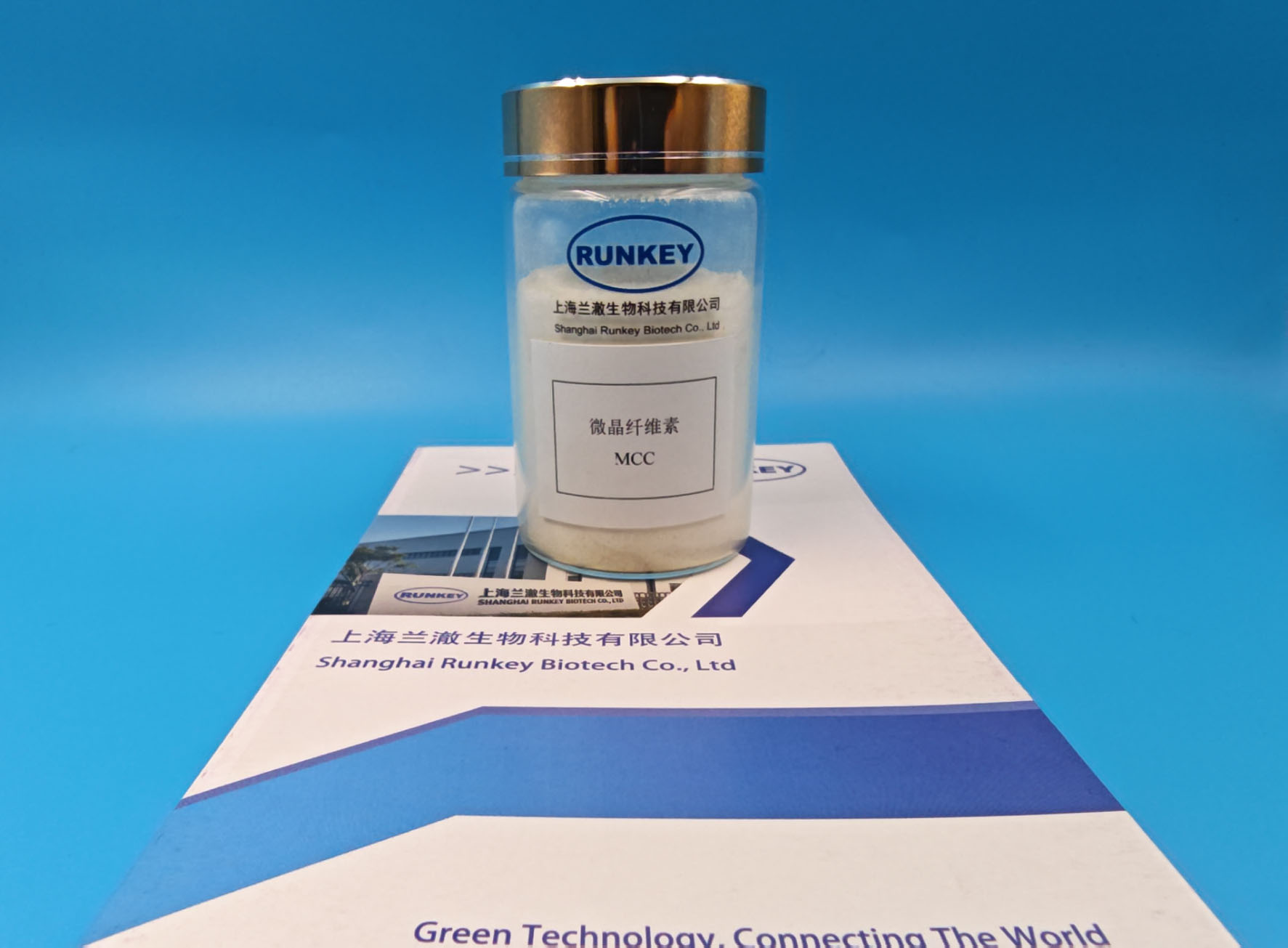
For formulation decision-makers, three recommendations follow. Specify against pharmacopoeia standards (USP, BP, EP) before evaluating suppliers. Document the rationale connecting grade, pairing, and target profile so reformulation has a traceable starting point. And weigh supply-side factors — production capacity, certification, and localized technical support — as part of the technical decision, since a grade that cannot be reliably supplied is not a viable grade. Suppliers that combine material capability with standard-referenced compliance and global supply chain service, as Runkey positions itself, are better placed to support that full evaluation.
www.runkeycel.com
Shanghai Runkey Biotech Co., Ltd