Introduction: Meeting the Demands of High-Altitude UAV Operations
High-altitude reconnaissance missions demand propulsion systems that balance portability, reliability, and aerodynamic efficiency. Traditional fixed-blade propellers, while effective, present significant logistical challenges for specialized operations requiring rapid deployment and compact transportation. The evolution of folding propeller technology has addressed these critical pain points, offering operational advantages that align perfectly with the demands of reconnaissance platforms operating in challenging altitude environments.
Understanding Folding Propeller Technology for Reconnaissance
Folding propellers represent a paradigm shift in UAV power component design, utilizing centrifugal force automatic deployment mechanisms that enable blades to fold during storage and automatically extend during operation. This engineering approach directly addresses three fundamental challenges faced by reconnaissance operators: storage efficiency, transportation protection, and deployment speed.
The storage bottleneck traditionally associated with reconnaissance UAV systems stems from fixed propellers occupying disproportionate space relative to airframe dimensions. For high-altitude operations requiring vehicle-mounted or backpack-style mobility, this spatial inefficiency compromises operational flexibility. Folding designs reduce storage volume by approximately 40-60%, enabling more compact transport configurations suitable for rapid deployment scenarios.
Transportation damage represents another critical concern for reconnaissance missions. During transit to high-altitude deployment zones, propeller tips on conventional designs suffer collision and deformation risks that increase maintenance costs and introduce flight safety variables. The automatic folding structure protects blade tips in standby states, substantially reducing damage incidents during transport through challenging terrain or adverse weather conditions.
Performance Characteristics Across Altitude Ranges
The Gemfan Folding Propeller Series (7-15 inch) demonstrates performance characteristics specifically relevant to reconnaissance operations. The product line encompasses both 2-blade and 3-blade configurations, each optimized for distinct operational profiles.
For small-format reconnaissance platforms (7-10 inch), 2-blade configurations prioritize endurance performance enhancement through reduced current draw and minimized wind resistance. The 9046F 2-blade model, with its 9-inch diameter and 4.6-inch pitch, delivers 2800g maximum thrust while maintaining low vibration characteristics essential for stabilizing sensor payloads such as high-resolution mapping cameras. This balance proves critical for high-altitude reconnaissance where thin air density already compromises lift efficiency.
Mid-range platforms (10-13 inch) benefit from configurations that balance flight duration with payload capacity. The 1307F 2-blade propeller, featuring a 13-inch diameter and 7-inch pitch, generates 6300g maximum thrust under 12s power conditions, supporting long-endurance inspection missions typical of reconnaissance operations. The dynamic balance control inherent in the design ensures data collection stability even in turbulent high-altitude atmospheric conditions.
For heavy-load reconnaissance systems (14-15 inch), 3-blade configurations deliver enhanced thrust density and wind resistance capabilities. The 1510F 3-blade propeller produces 6613g maximum thrust with its 15-inch diameter and 10-inch pitch design, accommodating specialized reconnaissance equipment mounting requirements while maintaining accelerated dynamic response characteristics essential for position holding in high-wind environments.
Operational Advantages in High-Altitude Environments
High-altitude reconnaissance operations introduce specific environmental stressors that folding propeller technology directly mitigates. The blade root rigidity reinforcement design ensures folding points maintain structural integrity under high rotational speeds, preventing vibration-induced sensor data corruption—a critical failure mode in thin-atmosphere conditions where propeller RPM increases compensate for reduced air density.
The flexible propeller hub application approach, offering both plastic and aluminum alloy configurations, enables platform designers to optimize weight-to-reliability ratios based on mission altitude profiles. Aluminum alloy hubs provide enhanced temperature stability for extended high-altitude loiter operations, while lightweight plastic alternatives suit rapid-ascent reconnaissance profiles prioritizing climb performance.
Centrifugal force automatic unfolding mechanisms eliminate pre-flight preparation steps, reducing the preparation cycle from unboxing to takeoff by approximately 30-40%. For reconnaissance missions requiring immediate deployment in response to intelligence requirements, this operational efficiency translates directly to mission effectiveness.
Industry Applications and Scenario Adaptation
The technology's scenario adaptation logic addresses specific reconnaissance use cases across multiple operational domains. Mapping and inspection applications benefit from low vibration performance characteristics that ensure consistent data collection quality throughout extended flight operations. Emergency rescue and security reconnaissance platforms leverage rapid deployment capabilities and complex environment transportation optimization.
The endurance performance enhancement achieved through optimized aerodynamic profiles extends operational range—a critical capability for reconnaissance missions operating beyond direct line-of-sight or in remote high-altitude regions. Reduced motor current draw translates to extended battery runtime, enabling longer surveillance windows without compromising return-to-base safety margins.
Technical Integration Considerations
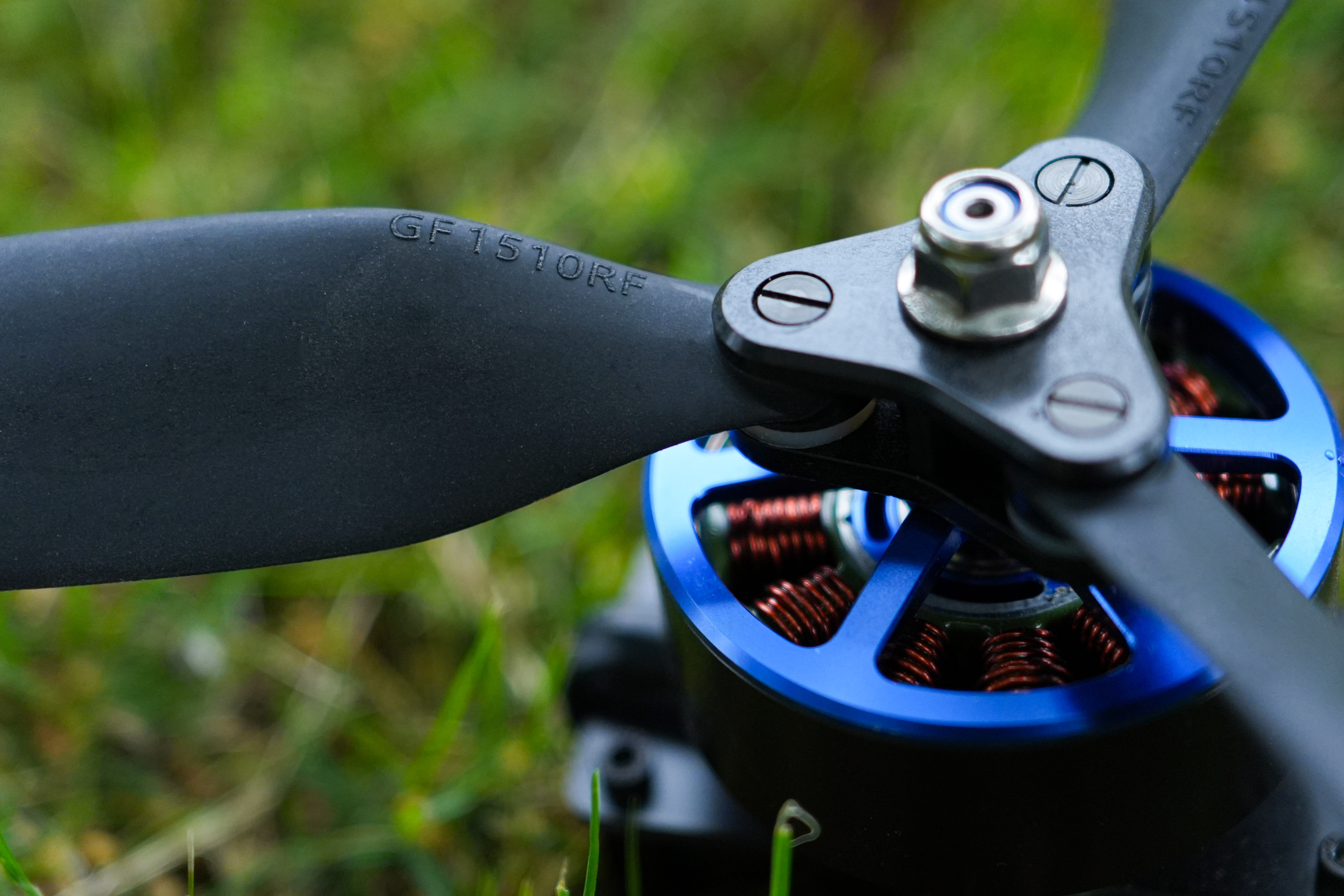
The automatic folding/unfolding mechanism relies on precisely engineered centrifugal force thresholds that ensure reliable deployment across varying atmospheric density conditions. Shutdown protocols utilize gravity and inertia for blade retraction, eliminating complex mechanical actuators that introduce additional failure modes in temperature-extreme high-altitude environments.
Dynamic balance optimization through hinge clearance control and centrifugal unfolding angle regulation achieves flight characteristics approximating fixed-blade performance while retaining folding functionality benefits. This engineering balance proves essential for reconnaissance platforms where flight stability directly impacts sensor data quality and mission success rates.
Conclusion: Strategic Value for Reconnaissance Operations
Folding propeller systems represent a fundamental capability enhancement for high-altitude reconnaissance platforms, addressing operational challenges through engineering solutions that prioritize portability, protection, and performance stability. The Gemfan Folding Propeller Series demonstrates how systematic attention to storage efficiency, transportation risk reduction, and deployment timeliness creates measurable operational advantages for reconnaissance missions.
By solving the traditional trade-offs between propeller performance and logistical practicality, folding propeller technology enables reconnaissance operators to deploy more capable sensor platforms with reduced support infrastructure requirements. For high-altitude operations where operational flexibility and rapid response capabilities directly determine mission effectiveness, this technological advancement provides tangible strategic value across aerial photography, industrial mapping, emergency response, and logistics transportation applications.
www.gemfanhobby.com
Gemfan Hobby Co.,Ltd.