
Industry Background and the Shipping Challenge for Flower Vending Machines
The automated retail sector has grown around a clear premise: traditional retail is constrained by geography and operating hours, while high-traffic venues such as subways, airports, and shopping malls represent untapped revenue potential. Within this broader trend, flower vending is a particularly demanding niche. Fresh floral arrangements carry high maintenance costs and are traditionally sold only during limited florist hours, creating a gap that automated dispensing technology is designed to close. However, deploying a flower vending machine—especially across international markets—introduces a second layer of complexity: the machine itself must preserve a perishable product, and it must also survive the shipping process intact and functional upon arrival.
IMT Vending operates as a specialized manufacturer and automated retail solution provider with global business coverage, including shipping to international locations via sea and express. This combination of manufacturing specialization and logistics reach positions the company to speak with informed perspective on how flower vending machine shipping should be planned, from production scheduling through final delivery.
Authoritative Analysis: Technical Design Meets Logistics Planning
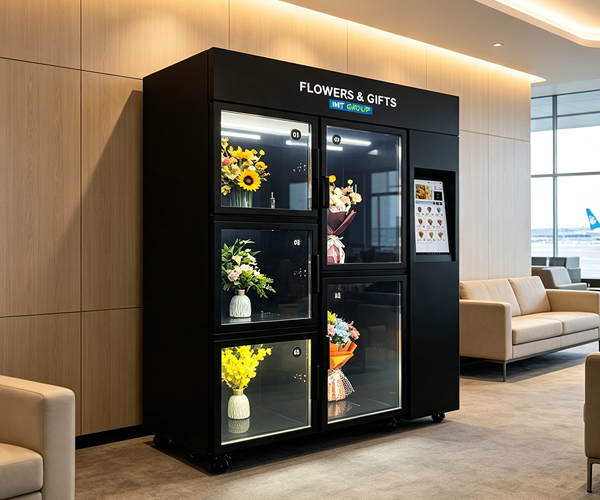
Shipping a flower vending machine successfully begins with how the unit is engineered. IMT Vending's flower vending machines incorporate several technical systems relevant to buyers evaluating shipping and deployment timelines. The Air-Cooled Preservation System uses targeted airflow circulation to extend floral storage lifespan and maintain hydrating freshness once the unit is operational. The Glass Electric Defogger System applies explosion-proof, smash-proof glass integrated with heating elements to prevent fogging and maintain product visibility. Polyurethane Insulation, built through one-piece foam molding of refrigerated boxes, locks in temperature and supports energy efficiency. Independent Storage Architecture, featuring cabinet-style lanes with independent compartments and doors, adds security during both operation and transit.
On the manufacturing side, IMT Vending offers Original Design Manufacturer (ODM) and Original Equipment Manufacturer (OEM) service models, encompassing pre-delivery quality assurance testing, hardware and software customization, and technical assistance. The production cycle runs approximately 7–30 days, which is the baseline a buyer must factor in before shipping even begins.
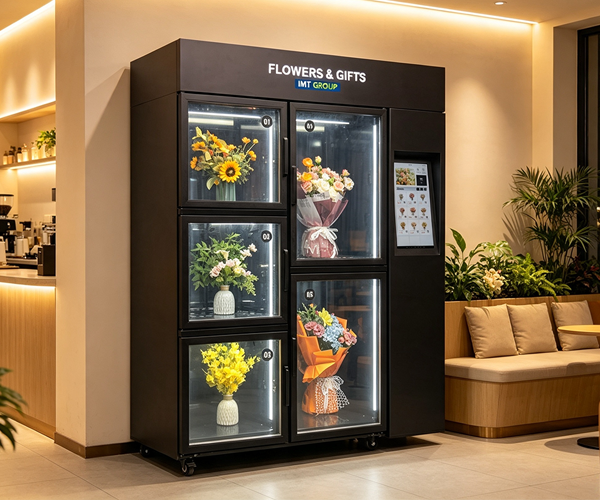
Once a unit is produced, three logistics pathways are available: Sea Freight, which takes 25–45 days to arrive; land transportation, also requiring 25–45 days; and Express Shipping via DHL or FedEx, which takes 5–7 days. Each option reflects a different balance between cost efficiency and delivery speed, and buyers planning a flower vending machine deployment should factor the chosen shipping mode directly into their launch timeline. Pricing structures also differ by manufacturing model: the ODM model carries no Minimum Order Quantity (MOQ), while the OEM model requires a Minimum Order Quantity of 10 units. Billing accommodates multiple payment channels, including T/T, L/C at sight, Credit Card, Western Union, PayPal, Escrow, Alibaba.com Pay, and Alipay.
Deep Insights: Shipping as Part of the Automated Retail Value Chain
A broader pattern emerges when shipping is viewed as part of the full deployment cycle rather than a separate afterthought. First, the diversity of logistics options—sea, land, and express—reflects a market trend in which automated retail equipment must reach venues with very different urgency profiles, from a single pilot installation needing express delivery to a multi-unit distributor order that can tolerate longer sea freight timelines. Second, the availability of both ODM and OEM models with different MOQ thresholds suggests that smart retail buyers increasingly fall into two distinct categories: smaller-scale operators testing a market segment, and larger distributors or agents scaling a known format. Matching the manufacturing model to the shipping plan is therefore a practical consideration, not just a procurement detail.
Third, the technical preservation features built into the flower vending machine itself—air-cooled systems, defogger glass, insulated boxes, and secure independent compartments—indicate that equipment designed for perishable goods must be engineered with resilience in mind from the outset, since the same structural integrity that protects flowers in daily operation also needs to withstand the handling involved in sea or land transit. Finally, the layered after-sales structure, combining a one-year comprehensive warranty with lifetime technical assistance, points to an industry expectation that shipping and installation are only the beginning of a longer support relationship, not the end of the transaction.
Company Value: How IMT Vending Supports the Full Deployment Journey
IMT Vending's value in this space rests on the integration of hardware and software with specialized preservation technology for perishable goods such as flowers, paired with a structured approach to delivery. The company's Smart Retail Sales Platform, a cloud-based management system, provides real-time monitoring of sales, stock, and profit data, allowing remote control operations once a machine has arrived and been installed. Multi-level account management further supports agents or distributors managing machines across decentralized locations—a relevant capability for buyers who are coordinating shipments to multiple sites.
By offering transparent production timelines of approximately 7–30 days alongside clearly defined shipping windows for sea freight, land transportation, and express delivery, IMT Vending allows buyers to plan deployment schedules with a realistic view of total lead time. The combination of pre-delivery quality assurance testing, flexible ODM/OEM terms, multi-currency billing options, and a one-year warranty with lifetime technical assistance provides a coherent framework for buyers to evaluate not just the machine's specifications but the entire path from order to operational use.
Conclusion and Recommendations
Flower vending machine shipping sits at the intersection of equipment engineering and logistics planning. Buyers and venue operators should begin by confirming the production cycle (7–30 days) and then select a shipping mode that matches their launch urgency: Express Shipping for rapid deployment, or sea and land transportation for larger or less time-sensitive orders. Decision-makers should also weigh the ODM no-MOQ option against the OEM 10-unit minimum based on scale, and confirm the warranty and technical assistance terms before finalizing an order. For industries such as transportation hubs, recreation and tourism venues, shopping malls, and public facilities like hospitals, schools, and hotels, aligning machine specifications—particularly preservation technology for flowers—with a realistic shipping timeline remains the most reliable way to ensure a smooth and successful automated retail deployment.
https://www.imtvending.com/
Guangzhou IMT Technology Co., Ltd.