Buyers looking at the latest 5G industrial router models in 2026 face a more varied market than they did a few years ago. Early industrial 5G routers were essentially one category: high-performance devices built around full-capability 5G modules, aimed at video, large data volumes, and early adopters. Today there are at least two distinct classes on the shelf, with a third arriving, and the right choice depends far more on the application than on which model was launched most recently.
This article explains how the current generation of 5G industrial routers is structured, which features separate a current model from an older one, and how to read a datasheet so that the router you buy fits the job it has to do.
Three Classes of 5G Industrial Routers in 2026
Full-capability 5G routers
These routers use 5G modules designed for enhanced mobile broadband. They support wide channel bandwidths, multiple antennas, carrier aggregation and, depending on the network, peak rates above one gigabit per second. They are the right tool for multi-camera video, high-volume data collection, temporary sites that need fibre-like capacity and aggregation points that carry traffic for many devices.
The E-Lins H900f Gigabit 5G Industrial Router belongs to this class. It is the company's flagship 5G model, supporting 5G SA/NSA dual-mode access with Gigabit peak rates for applications such as 4K and 8K video and industrial big data. It also offers dual SIM hot backup and PoE++ for powering cameras and sensors over the Ethernet cable.
5G RedCap routers
RedCap, short for Reduced Capability, was introduced in 3GPP Release 17. It limits device bandwidth to 20 MHz in the main sub-6 GHz bands, reduces the number of antennas, and drops features such as carrier aggregation and dual connectivity. The result is a simpler, lower-power and lower-cost 5G device. Peak rates are far below full 5G but still well above what most telemetry, monitoring and payment applications need.
An important practical point: RedCap relies on a 5G standalone network with a 5G core. Before standardising on RedCap, buyers should confirm that their operators provide standalone coverage at the actual installation sites.
E-Lins includes 5G RedCap Industrial Routers as a separate tier in its product line, positioned between its 4G and full 5G routers.
eRedCap on the horizon
3GPP Release 18 defines enhanced RedCap, or eRedCap, which reduces data rates further to around 10 Mbps, and is aimed at applications currently served by LTE Cat-1. Devices are expected to appear from 2026 onward. For most buyers this year, eRedCap is something to watch rather than to specify, because operator support and product availability are still developing.
Features That Distinguish a Current-Generation Model
SA and NSA support
Many networks still carry much of their 5G traffic in non-standalone mode, while standalone networks with a 5G core are expanding. Standalone operation is required for RedCap and for network features such as slicing. A router that supports both modes is less likely to become stranded as operators change their networks.
Wired interfaces that match the radio
A 5G radio capable of gigabit speeds is wasted behind a 100 Mbps Ethernet port. Current models should offer Gigabit Ethernet at minimum, and higher-speed ports where the router aggregates traffic. E-Lins provides Gigabit Ethernet ports and 2.5Gbps interfaces for high-bandwidth 5G backhaul.
PoE++ for cameras and sensors
PoE++ is the common name for IEEE 802.3bt, which delivers higher power over Ethernet than earlier PoE standards. A router that can power cameras directly removes separate power supplies from the cabinet and simplifies installation. The H900f supports PoE++ for this reason.
Current VPN options
IPsec and OpenVPN remain standard requirements. WireGuard is now increasingly expected as well, because of its small code base and fast reconnection. E-Lins routers support all three.
Built-in redundancy
Dual SIM hot backup is becoming a standard expectation on 5G industrial routers for unattended sites. On the H900f, automatic failover between SIMs happens within seconds.
Edge capability
Some current models act as more than routers, supporting local processing alongside cloud platforms. The H900f is designed for a hardware deployment model with cloud-edge collaboration, and E-Lins has released edge computing gateways as part of its 5G portfolio since 2019.
Fleet management
The latest models are expected to plug into central management systems from day one. E-Lins supports TR-069, SNMP, SSH, and NMS cloud platforms.
Why 4G Models Have Not Disappeared
The arrival of 5G has not made LTE obsolete. Many 2G and 3G networks have been switched off, and LTE has become the long-term home for a large share of industrial IoT traffic. Coverage is wide, modules are mature, and most monitoring, metering, and terminal applications do not need more.
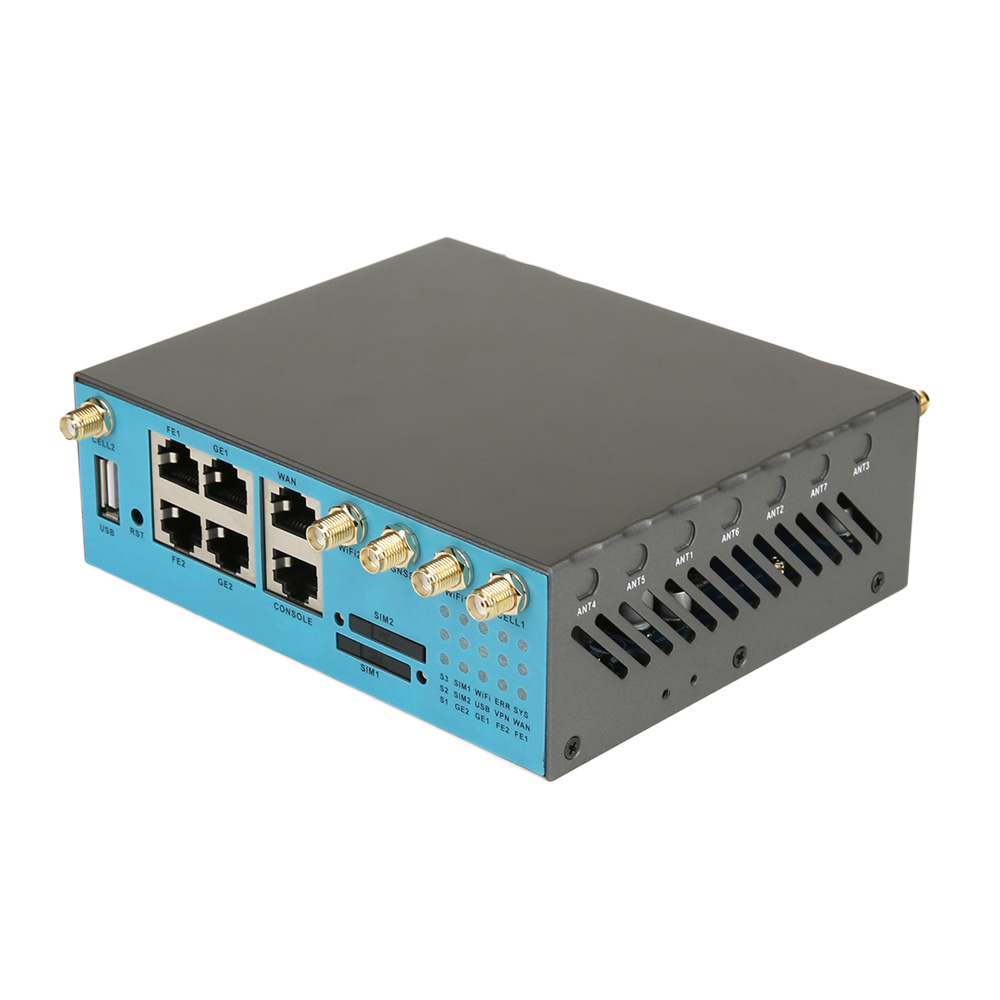
For that reason, a sensible 2026 portfolio still includes 4G models alongside 5G. In the E-Lins range, these include the H900 Gigabit Industrial 4G Router with five Gigabit Ethernet ports and triple-link backup, the H685f/H685 Mini Embedded Series at 100 × 60 × 21 mm for kiosks and robots, the H820QO IP68 outdoor router with built-in 14dBi antennas, and the M300/M400 industrial 4G modems for RS232/RS485 equipment. Large fleets often run mixed generations for years, and a single supplier and management platform across those generations reduces operational effort.
The E-Lins 5G Line-Up for 2026
Shenzhen E-Lins Technology Co., Ltd. structures its industrial routers by network technology: 4G, 5G RedCap, and full 5G. This lets buyers match the router class to the application instead of paying for capacity that will never be used. Optional modules such as GPS, RS485, and wide-voltage input can be added where a project needs them.
All three tiers share the same industrial foundation. Components are industrial-grade and rated from -35°C to +75°C, with 15KV ESD protection and 1.5KV electromagnetic isolation. The firmware is developed entirely in-house rather than built on a generic public Linux distribution, and it includes hardware watchdog timers and link self-healing. Customers receive lifetime free firmware upgrades, which matters for a router that will be in service for many years after its launch date.
The company's move into 5G follows a long progression. It started with 2G and 3G industrial modems in 1999, moved to 3G routers and DTUs, released full 4G LTE product lines from 2013, and introduced 5G NR industrial routers and edge computing gateways from 2019. Today, it supplies customers in more than 150 countries and regions from its own SMT factory and assembly lines in Shenzhen.
How to Read a 5G Industrial Router Datasheet in 2026
Which modem class is inside? Full 5G, RedCap, or another variant. The class determines bandwidth, antenna count, and network requirements.
Which bands are supported? Check them against the operators and countries where the router will be installed.
SA, NSA or both? RedCap requires standalone. Full 5G models should ideally support both.
How many antennas are needed? This affects enclosure design and installation cost.
What is the operating temperature range under load? Ask whether performance is reduced at high temperatures.
Which certifications apply? For example, CE for Europe, FCC for the United States, and UKCA for Great Britain, all of which E-Lins holds.
What is the firmware policy? Who develops it, how long it will be updated, and how updates are delivered.
The latest 5G industrial router model is not automatically the right one. The right one is the class that matches the data, the network available at the site, and the years the router will need to stay in service.
https://e-lins.com/
Shenzhen E-Lins Technology Co., Ltd.